Mains: GS II – Social Justice
Why in News?
Recently the central government reiterated in the Supreme Court that the creamy layer concept does not apply to SC/ST.
What is reservation in Indian Socio-Political setup?
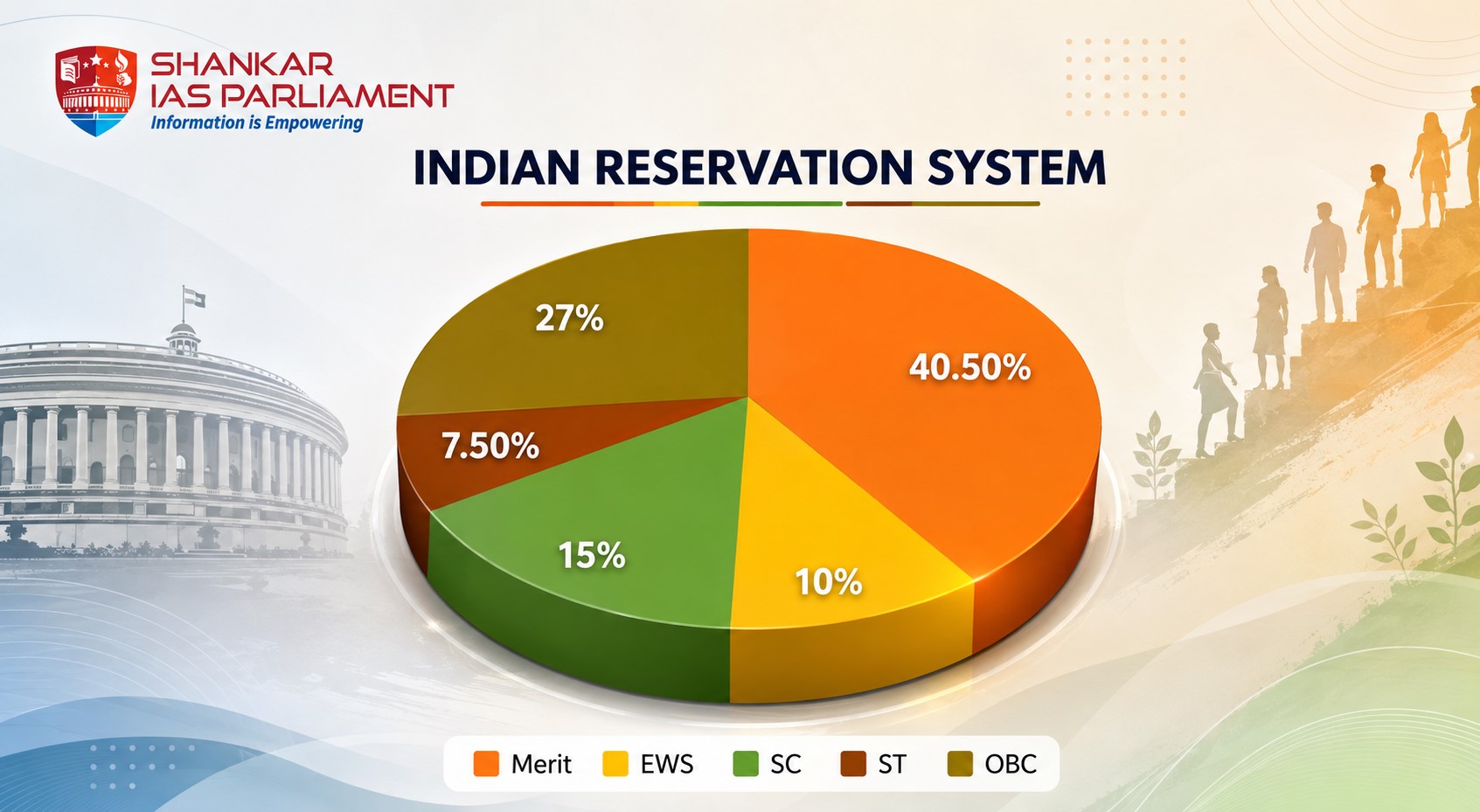
- Reservation in India – It sets aside a fixed percentage of seats in higher education, government jobs, and political bodies for historically disadvantaged and marginalized groups.
- It is a system of affirmative action and its main goal is to promote social justice and ensure fair representation.
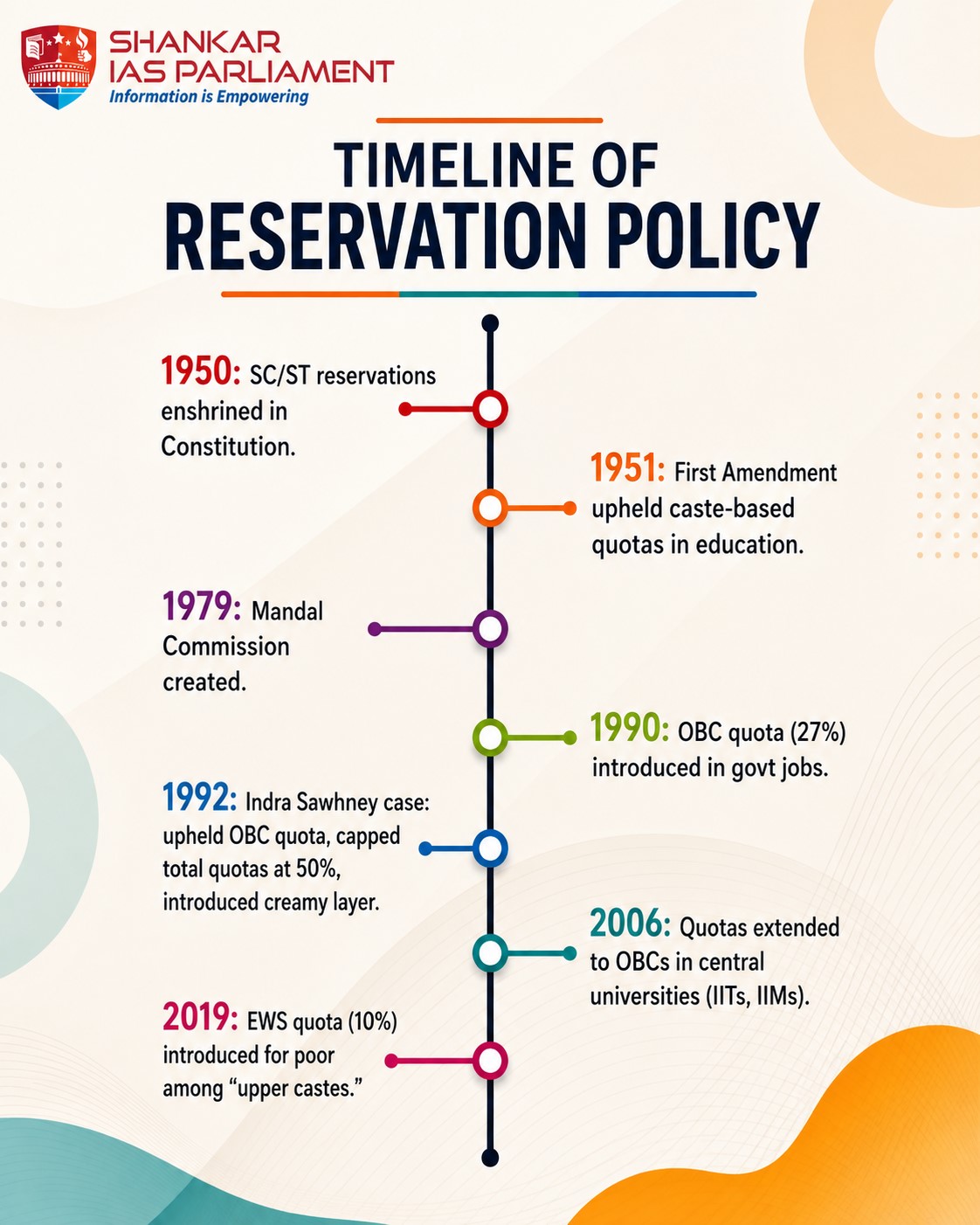
- Evolution
What is the significance of reservation in India?
- Correcting Historical Injustice – Addresses centuries of caste-based discrimination, untouchability, social exclusion, and denial of equal opportunities faced by historically disadvantaged communities.
- Level Playing Field – Provides access to education, employment, and economic opportunities to communities that have historically lacked social capital, resources, and generational wealth.
- Ensuring Fair Representation – Promotes adequate representation of SCs, STs and other disadvantaged groups in public employment, educational institutions, and legislatures, thereby strengthening inclusive governance.
- Combating Discrimination – Acts as an institutional safeguard against entrenched social prejudices and caste-based discrimination, helping translate the constitutional principle of equality into substantive equality.
- Promoting Social Justice – Advances the constitutional vision of social, economic and political justice by enabling disadvantaged groups to participate more fully in nation-building.
- Enhancing Social Mobility – Reservation can create opportunities for upward mobility by improving access to education, government employment, and decision-making institutions.
What is the creamy layer concept?
- Indra Sawhney judgment 1992 – The Supreme Court while upholding the implementation of OBC reservations introduced by the V.P. Singh government, gave rise to the concept of the creamy layer.
- The Court reasoned that reservation benefits should reach those who genuinely require them.
- Therefore, certain socially and economically advanced sections within the OBC category should be excluded from reservation.
- Following the judgment, the Government of India formulated detailed criteria for identifying the creamy layer.
- Excluded persons – The OBC creamy layer includes individuals whose parents earn an annual income above Rs.8 lakh or hold high-ranking positions in government, public sector undertakings (PSUs), armed forces, professions, or own substantial property.
- These persons are considered socially and economically advanced and do not qualify for OBC reservation benefits.
To know more about creamy layer click here
What is graded inequality and the need for sub-categorisation?
- Graded inequality – The idea refers to the unequal levels of backwardness and representation among communities included within the same reservation category.
- A single constitutional category may contain communities that have benefited relatively more from reservation while other, more disadvantaged communities remain inadequately represented.
- This problem predates the creation of the national OBC classification.
- For decades, State governments had recognised various groups as “Backward Classes” under Article 16(4) and had divided their reservation quotas among different communities.
- States such as Andhra Pradesh, Tamil Nadu and Maharashtra, among others, had reservation matrices that divided the overall quota for Backward Classes into smaller shares for particular communities.
- The objective was to ensure equitable representation among unequal groups and this became the basis of what is now called sub-categorisation.
- Sub-categorisation means dividing the existing reservation quota of a particular category among different communities within that category.
- It does not increase the overall quantum of reservation; rather, it seeks to distribute the available quota more equitably and prevent relatively advanced communities within a category from crowding out more backward ones.
- Davinder Singh Judgment – The present controversy gained momentum after the Supreme Court’s August 2024 Davinder Singh judgment.
- The judgment recognised that SCs and STs are not homogeneous groups and that there are different degrees of backwardness among communities included in these constitutional lists.
- It therefore permitted State governments sub-categorise SC and ST communities within the existing lists, with the objective of ensuring that the benefits of reservation reach communities that have been routinely crowded out by relatively less backward communities.
- Importantly, the Court distinguished sub-categorisation from inclusion or exclusion from the SC/ST lists.
- While the latter is constitutionally entrusted to Parliament, sub-categorisation within the existing lists was held to be within the competence of State governments.
Why the central government opposed the Creamy Layer for SC/STs?
- Historical injustice – The Union government has opposed extending the creamy layer principle to SCs and STs.
- Its central argument is that their historical disadvantage cannot be equated with economic backwardness.
- Different Levels of Inequality – According to the Central government:
- SCs face historical disadvantage arising from untouchability,
- STs are identified by factors including their distinct cultures, geographical isolation and backwardness.
- OBCs, by contrast, are identified primarily through a combination of social, educational and economic disadvantages.
- The government therefore maintains that SC/ST reservation seeks to achieve social equality and justice, overcome historical discrimination and ensure inclusive participation in public life.
- Discrimination against SCs and STs, it argues, does not disappear merely because an individual or family becomes economically better off.
- Constitutional and Legal Arguments – The Centre has relied upon several Supreme Court judgments:
- Indra Sawhney (1992) – Introduced the creamy layer principle for OBCs and expressly stated that it had no relevance to SCs and STs.
- Ashoka Kumar Thakur judgment 2008 – It clarified that the creamy layer principle does not apply to SCs and STs.
- 2005 E.V. Chinnaiah judgment – It observed that even if a situation requiring exclusion of a creamy layer from SCs were to arise, Parliament alone would have to undertake the necessary legislative measures.
- Articles 341 and 342 of the Constitution – The President notifies the SC and ST lists, while any inclusion or exclusion from those lists can be effected only through an Act of Parliament.
- Therefore, State governments, courts, tribunals or other authorities cannot modify or alter the constitutional lists.
- The government argued that reservation policy requires a holistic review, empirical evidence and socio-economic data concerning beneficiaries.
- It contended that courts cannot issue a writ of mandamus compelling the executive to adopt a particular policy merely because an alternative policy may appear fairer or wiser.
- The Centre has also challenged the maintainability of the petition under Article 32, arguing that it does not establish infringement of a fundamental right.
What lies ahead?
- The future of the creamy layer concept involves a fierce legal and political debate over extending income-based exclusions to Scheduled Castes (SC) and Scheduled Tribes (ST) quotas, alongside recent judicial refinements to how salary and status are calculated for Other Backward Classes (OBC).
- While OBC quotas retain the exclusion, the Union government strongly opposes applying it to SC/ST reservations, leaving any major structural changes in the hands of Parliament.
Reference
The Hindu| Centre’s stand on Creamy layer



