Mains: GSII – Polity| Social Justice
Why in News?
The Supreme Court upheld the Madras High Court’s decision striking down Tamil Nadu’s order allowing converts to Islam to claim Backward Class (Muslim) certificates based on their pre-conversion caste status.
What is the Background of the Case?
- A man born to Hindu parents converted to Islam in September 2015 and applied for a Backward Class (Muslim) certificate.
- In March 2024, Tamil Nadu allowed eligible persons from BC, MBC and Denotified Communities to obtain BC (Muslim) certificates after joining recognised Muslim sub-groups.
- The Madras High Court struck down this order. Tamil Nadu then appealed to the Supreme Court.
What Did the Supreme Court Rule?
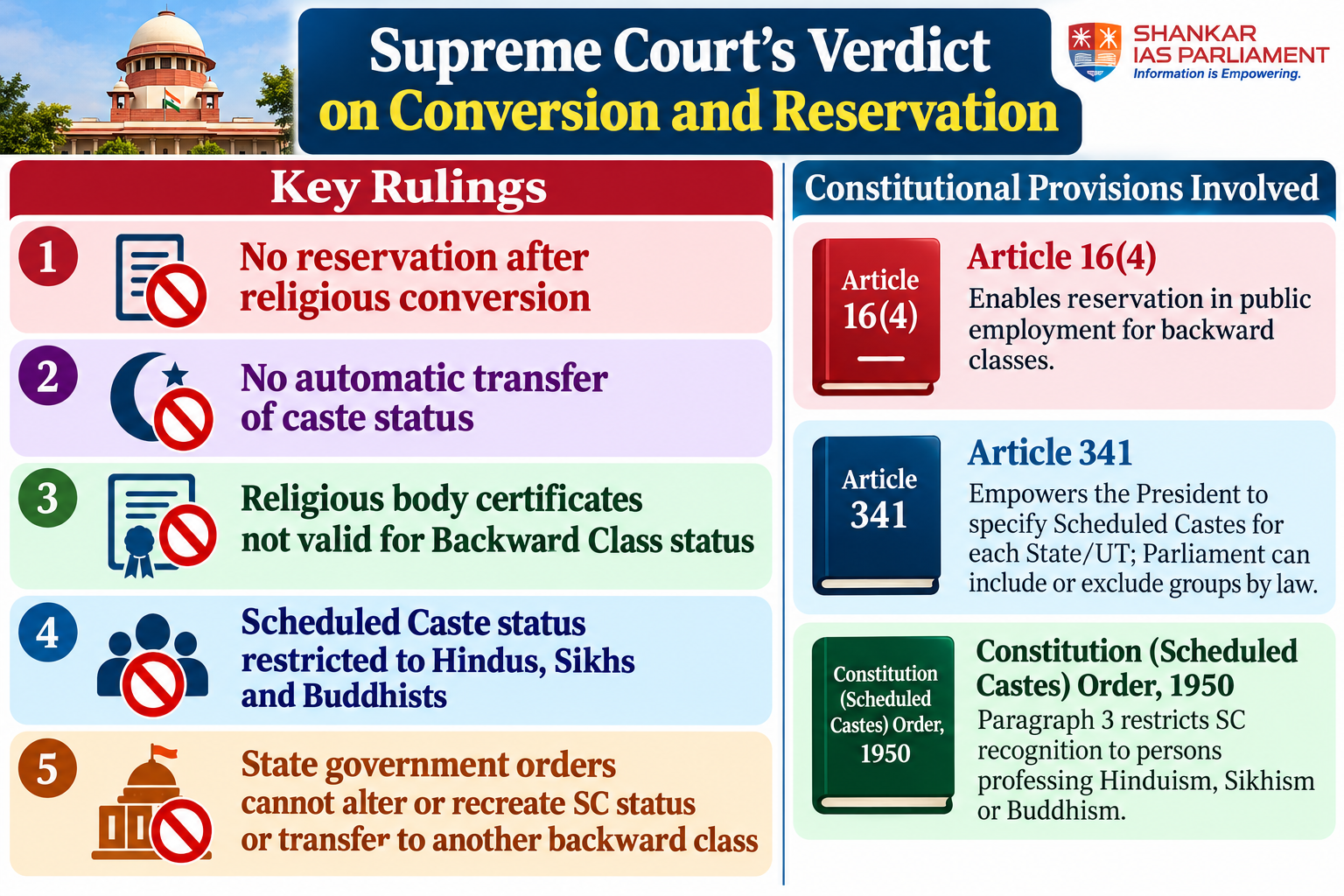
- Reservation after religious conversion – A person cannot claim reservation under Article 16(4) merely on the basis of social backwardness associated with their pre-conversion status.
- No automatic transfer of caste status – Conversion from Hinduism to Islam does not automatically confer membership in a recognised Backward Class Muslim community.
- Community certificates – A private religious body, such as a Jamath, cannot conclusively determine statutory Backward Class status through a conversion certificate.
- Scheduled Caste status – Under Article 341, Scheduled Caste status is governed by the Constitution (Scheduled Castes) Order, 1950.
- Paragraph 3 restricts recognition to persons professing Hinduism, Sikhism or Buddhism.
- Limits on government orders – A State government order cannot independently alter or recreate Scheduled Caste status or automatically transfer an individual into another recognised backward community.
|
Constitutional Provisions Involved
|
- Article 16(4) – Enables reservation in public employment for backward classes inadequately represented in State services.
- Article 341 – Empowers the President to specify Scheduled Castes for each State or Union Territory; Parliament can subsequently include or exclude groups by law.
- Constitution (Scheduled Castes) Order, 1950 – Specifies the religious eligibility condition for Scheduled Caste recognition under Paragraph 3.
|
What were the Key Legal Precedents?
- G. Michael v. S. Venkateswaran (1951) – Concerned the eligibility of a person who converted from Hinduism to Christianity to claim Scheduled Caste-related benefits.
- Indra Sawhney v. Union of India (1992) – Recognised that social backwardness can exist among occupational groups, sects and denominations outside Hinduism, subject to the applicable constitutional and legal framework.
What are the Implications of the Verdict?
- Reservation policy – Reinforces the need to establish eligibility under the applicable legal framework rather than relying solely on pre-conversion caste identity.
- Administrative accountability – Prevents community certificates and executive orders from independently creating statutory social status.
- Social justice – Raises questions about how historical disadvantage persists or changes after religious conversion.
- Centre–State relations – Highlights the limits of State executive action in matters governed by constitutional provisions and statutory classification.
What is the Future Scope?
- Evidence-based identification – Assess social and educational backwardness using appropriate empirical data and established legal criteria.
- Clear guidelines – Develop transparent procedures for determining eligibility for backward-class certificates after religious conversion.
- Constitutional compliance – Ensure reservation policies remain consistent with Articles 16(4) and 341 and the applicable legal framework.
- Inclusive welfare – Address persistent educational, economic and occupational disadvantages through legally permissible welfare measures.
Reference
The Hindu| Conversion and Reservation



