Prelims - Current events of national and international importance | Economic and Social Development.
Why in News?
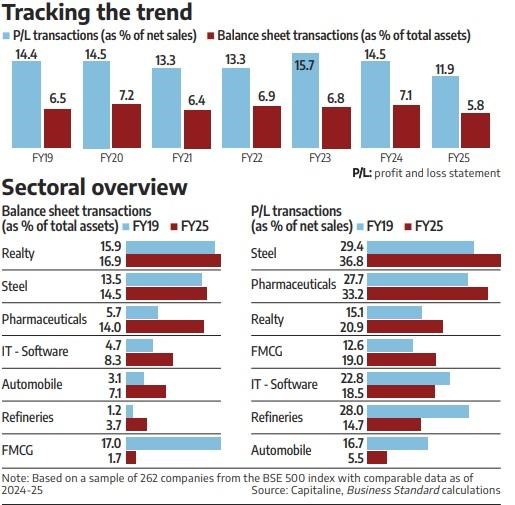
Recently, the data show that the value of related-party transactions has been lower than the levels seen before the pandemic.
- RPT – It is a deal or arrangement made between two entities that are connected by a pre-existing business relationship or common interest. It is legal.
- Usage – This can involve the buying or selling of goods or raw materials among group companies.
- It can be used to benefit promoters at the cost of minority shareholders.
- Reported in – Transactions are reported on the balance sheet and the profit-and-loss statement.
The balance sheet displays the company's total assets and how the assets are financed, either through either debt or equity (Assets = Liabilities + Equity).
- Regulated by – Securities and Exchange Board of India (SEBI).
- Regulated under - The Companies Act, 2013.
- Regulation – SEBI requires shareholder approval for related-party transactions that exceed a defined threshold to ensure they do not harm shareholder value or corporate profitability.
- Recent regulation changes – The consultation paper is easing the minimum threshold requirements at which such transactions would require shareholder approval.
- It reduces regulatory burden for large-turnover companies that otherwise require frequent approvals.
- Current values in India – Proportion of balance sheet assets was 5.8% in 2024-25 (FY25), compared to 6.5% in (FY19).
- Profit and loss statement was equivalent to 11.9% of net sales in FY25 compared to 14.4% in FY19
- Sector-wise usage – Sectors such as steel, real estate and pharmaceuticals have a higher share of transactions.
- The value of RPTs on the balance sheet of real estate is equivalent to nearly 17% of their assets.
- RPT values in the profit-and-loss statement constitute 20% or more of net sales in multiple sectors.
Reference
Business Standard| RPT Pre-Pandemic Data



