Mains: GS II – International issues
Why in News?
Recently, world refugee day was observed worldwide to honour the courage and resilience of refugees.
Who are refugees?
- Refugee – According to United Nations, a refugee is someone who has been forced to flee his or her country because of persecution, war or violence.
- A refugee has a well-founded fear of persecution for reasons of race, religion, nationality, political opinion or membership in a particular social group.
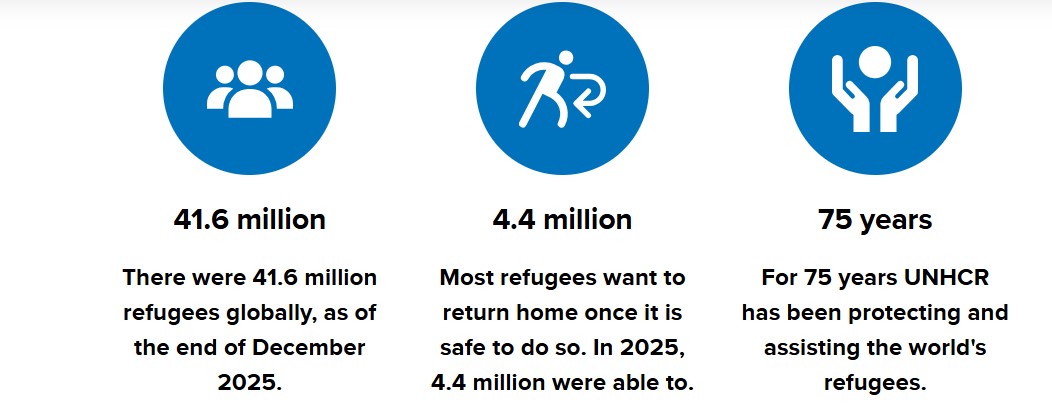
- Global refugee data
- Status of Citizenship – Citizenship is permanent membership of a country.
- It gives full rights like voting, holding a passport, and political participation.
- Citizenship is the highest legal status and refugees can later become citizens through naturalization.
Asylum is a form of legal protection granted by a sovereign state to individuals fleeing their home countries to escape persecution or serious harm.
What are the global framework on Refugees?
- The 1951 Refugee Convention – The 1951 Convention provides the internationally recognized definition of a refugee and outlines the legal protection, rights and assistance a refugee is entitled to receive.
- The 1967 Protocol – The original 1951 Convention was geographically (events occurring in Europe) and temporally (events before January 1, 1951) restricted.
- The 1967 Protocol removed these limitations, making the legal framework universal.
- The Global Compact on Refugees (2018) – A non-binding UN framework designed to ensure a more predictable and equitable burden-sharing among member states.
- It provides a blueprint (the Comprehensive Refugee Response Framework) to ease pressure on host countries, enhance refugee self-reliance, expand third-country solutions, and support safe conditions for return.
World Refugee Day an UN‑designated day observed on June 20, honouring the courage and resilience of refugees, who were forced to flee conflict, war, or persecution.
The theme for World Refugee Day 2026 is "Until Everyone Is Safe"
What is the role of United Nations for High Commissioners of refugees?
- Protection and Legal Assistance – The UNHCR safeguards the rights of refugees under international law.
- It helps prevent the forced return of refugees to unsafe conditions, supports access to asylum procedures, and assists in obtaining legal identity and travel documents.
- Emergency Relief and Humanitarian Support – During refugee crises, UNHCR provides essential services such as shelter, food, clean water, healthcare, and sanitation.
- It also coordinates large-scale emergency responses when populations are displaced by conflict or disasters.
- Refugee Camps and Community Services – UNHCR helps establish and support refugee camps and settlements when necessary.
- In collaboration with governments and humanitarian partners, it facilitates access to education, healthcare, and other community-based services.
- Durable Solutions for Refugees – To help refugees rebuild their lives, UNHCR promotes three long-term solutions:
- Voluntary repatriation – supporting safe return to the country of origin when conditions permit.
- Local integration – assisting refugees in settling permanently in the host country.
- Resettlement – relocating vulnerable refugees to a third country that can offer protection.
- Advocacy and International Coordination – UNHCR advocates for refugee rights and encourages states to uphold international protection standards.
- It also coordinates with governments, NGOs, and other UN agencies to deliver effective humanitarian assistance.
- For example, In major displacement crises, such as those resulting from the Syrian Civil War and the conflict in Ukraine, UNHCR has provided shelter, financial assistance, legal aid, and protection services to millions of affected people.
What is the legal framework for refugees in India?
- No Refugee Law in India – India has no formal or comprehensive refugee law and not a signatory to the 1951 Refugee Convention or its 1967 Protocol.
- Legal framework – India treats refugees as ordinary foreign nationals or illegal immigrants under the below given laws –
- The Foreigners Act (1946)
- Registration of Foreigners Act (1939)
- Passport Act (1920)
- Constitutional Safeguards
- Article 21 – Right to life and liberty for all persons.
- Article 14 – Equality before law for citizens and non-citizens.
- Non refoulement – Courts uphold the principle of not sending refugees back to danger, except in national security cases.
- Citizenship Amendment Act (CAA) – It, grants fast‑track Indian citizenship to persecuted religious minorities (Hindus, Sikhs, Buddhists, Jains, Parsis, Christians) from Afghanistan, Bangladesh, and Pakistan who arrived before 31 December 2014.
- Courts have sometimes intervened to balance national security with humanitarian duty (e.g., Rohingya cases).
India hosts over 252,000 refugees and asylum seekers majorly from Tibet, Myanmar Sri Lanka and Afghanisthan, making it one of the largest host countries in South Asia.
What are the positive impacts of Refugees in India?
- Economic Growth and Entrepreneurship – Refugees often demonstrate strong entrepreneurial spirit, establishing businesses that create jobs and stimulate local economic activity.
- Labour Shortage Relief – They help address workforce gaps by working in sectors with labor shortages, including healthcare, agriculture, hospitality, and manufacturing.
- Fiscal Contributions – Over time, refugees frequently become net contributors to public finances through taxes, supporting essential services and helping offset the effects of aging populations.
- Infrastructure and Community Development – Their presence can encourage investments in infrastructure and public services, such as schools, healthcare facilities, and transportation networks, often supported by development programs.
- Cultural Diversity – Refugees bring diverse skills, experiences, and perspectives that foster innovation and enrich the cultural and social fabric of host communities.
|
Influence of refugees in Indian cuisine
|
- Refugees enrich culture, especially in food for example, Bengali cuisine was reshaped by refugee survival cooking, refugee families developed zero‑waste cooking like using vegetable peels, stems, rice starch (fyan), and chhana water were reused.
- Burmese refugees brought noodle soups like mohinga, and Punjabi refugees popularized the tandoor culture.
|
What are the challenges of refugee crisis?
- Asylum Processing and Statelessness – Refugees often face complex and lengthy asylum procedures that delay access to legal status and identification documents.
- Restrictive migration policies can limit their ability to move freely, while stateless individuals struggle to obtain official documentation needed for essential services.
- Economic and Structural Hardships – Many refugees experience unemployment, underemployment, and poverty due to difficulties in having their qualifications recognized and gaining local work experience.
- Access to safe, stable housing is often limited, and children and young people frequently encounter disruptions to their education.
- Health and Well-Being – Displaced populations commonly face mental health challenges, including trauma and depression, often with insufficient psychosocial support.
- They may also have limited access to healthcare, medications, and adequate sanitation, increasing the risk of illness.
- Social and Protection Risks – Refugees frequently encounter discrimination, xenophobia, and social exclusion in host communities.
- Vulnerable groups, such as women, children, and people with disabilities, face increased risks of violence and exploitation.
- Additionally, displacement often results in the loss of family connections and important support networks.
|
Refugee challenges in India
|
- Illegal Migration and Security – Porous borders with Myanmar and Bangladesh enable trafficking, smuggling, and infiltration.
- Rohingya refugees raise concerns of radicalization and internal threats.
- Demographic Strain – Large refugee influxes in states like Mizoram and Manipur burden civic resources, law and order, and intensify ethnic tensions with host populations.
|
What are the ethical dimensions ?
- Human Rights vs Sovereignty – Nations have a duty to protect refugees, but also the right to control borders and resources, creating constant tension.
- Non‑Refoulement – Refugees must not be sent back to danger; violating this weakens democratic values.
- Global Burden‑Sharing – Refugees are a global responsibility, yet poorer nations host most, raising fairness issues for richer countries.
- Refugee vs Migrants – Law separates political refugees from economic migrants, but ethics note extreme poverty also threatens basic human rights.
What is the way forward?
- National Refugee Law – India should frame a clear law to protect refugees, instead of relying on ad‑hoc measures.
- Food Security – Refugees can be included in community kitchens and zero‑waste food programmes.
- Livelihoods – Skill training, micro‑finance, and job opportunities can reduce dependency.
- Climate Resilience – Refugee settlements should be planned in safe zones with disaster preparedness.
- Regional Cooperation – South Asian countries should work together on refugee issues.
- Awareness – Public campaigns can highlight refugee contributions to reduce stigma.
To take mains test click here
Reference
The Hindu | Refugee
CGTN| Refugee Crisis



