Prelims: Current events of national and international importance | Conservation
Why in News?
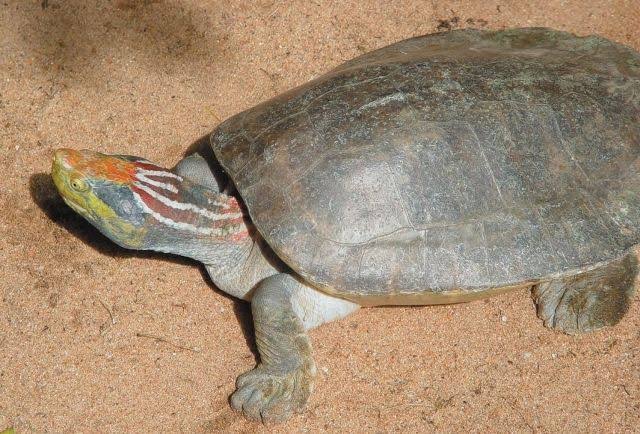
The red-crowned roofed turtle is clinging to survival in a shrinking sanctuary.
It is one of the 3 large freshwater species in the genus Batagur found in India.
Scientific Name – Batagur kachuga.
It is endemic to North India.
It is one of the most endangered freshwater turtle species in the world.
Habitat –Large, flowing river channels with high sandbanks and rocky outcrops; prefers deep pools, riffles, and elevated sandy nesting banks.
Distribution
Global level – Historically distributed across the Ganga River basin; marginal habitat in Bangladesh and Nepal with no confirmed wild populations outside India.
In India - The National Chambal Sanctuary (Chambal River) at the tri-junction of Rajasthan, Madhya Pradesh, and Uttar Pradesh remains the only area with a substantial wild population.
Sexual Dimorphism - Males are significantly smaller than females, reaching only about half their length.
Striking Appearance - During the breeding season, adult males develop vivid red, yellow, white, and blue markings on their faces and necks to attract mates and Intraspecific Communication.
They feature a reddish-orange head with a distinctive black crown.
Physical Features -
Carapace (Upper Shell) - Greenish-brown with yellow markings; it is strongly "keeled" (ridged), particularly in younger individuals.
Plastron (Lower Shell) - Yellow with black patterns.
Nesting – Season - March.
Unlike marine arribada events, the species nesting is solitary or in small aggregations tied to suitable sandbanks.
Diet – Predominantly herbivorous, feeding on aquatic vegetation. It contributes to regulation of aquatic plants and nutrient cycling.
Bio Indicator Species – Population trends of this turtle serve as indicators of river health and freshwater ecosystem integrity.
Conservation Status
IUCN - Critically Endangered.
CITES - Appendix I.
Wild Life (Protection) Act, 1972 - Schedule I.
Major Threats - Intensive hunting of adults and collection of eggs; illegal trade.
Habitat degradation from sand mining, river channel modification, and erratic water releases by dams.
Fatal entanglement in fishing nets and unsustainable fishing practices.
Loss and disturbance of nesting banks due to agriculture and development.
Low population size and fragmented distribution increasing extinction risk.