Why in News?
Recently , Union Home and Cooperation Minister has announced a target of establishing two lakh Primary Agricultural Credit Societies (PACS) within five years.
What are PACS?
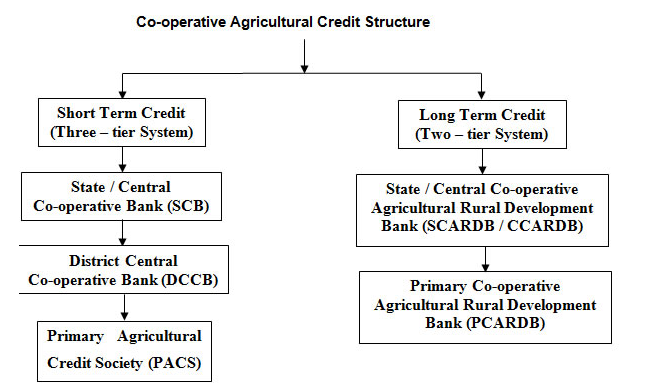
- PACS - Primary Agricultural Credit Societies are the grass root level arms of the short-term co-operative credit structure.
The formation of PACS dates back to 1904 when the first Co-operative Credit Societies Act was passed.
- Objective – PCAS was designed to democratise credit, empower rural populations, and combat exploitative practices by intermediaries.
- Evolution - Cooperatives became instrumental in enabling agricultural credit, dairy development, and marketing.
- Function - PACS deals directly with the rural (agricultural) borrowers
- Give loans and collect repayments of loans
- Undertake distribution and marketing functions
- Financial bridge - It serves as the final link between the ultimate borrowers on the one hand and the higher financing agencies, namely the Scheduled Commercial Banks, and the RBI/NABARD on the other hand.
- Organisational Structure of PACS
- General Body of PACS - Exercise the control over board as well as management.
- Management Committee - Elected by the general body to perform the work as prescribed by the society’s rules, acts, and by-laws.
- Chairman, Vice-Chairman, and Secretary - Work for the benefit of the members by performing their roles and duties as assigned to them
What hindered the potential of PACS movement?
- Political interference - Many cooperatives became heavily politicised, often controlled by local elites with vested interests.
- Inefficient management - The governance structure of cooperatives has frequently lacked professionalism, leading to poor financial management and unsustainable operations.
- Dependence on State funds - Cooperatives have traditionally relied on government subsidies, making them financially fragile and incapable of competing with private enterprises.
- Limited inclusivity - Women, Dalits, and other marginalised groups have often been excluded from decision-making roles, undermining the equitable objectives of cooperatives.
- Fragmented approach - Most cooperatives have focused on a narrow set of activities without integrating themselves into broader supply chains, thereby failing to achieve economies of scale or market competitiveness.
What are the recent government initiatives for cooperatives promotion?
- New model bylaws - The adoption of bylaws allowing cooperatives to operate in territories beyond their traditional core areas aligns with the need for modernisation and diversification.
- Phased rollout - Dividing the establishment of PACS into two phases, with significant involvement from the NABARD, NDDB NFDB ensures that resources and expertise are focused on sectors that require immediate attention.
- Liquidation of defunct PACS - Introducing standard operating procedures for liquidating non-functional PACS is a step towards streamlining the cooperative ecosystem.
- Inclusivity focus - The explicit emphasis on the participation of women, Dalits, and tribal to foster social harmony and economic equity.
- Integration into global supply chains - Using PACS as conduits for robust forward and backward linkages in global markets facilitates market competitiveness and scalability.
What are the challenges in empowering cooperative movement?
- Avoiding political interference -There must be strong checks and balances and clear guidelines on governance and accountability in place to prevent political capture of the new PACS.
- Capacity building and professional management - Providing training to PACS members on modern management practices.
- Sustainable financial model – Curtailing over-reliance on subsidies to guide toward self-sufficiency through income-generating activities and effective revenue models.
- Ensuring inclusivity - Quotas for women, Dalits, and other vulnerable sections in leadership roles to empower marginalized groups.
- Technological integration - The new PACS must leverage digital tools for accounting, credit disbursal, and market access.
- Issuing micro-ATMs and RuPay Kisan Credit Cards is a positive start, but comprehensive digital infrastructure is needed.
- Effective liquidation process - Ensuring fairness and efficiency in liquidating defunct cooperatives.
- Mismanagement during this process could lead to legal disputes or financial losses.
- Monitoring and evaluation - The government must establish independent monitoring agencies to periodically assess the progress and impact of the new PACS.
What needs to be done to strengthen the movement?
- Data-driven approach - Identifying areas where PACS are most needed through comprehensive surveys to optimise resource allocation and to avoid duplication of efforts.
- Grassroots participation - Involving local communities in decision-making and planning will foster a sense of ownership and accountability among beneficiaries.
- Collaboration with the private sector - Public-private partnerships can provide access to modern technology and global markets, enhancing the competitiveness of cooperatives.
- Policy consistency - Long-term success depends on consistency in policy implementation across different States.
- Value addition - PACS must venture into value-added services such as food processing, cold storage, and export facilitation to boost farmer incomes.
Reference
The Hindu | India’s Cooperative Dream



