Prelims: Current events of national and international importance | Science and Technology
Why in News?
Researchers from the Jawaharlal Nehru Centre for Advanced Scientific Research (JNCASR), Bengaluru, have demonstrated for the 1st time that the optical properties of metals can be actively modified using mechanical strain.
- Plasmon Resonance - Metals have a unique ability to trap and condense light waves into volumes significantly smaller than the wavelength of the light itself.
- The Driver- It is dictated by the material's plasma frequency, which has traditionally been considered unchangeable because it depends entirely on the metal's native free-electron concentration.
- Applications - This property underpins sub-wavelength photonic circuits, ultrasensitive biosensors for cancer diagnostics, and optical metasurfaces.
- Recent Experiment - To isolate the exact impact of mechanical deformation on light interaction, the team grew 2 identical 10-nanometer-thick films of Titanium Nitride (TiN).
- It mimics the optical behavior of gold but stands out because it is fully compatible with Complementary Metal-Oxide-Semiconductor (CMOS) chip fabrication.
- Film A (Control) - Grown completely strain-free on a Magnesium Oxide (MgO) substrate.
- Film B (Strained) - Subjected to controlled, in-plane tensile stretch by growing it on top of an Aluminium Scandium Nitride (Al0.3Sc0.7N
 ) buffer layer, which features a wider crystal lattice space.
- Using Electron Energy Loss Spectroscopy (EELS) inside a highly specialized scanning transmission electron microscope, the researchers mapped the plasmon energy levels at near-atomic resolution across the films.
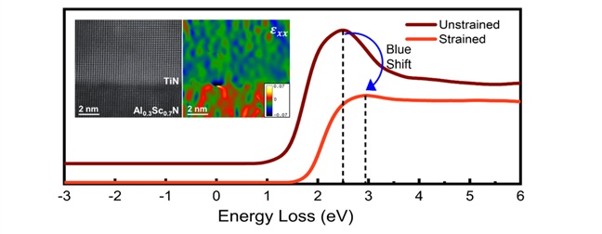
- The Discovery Mechanism - The mechanically stretched (strained) TiN film exhibited a pronounced blue shift of 0.30 to 0.45 electron volts (eV) in its plasmon resonance relative to the unstrained baseline.
- First-principles Density Functional Theory (DFT) calculations revealed exactly why this happens:
- Tensile Strain Application - Pulling the crystal lattice mechanically lowers the energy barrier required to form nitrogen vacancies within the TiN structure.
- Vacancies as Donors - These newly formed nitrogen vacancies act as intrinsic electron donors.
- Frequency Shift - The sudden surge in free-electron concentration elevates the metal's core plasma frequency, causing the observed blue shift toward higher energy levels.
Reference
PIB | Optical properties of metals



