Why in news?
The RBI has issued a fresh set of rules for non-banking finance companies (NBFCs) which limits lending to IPO investors to Rs 1 crore per borrower from April 1, 2022.
What is an Initial Public Offering (IPO)?
- An initial public offering (IPO) refers to the process of offering shares of a private corporation to the public in a new stock issuance.
- Companies must meet requirements by exchanges and the Securities and Exchange Commission (SEC) to hold an IPO.
- IPOs provide companies with an opportunity to obtain capital by offering shares through the primary market.
How does IPO funding work?
- IPO Funding is a loan offered for applying in primary stock market by NBFC's to high net worth individuals (HNI).
- The investor pays only small margin for applying in IPO and rest amount is funded by the lender.
- Interest is charged between 8 to 12% and it varies by the lender.
- Through IPO Funding, an investor can leverage its own funds in primary market and thereby maximize the profits in a very short span of time.
- IPO Funding loans are short term loans, where in most cases they are for 7 days, from the IPO closing day to date of listing of IPO shares.
- Repayment of these short term loans is up to 3 months.
What are the advantages of IPO funding?
- Investor can apply for more shares, thus increasing the chances of a large allotment.
- Offers good opportunity to make huge profits in a short span.
- Only small amount of margin is needed which increases the profits multifold.
- Funding cost came down significantly in recent time because of quick IPO listings and reduced interest rates.
- Simple Documentation and streamlined speedy processing of loans.
What are the concerns of IPO funding?
- It is a high risk high reward investment that could result in to massive losses.
- Since investor pays only small amount of margin money, the losses could be multi fold.
- It is not for investors applying in retail category.
- Borrowing limit varies as per the scheme launched for the IPO, and on the level of subscription under the HNI category.
- Interest rate varies as per the scheme launched for the IPO, and is charged upfront.
What is the new RBI framework?
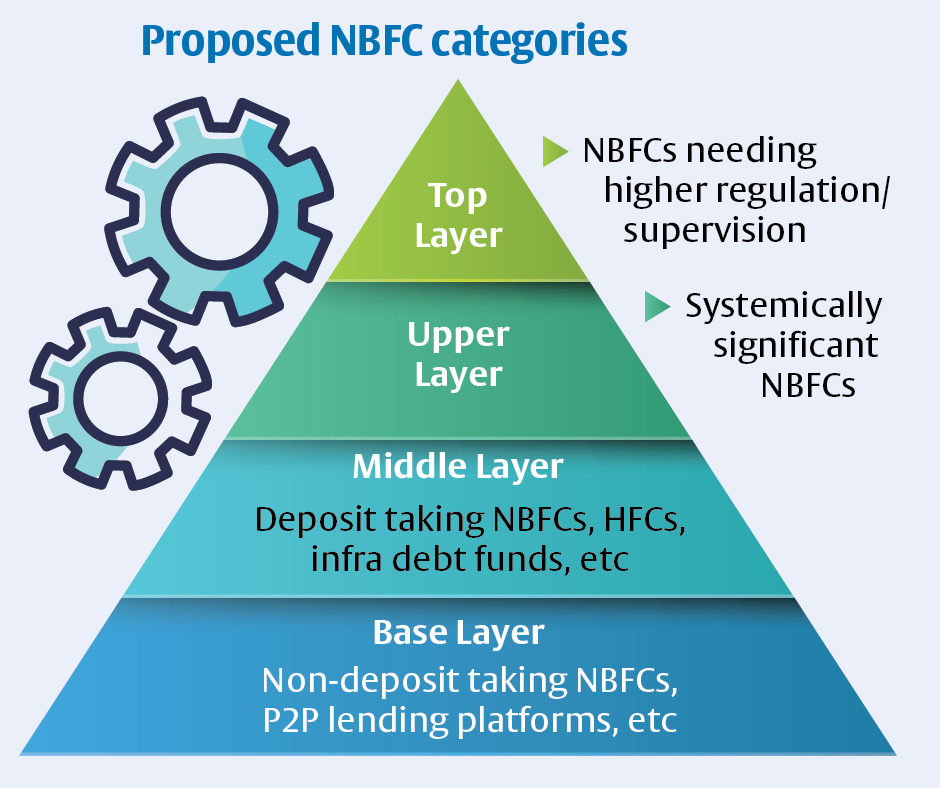
- Layer-based structure - Under the new framework, the regulatory structure for NBFCs shall comprise four layers — base, middle, upper and top layer.
- The first category primarily entails non-deposit taking NBFCs with less than Rs 1,000 crore in assets.
- The second category includeall deposit taking NBFCs irrespective of asset size.
- The Upper Layer will comprise the top ten eligible NBFCs in terms of their asset sizes.
- Depending on sudden risk factors, the RBI can move Upper Layer companies to the Top or fourth category, citing systemic risks.
- Sensitive exposure – Exposure to the capital market and commercial real estate shall be the sensitive exposure for NBFCs.
- The RBI has proposed sensitive sector exposure norms for NBFCs in the middle and upper layers.
- Minimum net owned fund - The regulatory minimum net owned fund for NBFC-Investment and Credit Companies, NBFC-MFI and NBFC-Factors shall be increased to Rs 10 crore by March 2027.
- Management of NBFC affairs - At least one of the directors should have relevant experience of having worked in a bank or an NBFC.
Why has the RBI come out with this rule?
- Non-banks are able to borrow funds at 4-5 % and interest rates on such loans have dropped to 7-8 %.
- Leveraged IPO bids unfairly tilt the allotment process in favour of short-term bettors removing the genuine long-term investors and distorting price discovery.
- The new rule aims to moderate the over-subscription numbers and listing gains.
- The RBI aims to put the NBFCs on line with banks that already has Rs.10 lakh limit.
What implication will the RBI rule have for upcoming IPOs?
- The new rules might reduce the quantum of funds available with high networth investors (HNI) for bidding in IPOs.
- The number of oversubscriptions in the HNI category will come down which will benefit the price discovery process.
- The NBFC sector has undergone considerable evolution in terms of size, complexity, and inter-connectedness and hence there is a need to align the regulatory framework for NBFCs.
References
- https://www.thehindubusinessline.com/money-and-banking/rbi-caps-ipo-funding-by-nbfcs-at-1-cr-per-borrower/article37130608.ece
- https://www.thehindubusinessline.com/opinion/editorial/rbi-is-right-to-curb-nbfcs-offering-ipo-funding-it-distorts-price-discovery-and-skews-ipo-allotment/article37165068.ece
- https://economictimes.indiatimes.com/news/economy/policy/rbi-caps-nbfc-ipo-funding-at-rs-one-crore-per-borrower-from-fy23/articleshow/87216686.cms
- https://www.cnbctv18.com/market/stocks/explained-rbi-rule-limiting-ipo-funding-by-nbfcs-to-rs-1-crore-per-borrower-and-the-implications-11219302.htm



