Why in News?
Recently, the chairperson of the National Quantum Computing Mission said India plans to launch a quantum satellite in “2-3 years for quantum communications”.
What is Quantum satellite?
To know about National Quantum Mission, click here.
- Quantum communication – It relies on individual photons and quantum principles to carry quantum information.
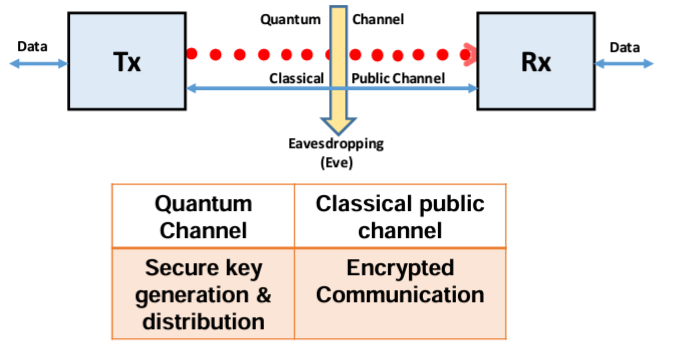
- Quantum satellite - These are communication satellites that uses quantum physics to secure its signals.
- Quantum cryptography - It uses quantum key distribution(QKD) to secure messages.
- Quantum Key Distribution (QKD) – QKD involves sending encrypted data as classical bits over networks, while the keys to decrypt the information are encoded and transmitted in a quantum state using qubits.
- QKD enables two parties to produce a shared random secret key (encryption key) known only to them.
- Quantum measurement — It is the act of measuring the properties of a quantum system, like a photon (the subatomic particle of light).
- According to the rules of quantum physics, a quantum measurement changes the state of the system.
- Methods of quantum encryption
- Encoding the key in a stream of photons (in two states, one representing 0 and the other 1) and any act of measuring them changes the state of the photons.
- Quantum entanglement - when two photons are entangled, any change to one particle will instantaneously change the other.
- Applications of quantum communication
- Satellite based Quantum Key Distribution (QKD) over larger distances
- Protecting sensitive client information in Banking/ Finance Industry
- Protecting customer credit card information
- Government and defence industry
- Protecting high value/sensitive data in remote data centres
- NavIC based RS-Key distribution
What are worldwide developments related to quantum communication?
- China & Japan have successfully demonstrated Quantum Communication experiments from satellite to ground.
- China - It currently operates the world’s largest QKD network with three quantum satellites and four ground stations.
- Europe - European Space Agency (ESA) is developing a technology demonstration satellite known as Eagle-1.
- Germany - Qube satellite was launched in August 2023 to test QKD capabilities.
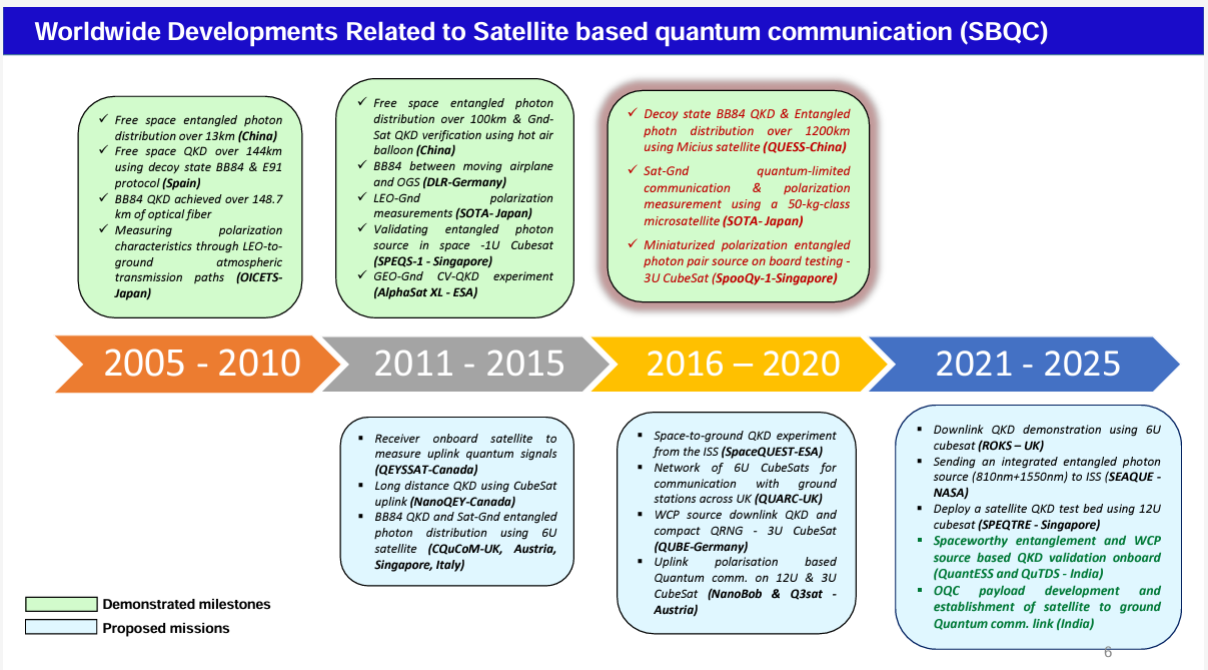
- India’s progress:
- Single photon based inter-building free space quantum communication link was established over a distance of ~300m of atmospheric channel.
- 2-way quantum secured client-to-client live video conferencing demonstration has been demonstrated.
- NavIC enabled synchronization mechanism has been implemented.
- BB84 protocol-based quantum key distribution(QKD) protocol was created.
What are the limitations of QKD?
- Lack of source verification - QKD does not provide a means to authenticate the QKD transmission source.
- Upgradation difficulty - Since QKD is hardware-based, QKD networks can’t be upgraded or patched easily.
- High cost - QKD increases infrastructure costs that eliminate many use cases from consideration.
- Limited security - The actual security provided by a QKD system is not the theoretical unconditional security from the laws of physic but rather the more limited security that can be achieved by hardware and engineering designs.
- Denial-of-service attack - Since eavesdroppers can cause a transmission to stop, they can deny the use of a transmission by its intended users (a.k.a. a).
- Restrictions on quantum physics - non-quantum information can be amplified before being transmitted across large distances whereas the no-cloning theorem prohibits the amplification of quantum information.
- Capacity limitation - Even the best optical fibers/ terrestrial free space can carry these photons only up to few hundreds of kilometres before light absorption makes the process impossible.
Post-quantum cryptography refers to cryptographic techniques that resist attacks from both quantum and classical devices using more advanced classical encryption.
Reference
The Hindu | Quantum Satellite



