0.1106
7667766266
x

Pumped Storage Hydropower

iasparliament Logo
October 20, 2026

PIB Analysis

Powering India’s Clean Energy Transition

Building India’s Energy Future with Storage

  • India’s installed non-fossil fuel capacity crossed 300 GW by July 2026, with 55.29 GW added in FY 2025–26.
  • India aims to achieve 500 GW of non-fossil fuel capacity by 2030.
  • Solar and wind variability increases the need for energy storage to meet peak demand and maintain grid stability.
  • The CEA projects 73.93 GW of storage capacity by 2031–32, comprising:
    • Pumped Storage Projects (PSPs): 26.69 GW.
    • Battery Energy Storage Systems (BESS): 47.24 GW.
  • PSPs store surplus electricity and supply power during peak demand, enabling large-scale renewable energy integration.

Types of Energy Storage

Feature

BESS

PSPs

Main role

Short-duration storage and rapid grid response

Long-duration, large-scale storage

Applications

Frequency regulation, peak management and grid balancing

Renewable energy integration, peak demand and grid stability

Deployment

Relatively quick and flexible

Requires suitable geography and infrastructure

Operating life

Generally shorter

Long operational life

Both technologies complement each other in ensuring reliable electricity supply.

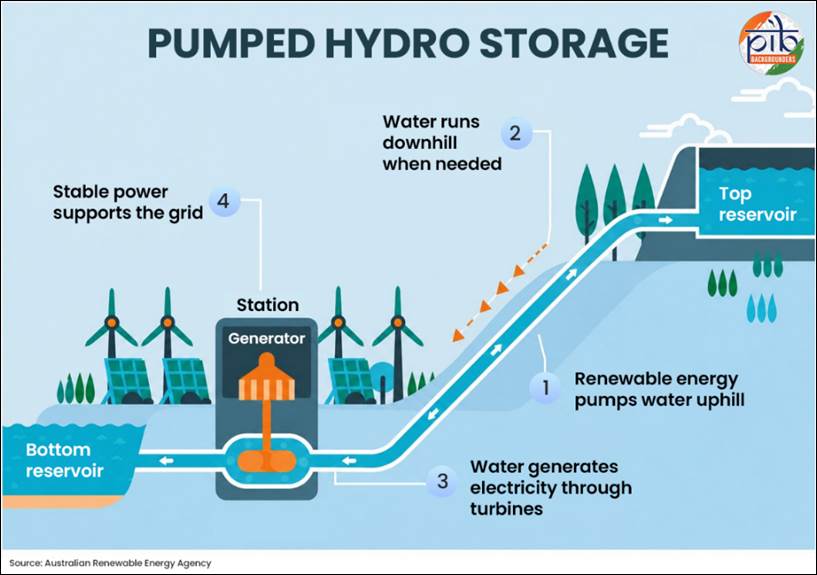
Understanding PSPs: Cycle of Energy Storage and Supply
https://static.pib.gov.in/WriteReadData/userfiles/image/2026/oct/image003_20261019110719_40663a.jpg

  • Charging: Surplus electricity pumps water from a lower reservoir to an upper reservoir.
  • Storage: Water retains energy as gravitational potential energy.
  • Discharging: Water flows through turbines to generate electricity when demand rises.
  • Recharging: Water is pumped back to the upper reservoir when surplus electricity is available.

Thus, PSPs function as large-scale water batteries.

Categorising Pumped Storage Power Plants

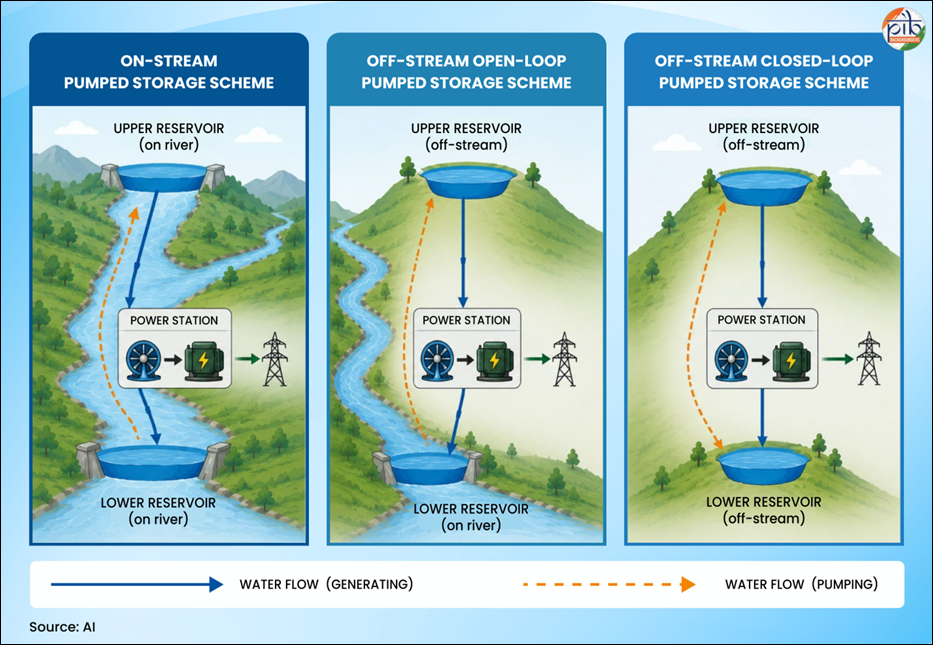
PSPs are classified according to their connection with natural watercourses.
https://static.pib.gov.in/WriteReadData/userfiles/image/2026/oct/image004_20261019110736_f6578c.png

A. On-stream Pumped Storage

  • Both reservoirs are located on a river, stream or nallah.
  • Water flows through turbines to generate electricity and is pumped back during surplus-power periods.

B. Off-stream Open-loop Pumped Storage

  • One reservoir is located on a river, stream or nallah, while the other is situated away from perennial watercourses.
  • Water is reused through pumping and generation cycles.

C. Off-stream Closed-loop Pumped Storage

  • Neither reservoir is located on a river, perennial stream or perennial nallah.
  • Water circulates between the reservoirs through repeated pumping and generation cycles.

Significance: Off-stream projects are increasingly being explored to accelerate development and minimise impacts on rivers and aquatic ecosystems.

Scaling Up Energy Storage: India’s Pumped Storage Momentum

As of August 2026, India's PSP development pipeline includes:

Development stage

Capacity

Projects

Operational

7.43 GW

10

Under construction/implementation

15.87 GW

11

Concurred/appraised by CEA

10.40 GW

8

The expanding pipeline will strengthen India's long-duration energy storage capacity.

India’s Regionally Diverse Pumped Storage Potential

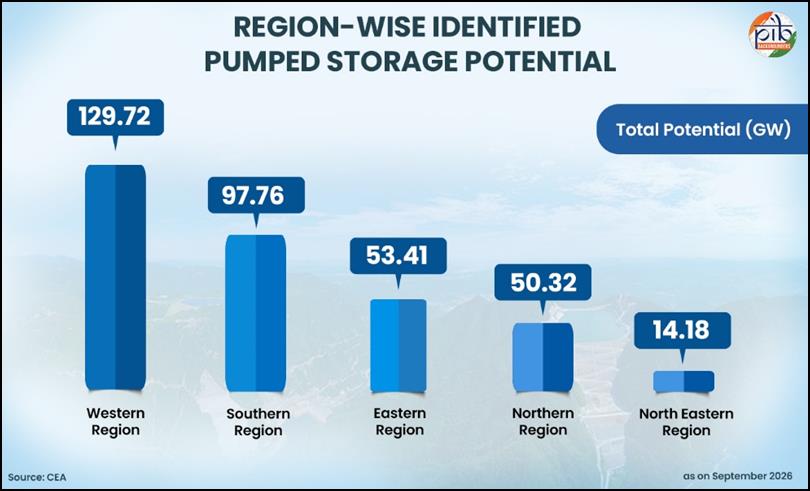
India has identified 320 PSPs with a combined potential of 345.38 GW.

  • On-stream projects: 62, with 56.67 GW potential.
  • Off-stream projects: 258, with 288.71 GW potential.

Regional potential

Region

Potential

Key States

Western

129.72 GW

Maharashtra (67.36 GW), Gujarat (33.36 GW)

Southern

97.76 GW

Andhra Pradesh, Telangana, Tamil Nadu

Eastern

53.41 GW

Odisha (41.53 GW)

Northern

50.32 GW

Uttar Pradesh, Himachal Pradesh

North Eastern

14.18 GW

North-Eastern States

Total

345.38 GW


https://static.pib.gov.in/WriteReadData/userfiles/image/2026/oct/image005_20261019110830_6133b7.jpg

Site assessment factors: Topography, geology, hydrology, reservoir characteristics, foundation conditions, seismicity, environmental impacts, construction materials, power potential and transmission connectivity.

Projected Capacity Addition of PSPs

The CEA envisages 100.81 GW of additional PSP capacity by 2035–36, taking cumulative capacity to approximately 105.56 GW.

Year

Addition (GW)

Cumulative capacity (GW)

Up to 2024–25

—

4.745

2025–26

2.68

7.425

2026–27

2.92

10.345

2027–28

1.60

11.945

2028–29

6.35

18.295

2029–30

13.50

31.795

2030–31

21.19

52.985

2031–32

8.80

61.785

2032–33

14.59

76.375

2033–34

11.88

88.255

2034–35

5.70

93.955

2035–36

11.60

105.555

The planned expansion will improve grid flexibility and support greater renewable energy integration.

Global Installed Capacity of PSPs

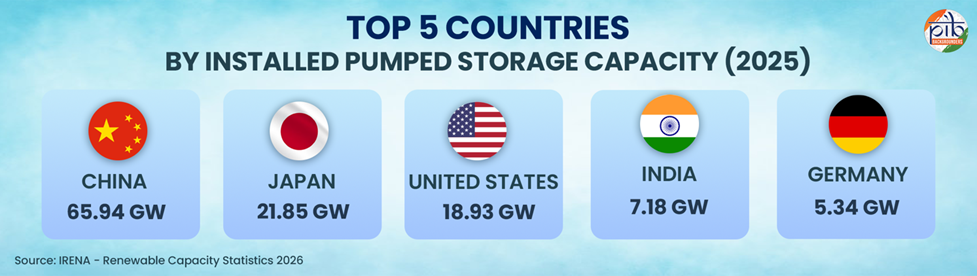
According to IRENA, global installed pumped hydro capacity reached 159.8 GW at the end of 2025.

Country

Installed capacity (approx.)

China

66 GW

Japan

22 GW

United States

19 GW

India

7.18 GW

India ranked fourth globally at the end of 2025. Its capacity increased to 7.43 GW by 2026.
https://static.pib.gov.in/WriteReadData/userfiles/image/2026/oct/image006_20261019110939_33e30b.png

Government Initiatives and Measures

  1. Dedicated PSP Guidelines: Ministry of Power issued guidelines in April 2023 to facilitate project development.
  2. Infrastructure Support: Budgetary support for roads, bridges, railway sidings, ropeways, communication facilities and transmission lines.
  3. Competitive Procurement: Tariff-Based Competitive Bidding (TBCB) guidelines notified in February 2025 for transparent procurement of storage capacity and stored energy.
  4. ISTS Charge Waiver: Projects awarded by 30 June 2028 are eligible for a 100% Inter-State Transmission System charge waiver for 25 years from commercial operation.
  5. Faster Approvals: CEA concurrence timelines for Detailed Project Reports reduced from 90 to 50 days; clearance for inter-State aspects removed.
  6. Streamlined Environmental Appraisal: Eligible PSPs may benefit from B2 categorisation and reduced baseline data requirements for off-stream projects, subject to applicable provisions.
  7. Survey and Investigation: Forest-land survey provisions and borehole exploration limits have been expanded to facilitate DPR preparation.
  8. Integrated Grid Planning: National electricity planning integrates storage and transmission development, with a roadmap for 100 GW of PSP capacity during 2025–26 to 2035–36.
  9. Digital Monitoring: The CEA’s Jal Vidyut DPR portal enables real-time monitoring of surveys, investigations and project preparation.
  10. Revised CEA Concurrence Threshold: A Gazette notification dated 1 August 2025 raised the capital expenditure threshold for hydro-generation schemes requiring CEA concurrence to ₹3,000 crore.
  • Off-stream closed-loop PSPs are exempt irrespective of capital expenditure.

Energy Transition’s Next Imperative

  • Renewable integration: Stores surplus solar and wind energy for later use.
  • Grid stability: Supports frequency management, peak demand and power-system resilience.
  • Energy security: Reduces dependence on fossil-fuel-based balancing power.
  • Long-term storage: Offers large-scale storage with a long operational life.
  • Sustainable development: Off-stream projects can reduce impacts on natural watercourses when appropriately planned.

Conclusion

Pumped Storage Hydropower will be a key pillar of India’s clean energy transition by providing long-duration storage, improving grid reliability and supporting the 2030 target of 500 GW of non-fossil fuel capacity.

Reference

PIB


There are no reviews yet. Be the first one to review.

ARCHIVES

sidetext