Why in News?
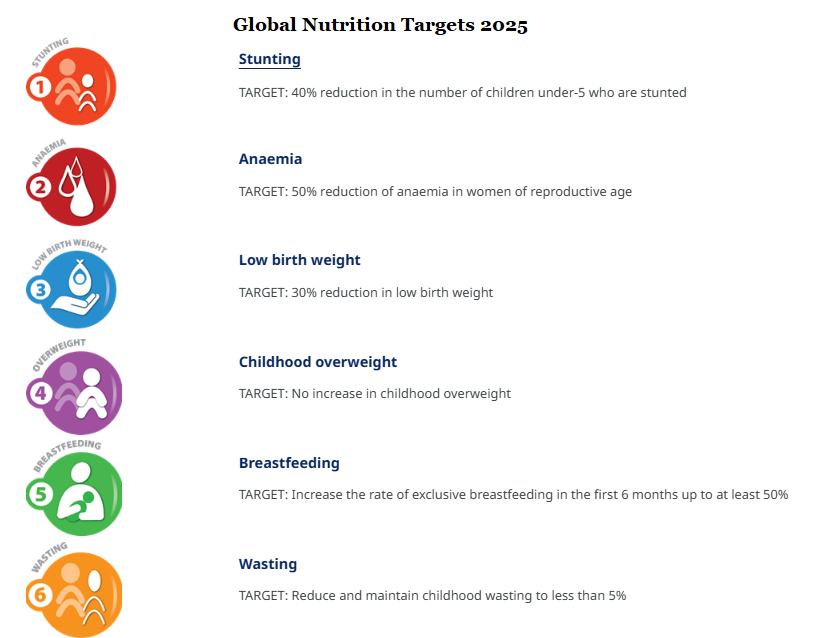
Recently , World Health Assembly released Global Nutrition Targets (GNTs) for 2025.
What are Global Nutrition Targets?
- Global Nutrition Targets (GNT) – They were set by the World Health Assembly as key national indicators of the effect of public health policies in alleviating maternal and child malnutrition.
- Global progress in nutrition - In general, there appeared to be slow and insufficient progress across countries with little progress in undernutrition, but an increase in overweight.
- Global projection - By 2030, it was projected that only a few countries would meet the targets for stunting, and none would meet low birthweight, anaemia, and childhood overweight.
- Obesity - Overweight had increased in children in almost all countries but was less than the prevailing undernutrition.
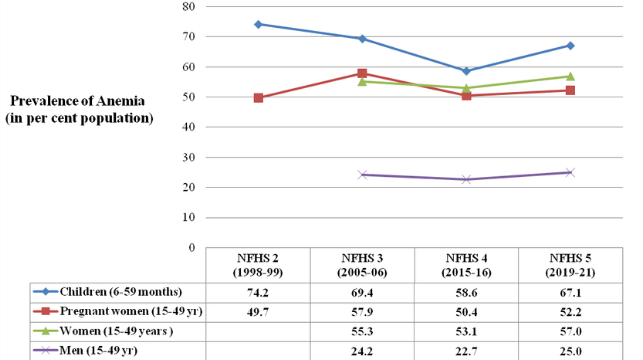
- Aneamia in India - The prevalence of anaemia has remained static in India for the last two decades.
Why is there a slow progress in nutritional health?
- Poor programme implementation – Ground level implementation of nutrition programs are either inadequate and do not reach bottom strata.
- Inadequate survey - With no national surveys, we do not know the cause of anaemia in India.
- Incorrect policies – Cause of anaemia is presumed to be iron deficiency, resulting in policies to improve dietary iron intake through fortification and supplementation.
- But recent large-scale surveys reveal that iron deficiency accounts for only a third of anaemia, while unknown causes account for another significant third.
- Early onset of deficiency - Stunting actively occurs within the first two years of life and increases from about 7-8% at birth to near 40% at two years of age.
On average, children reach half their adult height in two years. If already stunted at two, it is difficult to un-stunt children by overfeeding in the hope of faster growth.
- Inadequate energy intake - Average fat intake of poor children in India is only 7 grams per day, versus the requirement of 30-40 grams per day.
Energy intake is the driver of growth in the first two years and the most energy-dense food is oil.
- Differences in measurement - Venous blood-based anaemia prevalence (as recommended by WHO) was roughly half the capillary blood-based prevalence.
- Singular approach - Same cut-off criteria for anaemia might not fit all populations.
- Metabolic risks - It occurs in about no less than 50% of Indian children aged 5-19 years, even in those stunted and underweight.
What can be done to improve nutritional health?
- Focus on double duty actions to simultaneously address the under- and over-nutrition burden.
- Diversifying diets effectively rather than focusing on select nutrient deficiencies.
- Accurate metrics are crucial for successful public health interventions.
- Prevention in the first two years is most important, even though the global nutrition target refers to stunting in under-5 children.
- Make burden of childhood overnutrition an important policy target to address overweight.
Reference
The Hindu | Public health nutrition policies



