Mains: GS II – Polity & Governance
Why in News?
Recently, The Lok Sabha introduced a bill providing for harsher penalties and time-bound investigations into examination paper leaks.
What is Public Examinations (Prevention of Unfair Means) Amendment Bill 2026?
- About the bill – The Bill seeks to amend the Public Examinations (Prevention of Unfair Means) Act, 2024.
- Objectives – To strengthen the existing anti-cheating law, curb exam malpractices, ensure time-bound investigations and provide speedy trials.
- To establish enhanced deterrence against organised crime groups and institutions to safeguard transparent, merit-based selections.
- Key institution – It includes the following institutions within its scope:
- Union Public Service Commission,
- Staff Selection Commission,
- Railway Recruitment Boards,
- Institute of Banking Personnel Selection,
- National Testing Agency,
- Ministries of the central government and their attached offices, and
- Other authorities notified by the central government.
What are the key features of the bill?
- Safeguard merit and uphold fairness – Ensure that candidates who achieve success through genuine preparation are not disadvantaged by cheating or examination paper leaks.
- Deter organized examination malpractice networks – Increase the penalties for examination-related offences by imposing longer imprisonment terms and higher fines.
- Promote expeditious adjudication – The establishment of Special Fast Track Courts and the implementation of time-bound investigations and trials are intended to prevent prolonged case pendency.
- Establish accountability for private service providers – Examination agencies, technology providers, and other service providers represent potential points of vulnerability.
- The amendment enhances their legal liability.
- Enhance institutional credibility – Restore public confidence in examinations administered for government recruitment and higher education.
- Safeguard youth aspirations – Competitive examinations determine access to government employment and higher education.
- Their credibility directly influences social mobility and equality of opportunity.
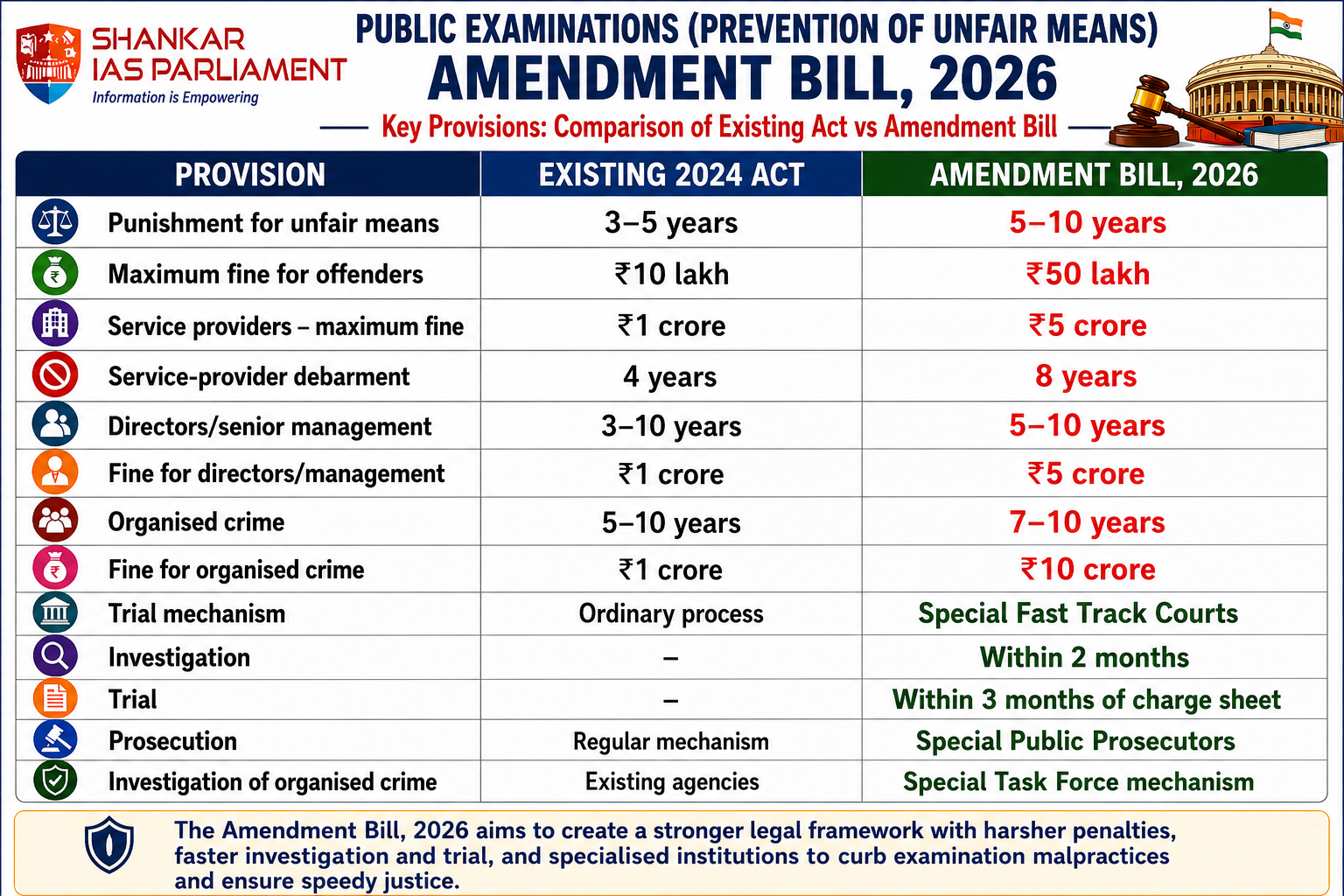
What the key changes proposed in the bill?
What are the key advantages of the bill?
- Stronger deterrence – Increasing imprisonment terms and fines raises the perceived consequences of examination malpractice.
- Raising the maximum fine for unfair means from ₹10 lakh to ₹50 lakh, and for organised crime from ₹1 crore to ₹10 crore, significantly strengthens deterrence.
- Faster justice – A major limitation of the criminal justice system is the frequent occurrence of prolonged litigation.
- The proposed procedural timeline is outlined below:
- The Bill requires that the investigation of an offence be completed within two months.
- The trial is to be completed within three months from the date the chargesheet is filed.
- Accountability across the examination ecosystem – It imposes liability not only on candidates but also on service providers, directors/management, and organised crime networks, recognising the sophistication of modern malpractice.
- Safeguarding honest candidates – Incidents of paper leaks and cheating undermine fairness in the selection process.
- Enhanced enforcement measures uphold the integrity of merit-based selection.
- Enhancing public trust in examinations – It supports fair public recruitment, equitable higher education admissions, administrative efficiency, equal opportunity, and youth confidence in institutions.
- Institutional Specialisation – Special Public Prosecutors, Special Fast Track Courts, and Special Task Forces may develop expertise in the investigation and prosecution of technologically sophisticated crimes.
What are the drawbacks of the bill?
- Punishment Alone Insufficient – Without an increased probability of detection and conviction, enforcement capacity is equally as important as sentencing.
- Risk of wrongful implication – Broadly defined criminal provisions increase the risk of wrongful implication for innocent candidates, employees, or service providers.
- Therefore, safeguards such as clear evidentiary standards, due process, and judicial oversight are essential.
- Time‑bound justice can create pressure – Although completing investigations in two months and trials in three months is desirable, complex cyber‑enabled exam fraud often requires digital forensics, multi‑state and financial investigations, evidence from technology providers, and strict chain‑of‑custody verification.
- Cybersecurity remains a central challenge – While legal frameworks can penalize data leaks, they are insufficient to prevent hacking, insider threats, malware, credential theft, cloud vulnerabilities, AI-enabled impersonation, or digital manipulation.
- Concerns Regarding Centralisation – Public examinations involve multiple agencies and levels of government; therefore, effective implementation depends on robust coordination between the Centre and States, as well as among various agencies.
- Dependence on Private Sector – Modern examination systems are increasingly reliant on advanced technologies and private sector service providers.
- The imposition of excessive compliance requirements can increase operational costs and reduce the pool of qualified service providers.
- Non- Systemic Reform – Focusing solely on punishment overlooks the systemic causes of malpractice, such as high-stakes exams, limited job opportunities, large candidate pools, weak infrastructure, and uneven digital capacity.
- Therefore, legal reform should be accompanied by examination system reform.
What lies ahead?
- Shift from punitive measures to prevention – By implementing a security-by-design examination ecosystem.
- Ensure each stage, from question creation to results, includes independent security controls.
- Strengthen end-to-end cybersecurity – By implementing encryption, multi-factor authentication, zero-trust architecture, blockchain audit trails, anomaly detection, independent audits, and strict access controls.
- Integrated Examination Security Framework – To establish a common protocol for UPSC, SSC, RRBs, IBPS, and NTA, covering people, process, technology, cybersecurity, and accountability.
- Strengthen whistle-blower mechanisms – By providing secure, anonymous reporting channels for exam officials, vendors, technical staff, printing and security personnel, and candidates, as insiders are key sources of information.
- Independent audits of service providers – It must be completed before exam contracts. These audits should assess cybersecurity, data protection, employee verification, disaster recovery, insider-threat controls, and past incidents.
- Develop specialized investigative capacity – By establishing task forces with expertise in cybercrime, financial investigation, digital forensics, and examination processes.
- Due Process in Fast‑Track Justice – It means speedy, not hurried justice, with courts safeguarding defence rights, evidentiary standards, judicial scrutiny, protection against arbitrary action, and proper appeals.”
- Reduce the stakes of a single examination – By introducing multiple cycles, computer‑based testing, transparent normalisation, secure question banks, and frequent recruitment to minimise consequences of one compromised exam.
- Examination Integrity Culture – By raising awareness among candidates and institutions about the ethical consequences of cheating.
- Connect exam integrity to recruitment practices and, ultimately, to integrity in public administration.
Reference
The Hindu | Public Examinations (Prevention of Unfair Means) Amendment Bill



