Prelims: Current events of national and international importance | Environment & Biodiversity
Why in News?
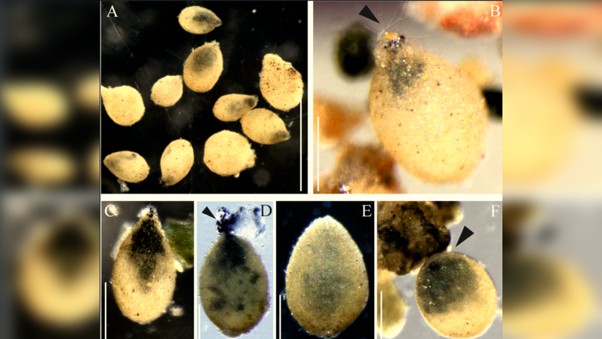
Scientists from Pune have discovered two new species of microscopic single-celled marine organisms, from the intertidal sediments along the Konkan coast of Maharashtra.
Key Characteristics of the New Species
- Classification - They belong to the genus Psammophaga, a group of benthic foraminifera (single-celled eukaryotic protists).
- Nomenclature - The name Psammophaga derives from Greek (psammo meaning sand, and phaga meaning eater).
- It refers to their unique habit of ingesting micro-particles and agglutinating sand grains to construct their protective shell-like structures (tests).
- Location - Discovered in the coastal intertidal zones along the Konkan region of western India.
- Taxonomic Nomenclature
- Psammophaga holzmannae - Named in honor of Dr. Maria Holzmann, a prominent Swiss scientist known for pioneering molecular research on foraminifera.
- Psammophaga sinhai - Named in honor of Dr. Rajiv Sinha / eminent Indian researchers for contributions to coastal geology and marine science.
About Foraminifera (Forams)
- Definition - Single-celled marine protists protected by hard shells (tests) made of calcium carbonate, silica, or agglutinated mineral sediment particles.
- Distribution - Found throughout global oceans, ranging from shallow intertidal beaches to deep ocean trenches.
- Ecological Significance
- Bio-indicators - Highly sensitive to changes in salinity, temperature, and heavy metal concentration.
- It makes them vital indicators of coastal marine ecosystem health and ocean acidification.
- Nutrient Cycling - Form a crucial component of the benthic food web by breaking down organic detritus and recycling nutrients within coastal sediments.
- Paleo-climate Proxies - Their fossilized shells are widely used by geologists and paleoclimatologists to reconstruct historical ocean temperatures and sea-level fluctuations.
Reference
Times of India | Pune scientists uncover 2 new marine species



