Prelims: Current events of national and international importance | Species
Why in News?
Recently, 2 Przewalski’s horse foals were born in the steppe region of Kazakhstan.
- These foals are considered the 1st Przewalski’s horses to be born in Kazakhstan’s grasslands in almost 2 centuries.
- It represents a significant milestone in the ongoing rewilding and ecological restoration efforts within Kazakhstan’s steppe ecosystems.
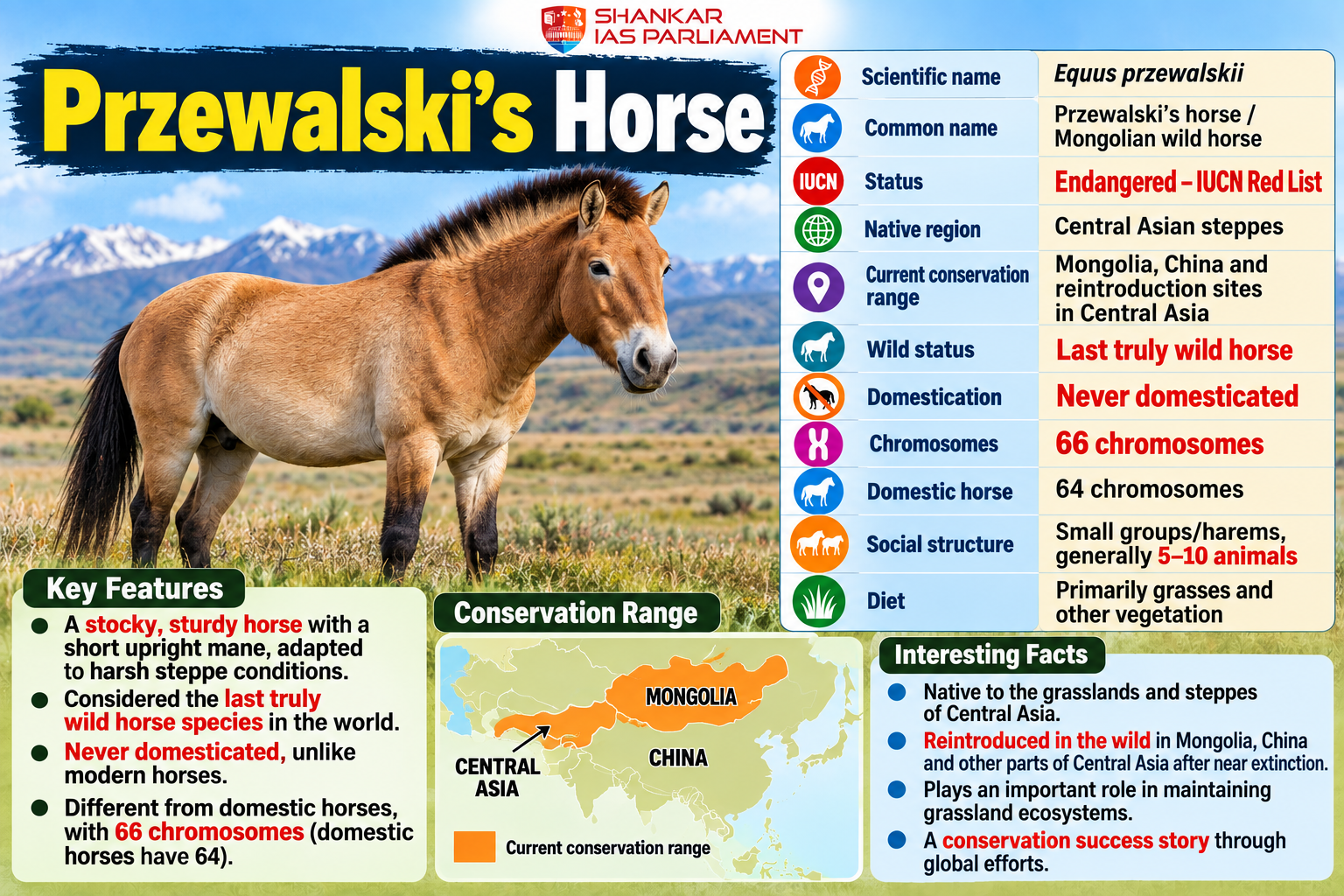
“Last Truly Wild Horse” refers to the unique status of Przewalski’s horse.
- Przewalski’s horse has never undergone domestication.
- This characteristic distinguishes Przewalski’s horse from feral horses, such as mustangs, which are descendants of domesticated horses that have reverted to a wild state.
- It represents a distinct lineage within the equine family.
Historical Decline
- The species was once widely distributed across the Central Asian plains.
- Major threats to the species included:
- Hunting,
- Agricultural expansion,
- Habitat loss,
- And competition with livestock.
- The last known wild individual was observed in 1969 in the Gobi Desert.
- The species persisted through populations maintained in European zoos and captive-breeding programs.
Reintroduction in Kazakhstan
- Altyn Dala Conservation Initiative
- Began in – 2005.
- Aim – To restore approximately 75,000 square kilometers of degraded steppe and semi-desert.
- The project addresses degradation resulting from the following factors:
- Overgrazing
- Unsustainable farming
- Climate change
- It is recognized as a UN World Restoration Flagship.
Przewalski’s Horse Reintroduction
- Since 2024, 22 Przewalski’s horses have been transferred from European zoos to Kazakhstan.
- The Alibi Reintroduction Centre serves as the main facility for this effort.
- The animals are gradually acclimated to survive in natural conditions.
Ecological Significance
As a large herbivore, the Przewalski’s horse plays a critical role in grassland ecosystems.
- Grazing – It regulates vegetation growth and may reduce the risk of wildfires.
- Movement of their hooves – It disturbs and loosens the topsoil, promoting soil aeration.
- Dung – It contributes essential nutrients to the soil.
- Grazing and movement – It helps to sustain healthy grassland ecosystems.
- Therefore, the reintroduction of Przewalski’s horses supports broader ecosystem restoration rather than solely focusing on species recovery.
Conservation Target
- Kazakhstan has set a target to establish a population of 40 Przewalski’s horses by 2029.
- Long-term objective
- To establish a stable, free-ranging population.
- To reduce dependence on human intervention.
Reference
Down to Earth | Przewalski’s Horse



