Prelims: Current events of National and International Importance| Science and Technology
Why in News?
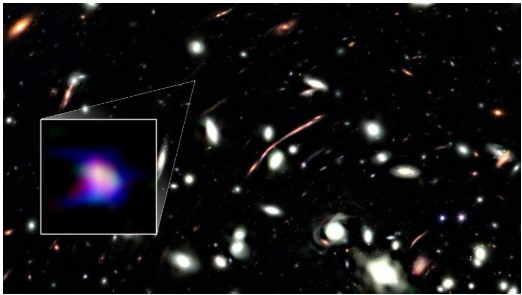
Using the James Webb Space Telescope (JWST) and gravitational lensing, an international team led by Associate Professor Kimihiko Nakajima of Kanazawa University discovered LAP1-B, a tiny, ultra-faint galaxy seen as it existed about 13 billion years ago (roughly 800 million years after the Big Bang).
- Extreme Chemical Primitiveness– LAP1-B has an oxygen abundance about 1/240th that of the Sun, making it the most chemically primitive star-forming galaxy identified to date.
- Because heavier elements like oxygen and carbon formed later inside early stars, its gas closely resembles the primordial universe.
- Gravitational Lensing & Spectroscopy– Researchers used the massive galaxy cluster MACS J0416 as a natural cosmic magnifier alongside JWST's Near-Infrared Spectrograph (NIRSpec).
- LAP1-B is so faint and star-poor that it does not show up in standard NIRCam images.
- Clues to Early Galaxies– The findings may carry chemical fingerprints from the universe's first stars and help explain a long-standing mystery about some of the oldest, faintest galaxies near the Milky Way.
Reference
Science Daily| Pristine galaxy from 13 billion years ago



