Prelims: Current events of National and International Importance| Environment
Why in News?
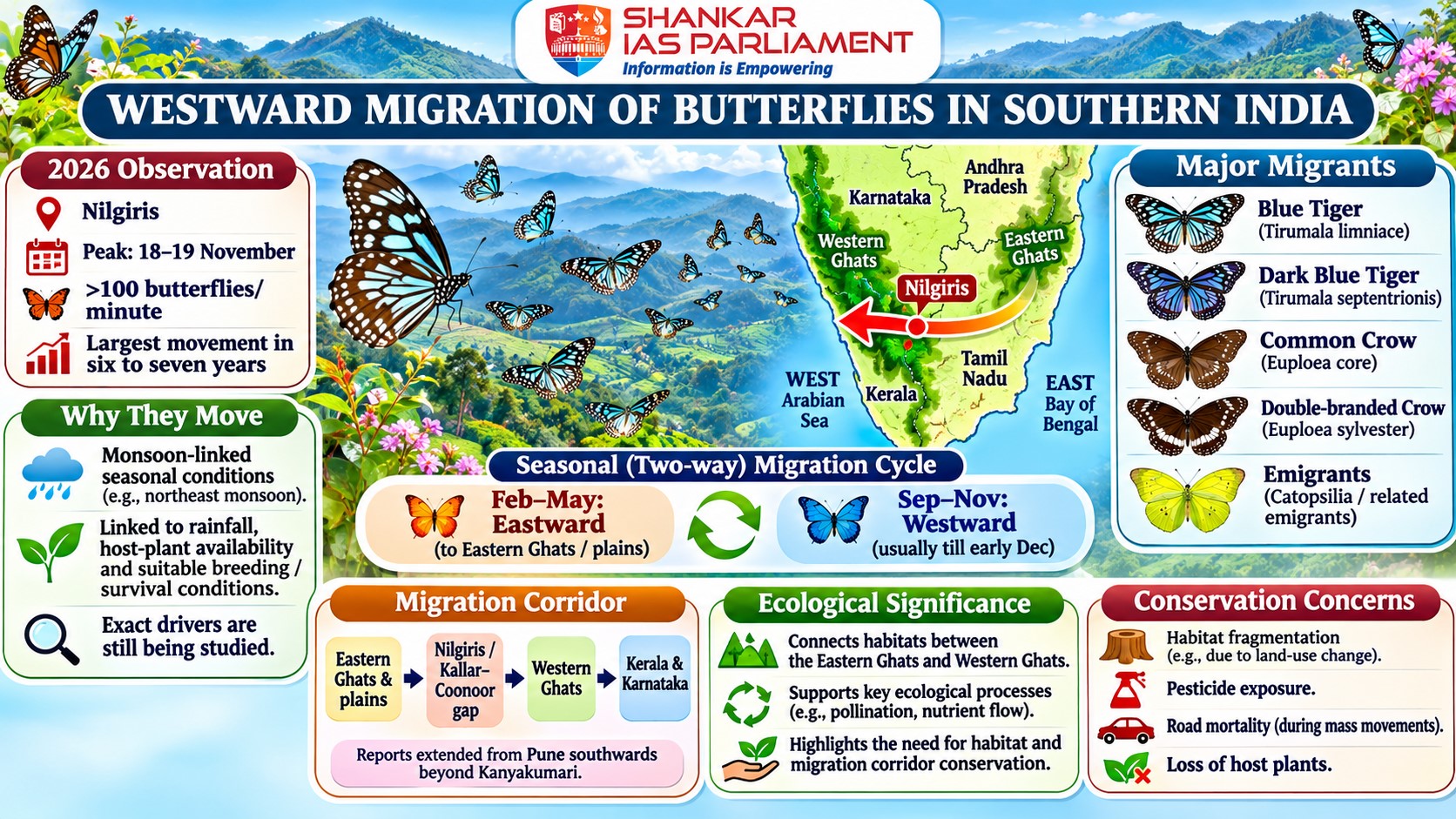
A large-scale westward butterfly migration was observed in the Nilgiris district of Tamil Nadu in November 2026, peaking on November 18 and 19 with more than 100 butterflies per minute crossing the skies.
Tracked from mid-September by volunteers from the Wynter-Blyth Association, the event was noted as the largest of its kind in the Nilgiris in six to seven years.
- Species Involved– Primarily brush-footed butterflies (Nymphalidae) and milkweed butterflies (Danainae), including Blue Tigers, Dark Blue Tigers, Crows, and Emigrants (Pieridae).
- Route & Terrain– Rather than a single narrow path, the butterflies move across a broad front spanning several kilometers.
- In the Nilgiris, they use valleys, knuckle ridges, and mountain passes—including the Kallar-Coonoor gap—moving toward Selas, Kolacombai, Mooparkadu, Geddai, and the Mukurthi highlands before heading onward toward Kerala and Karnataka.
- Wider Footprint– Sightings linked to the seasonal movement were reported as far north as Pune, south beyond Kanyakumari, and across to Sri Lanka.
Biannual Migration Pattern in Southern India
- Westward Movement (September–November)– Butterflies move from eastern areas and plains toward the Western Ghats, coinciding with the Northeast Monsoon.
- Eastward Movement (February–May)– Butterflies move eastward from the Western Ghats toward the Eastern Ghats ahead of the Southwest Monsoon.
- Causes– While monsoon rains and host-plant/resource availability are key factors, experts note that the exact triggers for the migration are still being studied.
Reference
The Hindu| Westward migration of butterflies in southern India



