Prelims: Current events of national and international importance | Environment
Why in News?
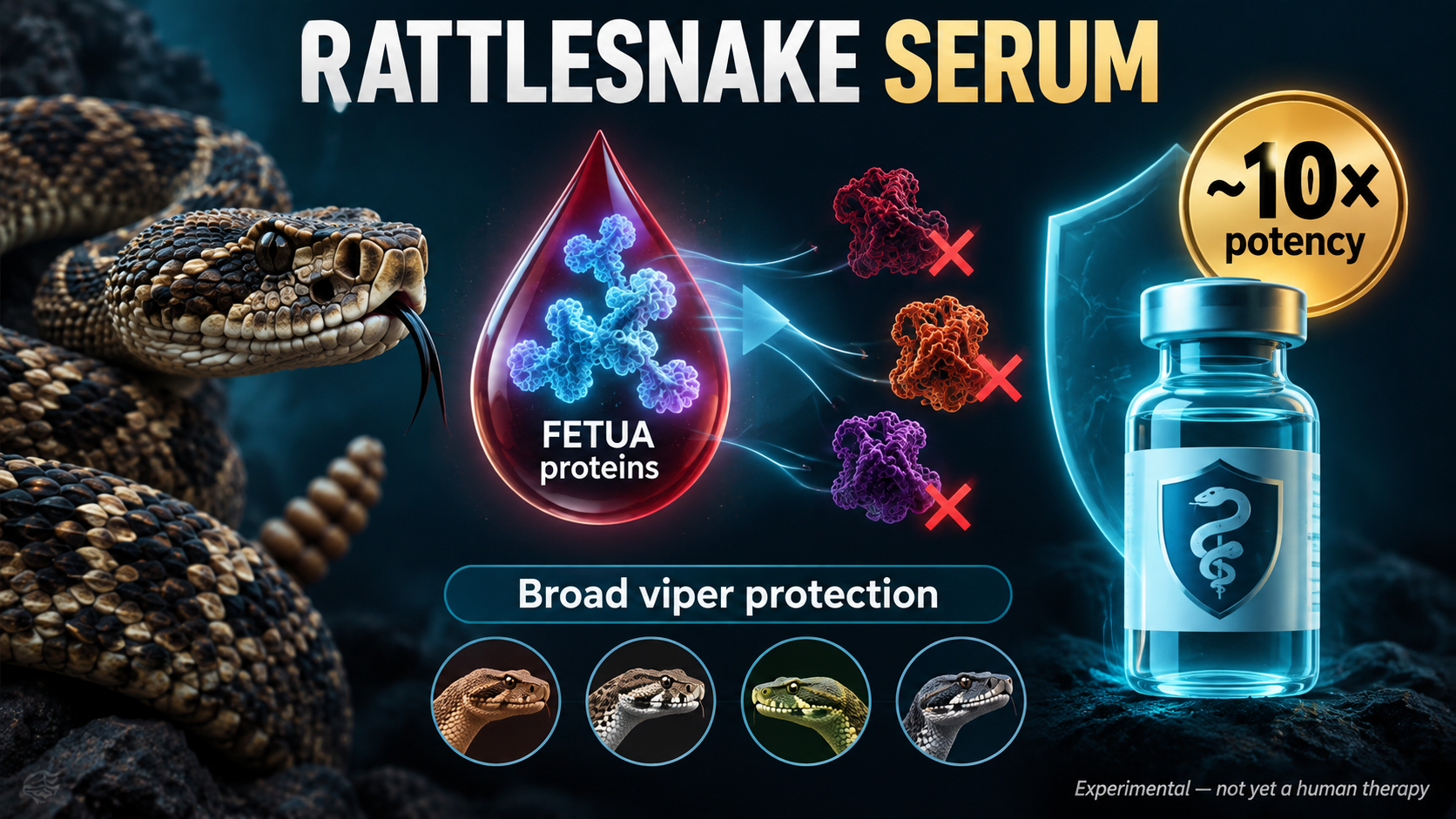
A breakthrough study revealed that specific combinations of toxin-blocking proteins naturally found in western diamondback rattlesnake (Crotalus atrox) blood serum can neutralize lethal viper venoms.
Rattlesnakes
- Rattlesnakes are pit vipers, a family of vipers with a heat-sensing pit organ between each nostril and eye.
- Habitat - Inhabits diverse biomes including arid deserts, scrublands, prairie grasslands, pine forests, and rocky hillsides.
- Geographic Range - Endemic to the Americas, spanning from southern Canada down through the continental United States, Mexico, and parts of Central and South America.
Venom resistance in snakes comes in two forms- either the targets in their bodies have evolved such that the venom doesn’t attack them, like in cobras, or they possess specific molecules in their bloodstream that serve as “toxin sponges”.
Scientific Discovery
- Evolutionary Immunity - Venomous snakes produce natural serum proteins called "toxin sponges" to protect themselves against self-envenomation or rival bites.
- Historical Context- In 1972, Japanese scientists discovered the first "toxin sponge",a protein named Fetuin-A in the Okinawa habu (Protobothrops flavoviridis), a pit viper endemic to Japan's Ryukyu Islands.
- Recent research revealed Fetuin-A belongs to a larger family of FETUA proteins.
- Targeting Metalloproteinases (SVMPs)
- Snake Venom Metalloproteinases (SVMPs) are the most abundant and destructive toxins in viper venoms, responsible for severe hemorrhage, tissue necrosis, and internal bleeding.
- Unlike standard antibodies, FETUA proteins act as natural inhibitors that bind directly to SVMPs to block their activity.
- Unexpected Efficacy- Combining multiple FETUA proteins completely blocked the overall lethality of rattlesnake venom, an unexpected result since rattlesnake venom contains 10 to 15 different toxin classes.
- Cross-Species Protection - The protein cocktail neutralized venoms from distantly related pit vipers, including:
- Eastern Diamondback Rattlesnake (Crotalus adamanteus).
- Malayan Pit Viper (Calloselasma rhodostoma).
- Chinese Moccasin (Deinagkistrodon acutus).
- Sochurek’s Saw-Scaled Viper (Echis carinatus sochureki—a true viper subspecies related to one of India's 'Big Four' venomous snakes).
- The proteins failed to protect against the Puff Adder (Bitis arietans), revealing limits to their cross-reactivity across true vipers.
Advantages Over Traditional Antivenoms
- 10x Higher Potency- Inhibits venom far more effectively per unit weight than conventional equine or ovine-derived antivenoms (CroFab).
- Recombinant Mass Production- Because FETUA proteins are genetically encoded, they can be produced in bioreactors via recombinant DNA technology—eliminating the need to maintain livestock or harvest live snake venom.
Significance for India
- The study tested efficacy by pre-mixing venom with the protein inhibitors before injection.
- This measures in vitro neutralizing capacity rather than treating an animal already envenomed (the real-world clinical scenario).
- Indian snakebite cases involve both vipers (hemotoxic) and elapids (neurotoxic cobras and kraits). FETUA proteins target SVMPs (vipers) and cannot neutralize neurotoxic elapid venoms.
- Rather than relying on rattlesnake-derived versions, Indian researchers recommend isolating native FETUA proteins from indigenous vipers and pairing them with targeted agents against elapid neurotoxins.
Reference
The Hindu | Rattlesnake blood



