SNAP-10A
Remembering the world’s first nuclear reactor to operate in space, SNAP-10A.
- SNAP-10A was the world’s first operational nuclear reactor in space.
- SNAP-10A was launched on April 3, 1965 by the U.S.
- While it still remains in orbit, it was operational for just 43 days.
- SNAP-10A was built as a result of the System for Nuclear Auxiliary Power (SNAP) programme or SNAPSHOT for Space Nuclear Auxiliary Power Shot.
- The objective of this programme was to develop compact, lightweight, reliable atomic devices that could then be employed in space, sea, and land.
- Reactor - The SNAP reactors had enriched uranium fuel with zirconium hydride as a moderator, and liquid Na-K alloy as the coolant.
- A thermoelectric converter was used to directly convert heat from the reactor into electricity.
- U.S. - SNAP-10A is the U.S.’ first and only known nuclear reactor in space.
- Russia - Has sent quite a few of them, including one that crashed and scattered radioactive debris over Canada in 1978.
References
- The Hindu - The world’s first operational nuclear reactor in space
Fast Radio Bursts
Scientists may finally discovered what causes mysterious fast radio bursts.
- Fast radio bursts (FRB) are intense but short radio signals that last for milliseconds.
- The first FRB was discovered in 2007 by American astronomer Duncan Lorimer which led to the term 'Lorimer Bursts'.
- Astronomers have been working on theories about what could be causing these signals, a research paper is published on that recently.
- Astronomers studied 2 neutron stars colliding and turning into a black hole generating a burst of gravitational waves.
A neutron star is the remnant of a collapsed supergiant star that was between 10 and 25 times the mass of our Sun.
- Theory - The merging of two neutron stars colliding and turning into a black hole may have caused the fast radio bursts.
- A neutron start has a magnetic field but a black hole does not have a magnetic field.
- Based on this, the paper mentions the fast radio burst could have been generated when the strong magnetic field of a neutron star ceases to exist.
- Limitation - The new theory can only truly apply to the fast radio burst that was discovered in FRB 20190520B.
- Scientists can’t definitively say that this hypothesis of a collapsing neutron star applies to all fast radio bursts.
References
- IE - Astronomers may have discovered source of fast radio bursts
- Science Alert - What Are Fast Radio Bursts?
Performer’s Rights
Actor Anushka Sharma challenged the sales tax levied against her income from advertisements and performances in award shows.
- In the year 1961, with the enactment of the Rome Convention, the concept of performer rights was accorded recognition.
- In 1994, performer rights were recognised under the Copyright Act, 1957 in India.
- The Act is also in conformity with 2 WIPO internet treaties concluded in 1996 namely, the WIPO Copyright Treaty (WCT) and WIPO Performances and Phonograms Treaty (WPPT).
- Performers - Indian law recognized the concept of performer in an exhaustive manner.
- Section 2(qq) defines the term ‘performer’, which includes actor, musician, dancer, acrobat, snake conjurer, a person delivering lecture or making any kind of performance.
- Performer’s Rights - Section 38 and 39 of the Copyright Act recognize the concept of performer rights.
- The performer engages in any performance including, literary work, song, movie is entitled for performer’s rights.
- For example, if copyright of a song is licensed, it would not just be the producer who would get a royalty but the singer and lyricist would also be entitled for a share.
- The protection of performer’s rights is 50 years from the end of the year in which the performance was fixed or it took place.
- The performers’ rights cannot be transferred or sold through an agreement.
- This ensures the production houses cannot simply buy out an artist and her work remains with her.
References
- IE - Anushka Sharma’s plea on sales tax disposed of by Bombay HC
- Legal Services India - Rights of Performers under Copyright Law
Bandipur National Park
Bandipur completed 50 years as a Project Tiger Reserve on April 1, 2023.
- On April 1, 1973, that the then Prime Minister Indira Gandhi launched the flagship Tiger conservation programme, Project Tiger.
- Bandipur was among the first 9 reserves to be brought under Project Tiger.
- History - Bandipur was once the private hunting grounds of the erstwhile Maharajas of Mysore.
- Bandipur National Park was formed in 1941 by including most of the forest areas of the then Venugopala Wildlife Park.
- In 1985 the area was enlarged and renamed as Bandipur National Park.
- At present, the adjoining Nugu Wildlife Sanctuary too has been incorporated under Bandipur.
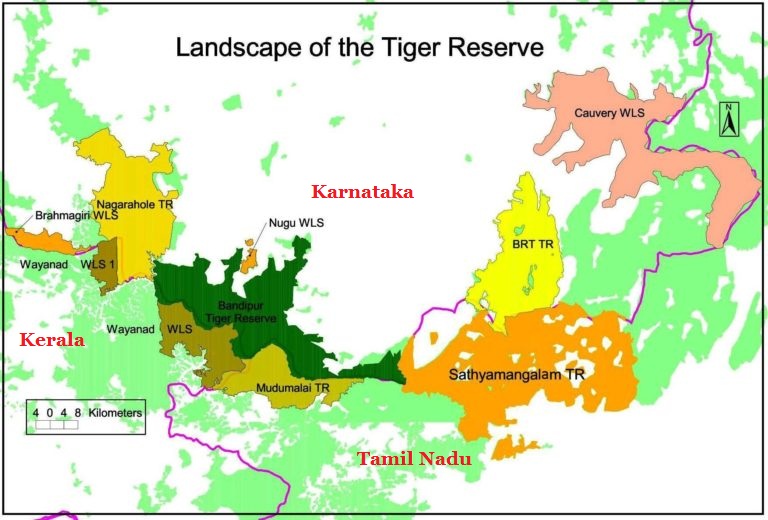
- Boundaries - Moyar River forms the natural southern border of Bandipur towards the Nilgiris.
- Kabini reservoir separates the Nagarahole and Bandipur National Park.
- Fauna - Apart from tigers and elephants, several endangered species such as sloth bears, gaurs, Indian rock pythons, jackals, muggers, and four-horned antelopes are found here.
- Flora - A wide range of timber trees are found here including teak, rosewood, sandalwood, Indian-laurel, Indian Kino tree, giant clumping bamboo, etc.
- Nilgiri Biosphere Reserve - The Bandipur Tiger Reserve is an important component of Nilgiri Biosphere Reserve, the country’s first biosphere reserve.
- Nilgiri Biosphere Reserve spans over Bandipur, Nagarahole, Mudumalai, and Wayanad
- Nilgiri Biosphere Reserve complex is home to the highest number of tigers (about 724) and Asian elephants in the country.
References
- The Hindu - Bandipur completes 50 years as Project Tiger Reserve
- Bandipur National Park
Reusable Launch Vehicle Mission
ISRO successfully carried out the landing experiment of the Reusable Launch Vehicle Autonomous Landing Mission (RLV-LEX) at Challakere.
- Reusable Launch Vehicle (RLV) Mission of ISRO aims to develop space planes/shuttles that can travel to low earth orbits, deliver payloads and return to earth for use again.
- RLV-TD (Technology Demonstrator) is a series of tests in developing essential technologies for a fully reusable launch vehicle to enable low-cost access to space.
- RLV LEX - The Reusable Launch Vehicle Autonomous Landing Mission (RLV LEX) test was the second of the 5 RLV-TDs.
- The first trial of the RLV-TD was conducted on May 23, 2016.
- Three more experiments have to be conducted.
- Return flight experiment (REX)
- Powered cruise flight
- Scramjet Propulsion Experiment (SPEX)
- RLV-TD will be used to develop technologies like hypersonic flight (HEX), autonomous landing (LEX), return flight experiment (REX), powered cruise flight, and Scramjet Propulsion Experiment (SPEX).
- This RLV will be scaled up to become the first stage of India’s reusable two-stage orbital (TSTO) launch vehicle in the future.
- ISRO’s RLV-TD looks like an aircraft.
- It consists of a fuselage, a nose cap, double delta wings, and twin vertical tails.
- 1st and 2nd RLV-TD
- The first test with RLV-TD (HEX1) involved the vehicle landing on a hypothetical runway over the Bay of Bengal.
- The second test with RLV-TD LEX experiment involved a precise landing on a runway.
- Advantages - Low-cost, reliable, and on-demand mode of accessing space.
- Global Scenario of RLV - Reusable space vehicles have been in existence for a long time.
- NASA space shuttles carried out dozens of human space flight missions.
- Space X demonstrates partially reusable launch systems with its Falcon 9 and Falcon Heavy rockets since 2017.
- SpaceX is also working on a fully reusable launch vehicle system called Starship.
References
- The Hindu - ISRO successfully conducts landing experiment of RLV-TD
- IE - ISRO’s Reusable Launch Vehicle Mission RLV LEX



