Prelims: Current events of national and international importance | Economy
Why in News?
The National Statistics Office (NSO) has proposed changes to the Periodic Labour Force Survey (PLFS) schedule, sampling design and estimation procedure from January 2027.
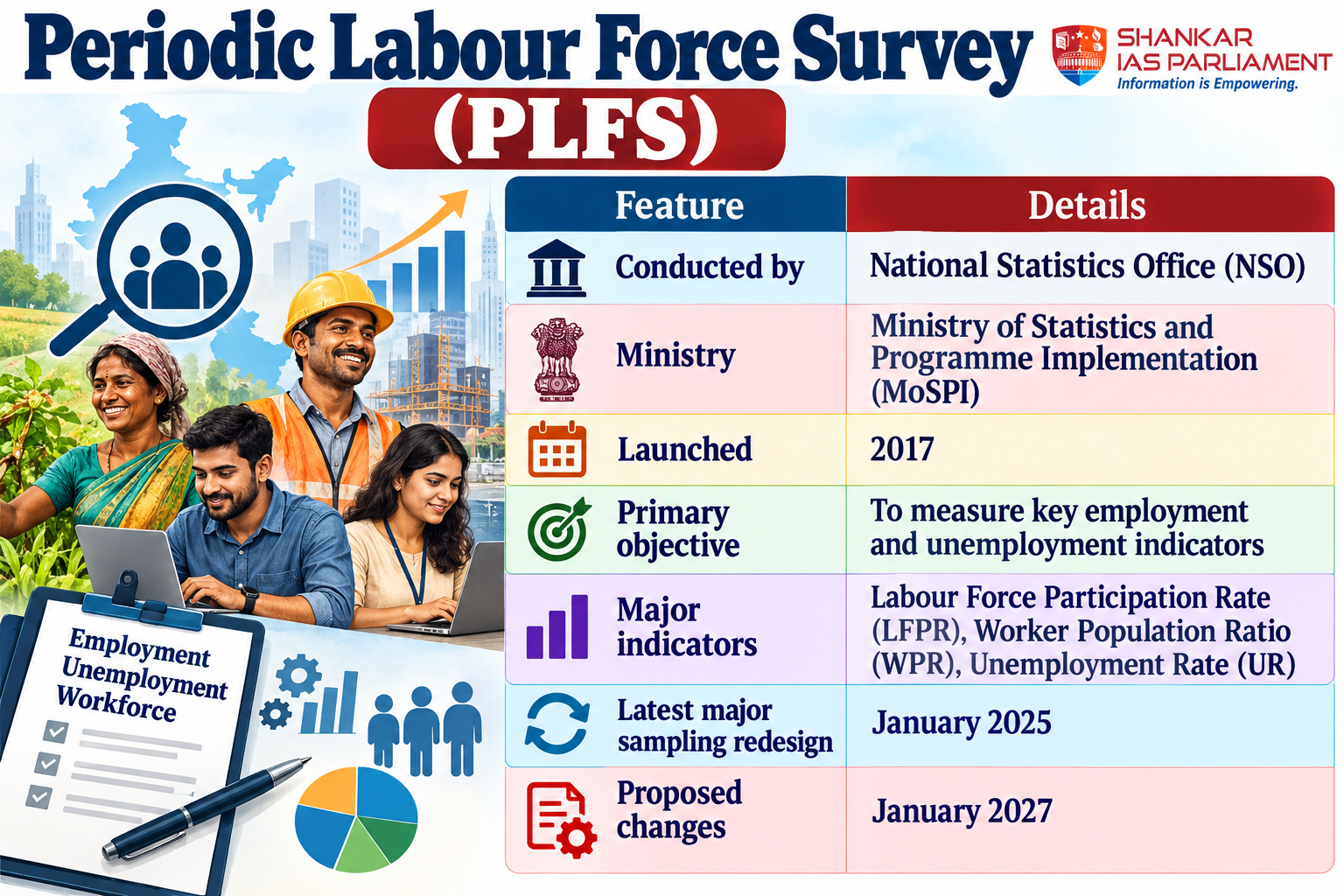
- Aim – To improve the coverage of digital platform workers, update the sampling frame and capture unpaid work more comprehensively.
Labour Force Participation Rate (LFPR) – The proportion of the population that is part of the labour force, including both employed individuals and those unemployed but actively seeking or available for work.
Worker Population Ratio (WPR) – The proportion of the population that is currently employed.
Unemployment Rate (UR) – The proportion of the labour force that is unemployed.
Major Changes in PLFS from January 2027
- Establishment of a distinct sampling stratum for digital platform workers
- Findings from PLFS 2026 demonstrated that the existing sampling arrangement was insufficient to adequately capture digital platform workers.
- A new Second Stage Stratum (SSS) specifically targeting digital platform work will be implemented.
- Digital platform workers constitute a subset of gig workers who perform tasks via digital platforms.
|
Parameter
|
Proposed arrangement
|
|
Rural areas
|
Four SSSs
|
|
Urban areas
|
Five SSSs
|
|
Households surveyed
|
14 households per selected First Stage Unit (FSU)
|
|
Identification
|
Additional binary question in Block 5 of Schedule 0.0PL
|
|
Coverage
|
Both rural and urban households
|
- Revision of the sampling frame – New samples for Panel 6 (2027–2028) will be selected using a revised sampling frame.
- The revised frame will incorporate the following considerations:
- Modifications identified in the updated Urban Frame Survey.
- Processes of urbanisation and de-urbanisation.
- Creation, division, or merger of districts and other administrative units.
- Subsequent updates to the rural Census 2011 sampling frame.
- Enhancements to sample allocation and stratification informed by experience from Panel 5.
- Transition period for the initial three months
- From January to March 2027, the sample will comprise FSUs drawn from both the Panel 5 frame and the updated Panel 6 frame.
- Monthly bulletins will report pooled estimates derived from both sampling frames.
- Relative Standard Error (RSE) estimates will be omitted during this three-month period.
- Enhancement of unpaid activity measurement – Schedule 10.4 will incorporate new questions to collect information on the following areas:
- Own-use production of goods.
- Unpaid household activities.
- Unpaid caregiving activities.
- Volunteer work.
- Unpaid trainee work.
- Scope of coverage:
- Rural and urban areas.
- Individuals aged 15 years and above.
- Applicable to the first visit only.
- Significance of the Proposed Changes
- Enhanced gig economy data – Improved measurement of digital platform work, which constitutes an increasingly significant segment of the labour market.
- Support for evidence-based policymaking – Provision of more reliable employment estimates to inform government planning.
- Recognition of unpaid work – Improved statistical visibility of caregiving, household production, and volunteer activities.
- Improved urban representation – Updated sampling methodologies can more accurately reflect changes in urbanisation and administrative boundaries.
- Continuity of estimates – Implementation of a transitional sampling arrangement is intended to prevent disruption in regular statistical releases.
Reference
PIB | PLFS Changes from January 2027



