Prelims: Current events of national and international importance | Environment
Why in News?
Recently, a UN report says global warming will exceed 1.5°C, demanding urgent corrective action.
- Released by – UN Environment Programme (UNEP)
- Key highlight – It identifies “Overshoot → Peak → Decline” as the most viable remaining strategy to limit climate damage and ultimately reduce global temperatures below 1.5°C.
- 1.5°C Target – Under the 2015 Paris Agreement, countries aim to keep the increase in global average temperature well below 2°C above pre-industrial levels and pursue efforts to limit it to 1.5°C.
|
Paris Agreement
|
- Nature – Legally binding international treaty on climate change.
- Adopted on – 12 December 2015 at COP21 in Paris, France by 195 Parties.
- Entered into force – 4 November 2016.
- Parties (as of 27 Jan 2026) – 194 Parties (US withdrawal).
- Key Instruments
- Nationally Determined Contributions (NDCs).
- Long-Term Low Emission Development Strategies (LT-LEDS).
|
- Current Situation – According to UNEP, global warming is likely to exceed 1.5°C within the next few years.
- If countries fully implement their current climate plans and net-zero targets:
- Peak warming is projected to reach approximately 1.8°C.
- Under current policies:
- Warming is expected to reach around 2.6°C by 2100.
- The possible range is 1.9°C to 3.6°C.
At COP30 (2025, Belém), the “Global Mutirão” decision became the first COP text to explicitly acknowledge the likelihood of a temporary 1.5°C overshoot.
It also committed to limiting the extent and duration of the overshoot and to closing adaptation gaps.
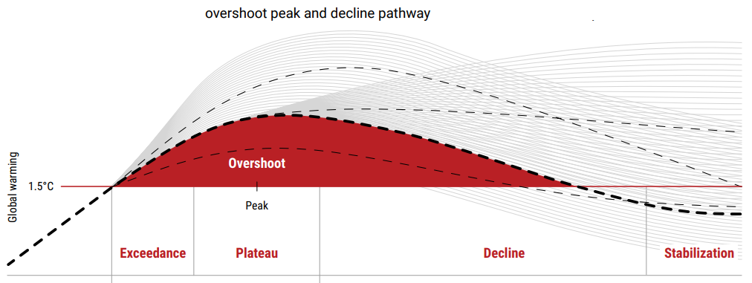
- Climate overshoot – It occurs when temperatures temporarily exceed the 1.5°C threshold before being reduced.
- “Overshoot, Peak and Decline” Pathway
- Overshoot – Temperatures are projected to exceed 1.5°C, which is now considered unavoidable.
- Peak – Global warming reaches its highest point, ideally remaining as low as possible, with the best-case scenario around 1.8°C.
- Decline – With net-negative emissions, temperatures are reduced below 1.5°C by 2100.
- Compound Risks – Additional warming will
- Accelerate sea-level rise,
- Increase the risk of coral collapse,
- Cause a 25% loss of glaciers by 2100,
- Reduce food production by 14% by 2050, and
- Raise the likelihood of tipping points in Antarctica, Greenland, the Atlantic Meridional Overturning Circulation (AMOC), and the Amazon.
- Hard Physics – Every five years of high emissions increases global temperatures by approximately 0.1°C.
- Reversing this trend requires the removal of about 220 gigatonnes of CO₂.
- One tree absorbs roughly one tonne of CO₂ over 30 years.
- CDR (Carbon Dioxide Removal) Limit – A credible return to 1.5°C is only possible if peak warming remains below 2°C.
- The UN report’s policy toolkit stresses deep emission cuts, rapid methane reduction, supplementary carbon dioxide removal, and transformational adaptation as the combined pathway to limit overshoot and return towards 1.5°C.
Reference
The Hindu | Global Warming Limit Breach



