World Happiness Report 2024
The World Happiness Report 2024 was released on March 20 to mark the UN’s International Day of Happiness.
- Aim - To measure, quantify, and compare happiness levels around the world.
- Brought by - A partnership of Gallup, the Oxford Wellbeing Research Centre, the UN Sustainable Development Solutions Network, and the WHR’s Editorial Board.
- First published in - 2012.
- Procedure – The Gallup World Poll surveys around 1,000 respondents in nearly every country on a variety of issues on a scale of 0–10.
- The World Happiness Report then averages the score from life evaluations per country over a 3 year period (2021–2023) and ranks from highest to lowest.
- Indicators - The ranking is based on individuals' own assessment of their life satisfaction, alongside factors like GDP per capita, social support, and life expectancy.
- Key findings of 2024 Report– Ranks 143 nations and for the 1st time, the report gives separate rankings by age group, in many cases varying widely from the overall rankings.
- Lithuania tops the list for children and young people under 30.
- Denmark is the world's happiest nation for those 60 and older.
- For the 1st time since the report was published, the United States (23rd) and Germany (24th) did not find a place among the list of 20 happiest nations.
- The latest report discovered that younger generations generally report higher levels of happiness compared to older age groups across most regions worldwide.
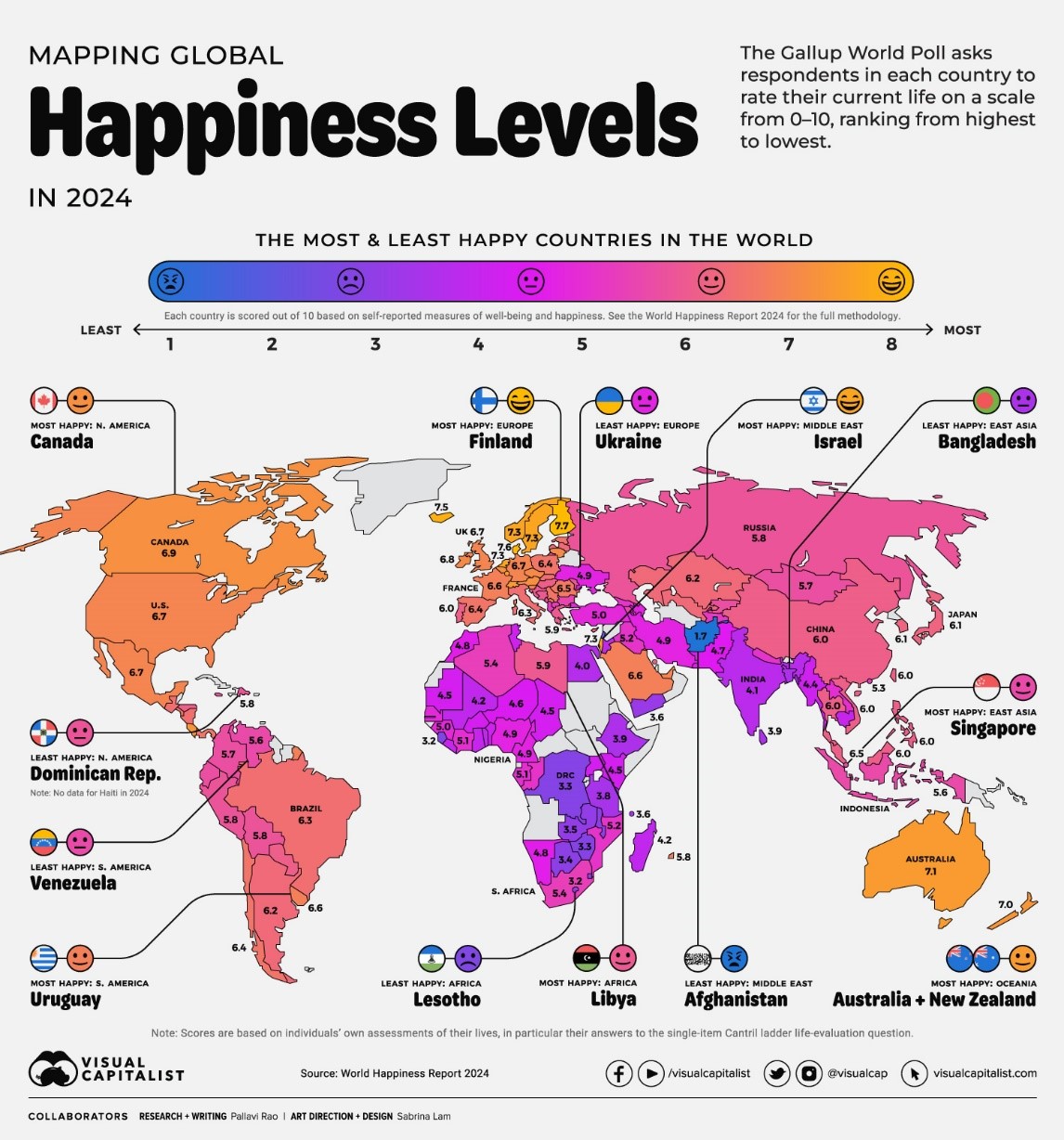
|
Most Happy Countries
|
Least Happy Countries
|
|
Finland (for the 7th year in a row )
|
Afghanistan
|
|
Denmark
|
Lebanon
|
|
Iceland
|
Lesotho
|
|
India’s Case
|
- India is ranked 126th, behind countries such as Libya, Iraq, Palestine and Niger.
- The young in India are the happiest while those in lower middle rung are the least happy.
- Older men, those in the higher age groups, currently married, and those who were educated, report higher life satisfaction compared to their respective peers.
|
References
- Hindustan Times | World Happiness Report
- VisualCapitalist | Image
Pushpak
Pushpak, an SUV-sized winged rocket released from an Indian Airforce Chinook helicopter successfully landed through RLV LEX-02 experiment recently.
- Pushpak is a Reusable Launch Vehicle (RLV).
- Developed by - Indian Space Research Organisation (ISRO).
- This is ISRO’s 2nd series of RLV landing experiment.
RLV-LEX -01 Experiment is the first test with RLV-TD (HEX1) involved the vehicle landing on a runway over the Bay of Bengal.
RLV-LEX-02 Experiment
- It demonstrated the autonomous landing capability of RLV from off-nominal initial conditions at release from a helicopter.
- Pushpak, was lifted by an Indian Airforce Chinook helicopter and was released from 4.5 km altitude.
- After release at a distance of 4 km from the runway, Pushpak autonomously approached the runway along with cross-range corrections.
- It landed precisely on the runway and came to a halt using its brake parachute, landing gear brakes and nose wheel steering system.
Reusable Launch Vehicle – Technology Demonstrator (RLV-TD)
- It is a series of tests in developing essential technologies for a fully reusable launch vehicle to enable low-cost access to space.
- The configuration of RLV-TD is similar to that of an aircraft.
- It has been configured to act as a flying test bed to evaluate various technologies.
- It will become the first stage of India’s reusable two stage orbital launch vehicle.
- Objectives of RLV-TD
- Hypersonic aero thermodynamic characterisation of wing body
- Evaluation of autonomous Navigation, Guidance and Control (NGC) schemes
- Integrated flight management
- Thermal Protection System Evaluation
References
- NDTV | Pushpak
- The Indian Express | Pushpak RLV landing experiment
- Business Standard | Pushpak
Kashmir’s Hangul (Cervus hanglu hangul)
Despite conservation efforts, Kashmir’s hangul deer risk is facing extinction.
- About - It is also known as the Kashmir stag or Kashmiri red stag which is highly shy and sensitive animal.
- It is the only Asiatic survivor or sub-species of the European red deer.
- State animal - It is the State animal of Jammu and Kashmir.
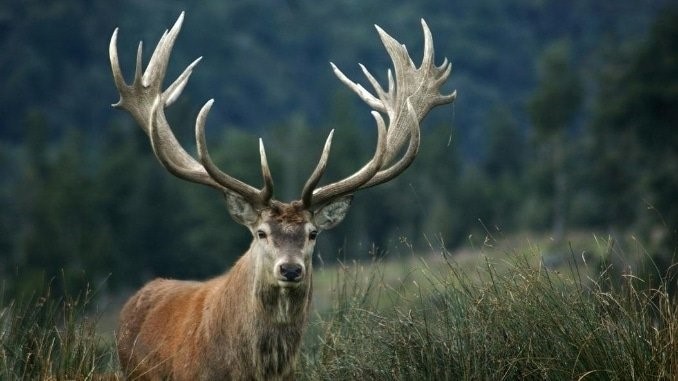
- Habitat – It lives in dense riverine forests, high valleys and mountains of the Kashmir valley and northern Chamba in Himachal Pradesh.
- Distribution –It is endemic to the hills of Kashmir and restricted to the Dachigam National Park.
- Conservation Status
- IUCN - Critically endangered
- CITES - Appendix I
- Threats - Habitat loss, poaching.
Dachigam National Park
- Dachigam National Park is located in Jammu and Kashmir.
- It is in the Zabarwan Range of the western Himalayas and was established in 1981.
- A protected area since 1910, it was declared as a national park in 1981.
- Other inhabitants at Dachigam are Musk deer, Brown Bear, Leopards, Jungle Cats, Himalayan black bear, and a few species of wild goat like the markhor and ibex.
References
- Scroll | Kashmir's Hangul
- Wildlife Sos | Kashmiri Stag
- Azim Premji University | Kashmiri Hangul
Netravati Waterfront Promenade Project
National Green Tribunal (NGT) in New Delhi has recently initiated action on the Netravati Waterfront Promenade Development Project in Mangaluru, Karnataka.
- Promenade project includes
- Setting up a biodiversity park and
- Creation of a bird-watching area near the netravati railway bridge,
- Building a pathway and laying a cycle track from the bridge to bolar sea face.
- The project is implemented by Mangaluru Smart City Limited (MSCL), a special-purpose vehicle created under the Union Government's Smart City Mission.
- Issue- National Environmental Conservation Foundation (NECF) in Karnataka had raised concerns regarding the project’s impact on the lives of common people in the area.
- NGT has taken suo motu cognisance and directed the formation of a joint committee to submit a detailed report on the project.
- The Project has been in controversy due to alleged violations of Coastal Regulation Zone (CRZ) norms and environmental regulations.
- Furthermore, there is no environmental impact assessment (EIA) report prepared for this project.
- Netravati River - The Netravati River, also known as the Bantwal River originates in the Bangrabalige valley of Yelaneeru Ghat in Karnataka.
- It joins the Kumaradhara River before emptying into the Arabian Sea.
- The Netravati is considered one of India's holy rivers and flows through the famous pilgrimage site of Dharmasthala.
References
- Down to Earth | Netravati Waterfront Promenade Development Project
- News Karnataka | Netravati Waterfront Promenade Development Project
Nomination Procedure
Filing of nominations for the 1st phase of the Lok Sabha polls began recently.
- Nomination Process - The process of nomination starts with the release of the notification for the Lok Sabha elections.
- Under this process, the candidates register their names with the Election Commission and claim that they are the right contenders to get public votes in the Lok Sabha election field.
- After examining all the certificates submitted by the candidates, the Election Commission decides their candidature for the Lok Sabha elections.
- Only after their candidature is finalised, the candidates can enter the election field and spread their campaign and seek votes in their favour.
- Eligibility - Any Indian citizen whose name is in the voter list can make nomination for the Lok Sabha seat.
- When a candidate is nominated by a political party, it is said that the candidates has got a ticket from the party.
- Independent candidates - Independent candidates file their nominations with their symbols, Election Commission examines their application for the symbol and allocates the party symbol after that.
- Submission authority - The nomination form can be submitted to the District Election Officer along with the prescribed amount as security deposit and submit an affidavit.
- Document submission - The nominators have to submit their passport size photo, Aadhar card, PAN card, domicile, caste certificate.
- Property details - The candidate has to give the details of their movable and immovable properties, income, expenditure, and loans of their wife and dependent children.
- Cases against the candidate - If any criminal case is going on against the candidate, or a court case is registered or if punishment has been given in any case, they also have to inform the Election Commission about that.
- Withdrawal process - The candidate can withdraw their name after a few days of nomination.
References
- The Hindu | Filing of nominations for loksabha
- The Indian Express | Loksabha nominations
- Zee Business | Lok Sabha Elections 2024



