Why in News?
In preparation for Mahakumbh 2025, dense forests have been developed at various locations across Prayagraj, to ensure pure air and a healthy atmosphere for the millions of devotees expected to visit the city.
- Miyawaki Foresting – An ecological engineering technique of afforestation, involves planting a diverse range of native tree species in a small area, which then grow into a dense, multilayered forest.
- Developed by – Japanese botanist Akira Miyawaki in 1970s.
- Aim – To create a self-sustaining forest, with a high level of biodiversity and to restore degraded land and combat climate change.
- Process – It involves planting trees and shrubs close to one another to accelerate their growth.
- Plants grow 10 times faster with this technique, making it a practical solution for urban areas.
- A completely maintenance-free, wild and native forest after the 1st 3 years.
- 4 steps of Miyawaki foresting technique
- Initial survey of the locality
- Collection of the seeds
- Preparation of planting sites
- Planting
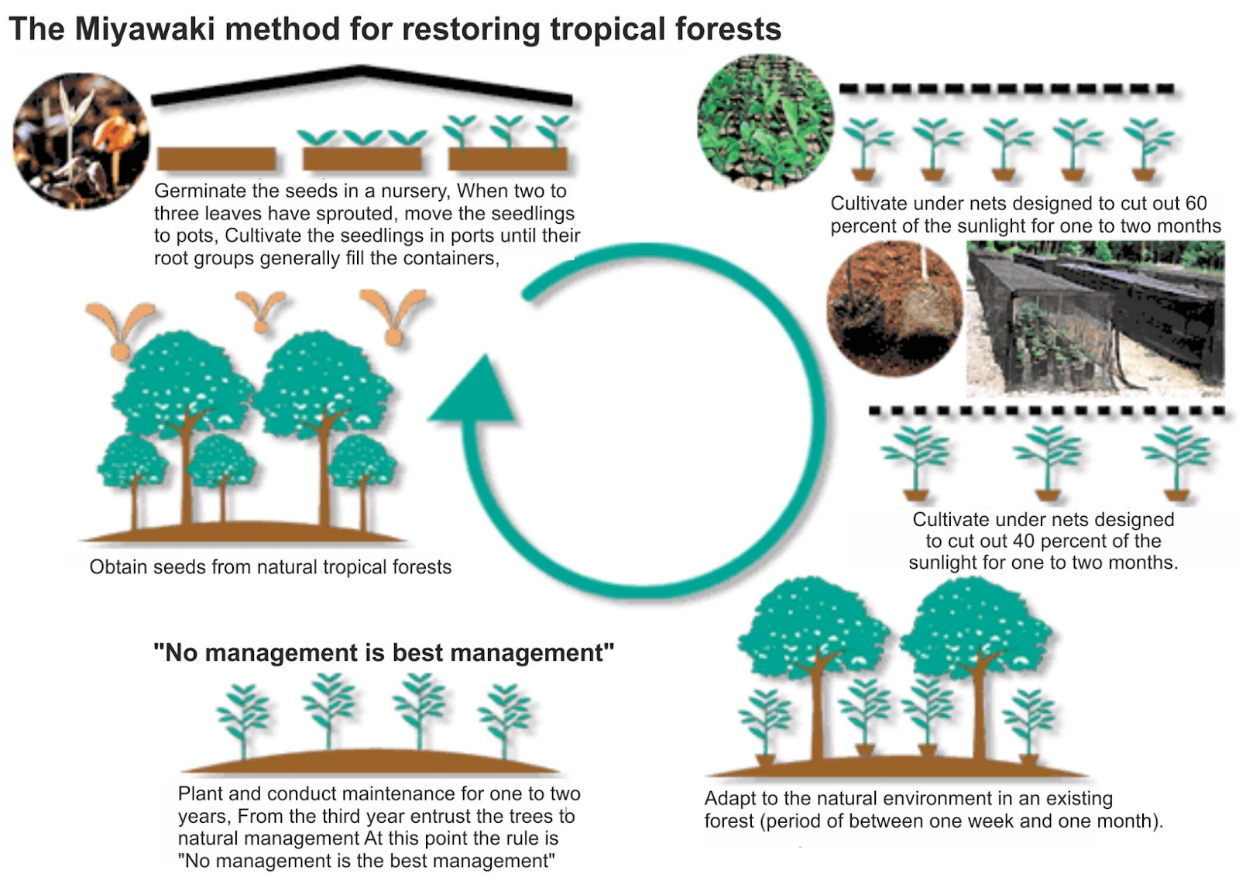
Miyawaki Technique is also known as Pot Plantation Method.
- Benefits – Up to 30 times more dense than conventional plantations.
- Up to 30 times better noise and dust reduction.
- Up to 30 times better Carbon-dioxide absorption as compared to a monoculture plantation.
- It is highly effective in the establishment of urban forests as well as converting unproductive wastelands into ecological and socially beneficial productive lands
The Prayagraj Municipal Corporation has utilized the Japanese Miyawaki technique over the past 2 years to establish multiple oxygen banks, which have now transformed into lush green forests. It also contributed to improving air quality, playing a crucial role in environmental conservation.
Reference
PIB| Green Mahakumbh using Miyawaki Technique



