Prelims: Current events of national and international importance | Environment
Why in News?
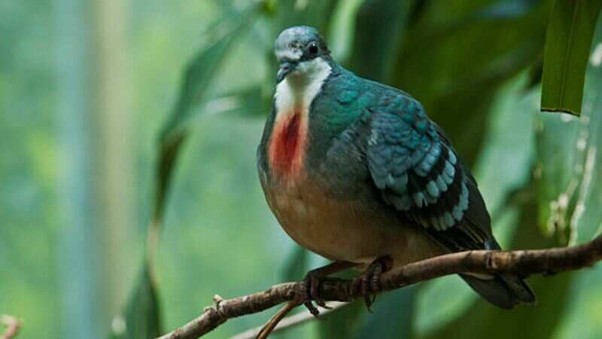
Researchers and Indigenous Forest patrollers captured the first confirmed photograph of the Mindoro bleeding-heart pigeon in the wild in two decades.
- Taxonomy - Belongs to the family Columbidae (pigeons and doves) and is one of five bleeding-heart species endemic to the Philippines.
- Nomenclature - Named for a distinctive vivid orange-red patch of feathers on its white chest that resembles an open, bleeding wound.
- Physical Attributes - Measures about 30 cm in length. Features iridescent green plumage on its head and neck, blue-green and brown upper parts, brown wings, and a single whitish wing bar.
- Behavior- A secretive, predominantly ground-dwelling bird that forages on the forest floor and takes flight only when threatened.
- Endemism - Found exclusively on the island of Mindoro in the Philippines.
- Traditional Habitat - Historically described as a lowland forest specialist, typically inhabiting forests at elevations around 400 m (up to 800 m).
- New Elevation Milestone- The 2026 camera trap documented the bird above 900 meters (nearly 3,000 feet) in the rainforests of the Iraya Mangyan ancestral domain.
- Scientists note that its presence at high elevations is likely not a habitat expansion, but rather a sign of habitat compression.
- Conservation - IUCN Red List- Critically Endangered (CR).
- Estimated wild population is extremely low, ranging between 50 and 249 mature individuals.
- Search for Lost Birds Program – It was designated as a "lost" species after going undocumented by science since 2005.
- Primary Threats
- Habitat Loss - Widespread deforestation driven by agricultural expansion, logging, and infrastructure development.
- Snaring & Poaching - Accidental capture in snares set on the forest floor for other ground species like red junglefowl.
- Illegal Wildlife Trade- Hunting for food and live capture for trade.
Reference
Times of India | A pigeon with a ‘bleeding heart’



