Prelims: Current events of national and international importance | Environment
Why in News?
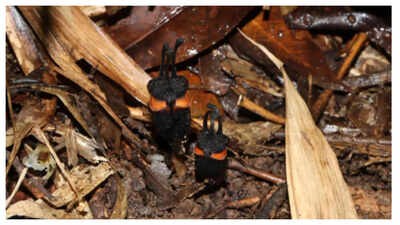
Botanists have discovered a new species of leafless, non-photosynthetic flowering plant in Thailand, named Thismia daemona, commonly called the "Devil Flower".
- Family - It belongs to the genus Thismia (family Thismiaceae), a group of small, unusual flowering plants commonly known as "fairy lanterns".
- Nomenclature - The species was named "daemona" due to its dark, blackish flower topped with horn-like appendages rising from a dome-shaped miter, along with bright reddish-orange patches near its base that resemble glowing eyes.
- The plant contains no chlorophyll, has no leaves or green parts, and cannot perform photosynthesis.
- It survives via mycoheterotrophy, obtaining all its nutrients underground from symbiotic fungal networks.
- Subterranean Lifestyle - It spends almost its entire life concealed beneath layers of forest leaf litter, emerging only when flowering.
- Habitat - Discovered in Thong Pha Phum National Park in western Thailand.
- Found growing at an altitude of nearly 1,000 meters in a seasonal montane evergreen forest, which is surprising since most Thismia species inhabit wet, humid lowland rainforests.
- Biogeographic Significance- It belongs to Thismia section Geomitra, extending the known distribution of this section farther north into Thailand (previously recorded only in Peninsular Malaysia, Borneo, and Sumatra).
- Conservation Status - Provisionally assessed as Critically Endangered (CR).
- Threats - Known from only a single population of fewer than 50 individual plants in a restricted area that experiences high tourist foot traffic.
Reference
Times of India | "Devil flower"



