Prelims: Current events of National and International Importance | Science and Technology | Agriculture
Why is in news?
Researchers at the Indian Institute of Technology Gandhinagar (IITGN) have developed seaweed-based hydrogel microbeads that release micronutrients in response to changes in soil acidity.
- The technology adapts the controlled drug-delivery approach used in wound and cancer treatment to deliver nutrients to crop roots when required.
About the Technology
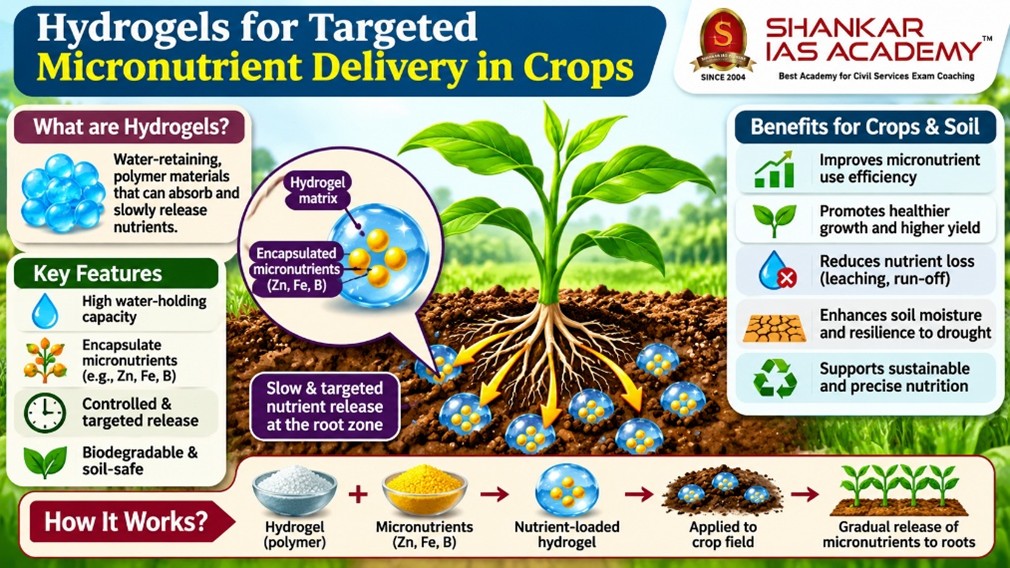
- The microbeads are designed to deliver essential micronutrients such as iron, zinc, manganese and copper to the rhizosphere — the narrow region of soil surrounding plant roots.
- They are made from κ-carrageenan, a gelling agent extracted from red seaweed, and trans-ferulic acid, a natural antioxidant found in cereals such as rice, wheat and oats.
- The beads are approximately 3.5 mm in diameter and retain micronutrients within a gel network.
- When roots lack certain nutrients, they release organic acids that lower the pH of the surrounding soil. The beads respond to this acidic environment by swelling and releasing nutrients.
How does it work?
- The hydrogel acts as a carrier that holds micronutrients close to plant roots.
- Acidity loosens the gel network, promoting swelling and release of the encapsulated nutrients.
- This enables localized and controlled delivery, reducing the risk of nutrients being chemically fixed in soil or washed away through leaching.
Key Findings
- At pH 4, the beads swelled by about 80% in two days, compared with 49% at neutral pH and 37% at pH 9.
- Over 14 days, the beads released 68% of their iron and 66% of their zinc under acidic conditions.
- At neutral pH, iron and zinc release was about 46% and 44%, respectively; at alkaline pH, it was 28% and 27%.
- In plant tests, bead-fed Arabidopsis thaliana showed higher chlorophyll content and larger leaves than plants that received no micronutrients.
Advantages
- Targeted nutrient delivery near roots can improve nutrient-use efficiency.
- May reduce nutrient loss through leaching and chemical fixation in soil.
- Uses seaweed-derived carrageenan and a naturally occurring antioxidant as components of the carrier.
- The approach may support precision agriculture and reduce the need for repeated broad-area application of micronutrient salts.
Limitations and Way Forward
- The findings are based on laboratory and model-plant studies; field-scale validation is still required.
- Further research is needed to assess effects on actual crop yield, nutritional quality and micronutrient accumulation in plant tissues.
- Long-term ecological safety, complete biodegradation and effects on soil microbes need further assessment.
Prelims Watch-Outs
- Hydrogels are three-dimensional polymer networks capable of absorbing and retaining large quantities of water.
- κ-carrageenan is obtained from red seaweed.
- Rhizosphere refers to the soil region directly influenced by plant roots and associated microorganisms.
- The research was published in ACS Omega, a peer-reviewed journal of the American Chemical Society.
Reference
PIB | IIT Gandhinagar researchers develop seaweed-based beads that release micronutrients when plants need them



