Prelims: Current events of National and International Importance | Environment
Why is in news?
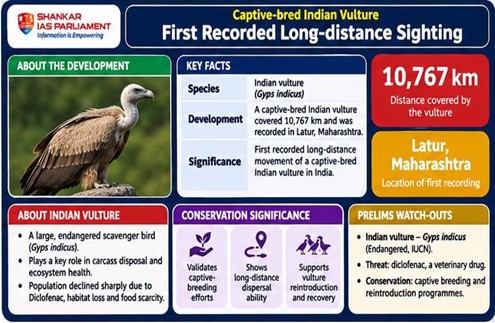
A seven-year-old captive-bred female Indian vulture, tagged F14/M99 and fitted with a satellite transmitter, was spotted in Ausa tehsil of Maharashtra’s Latur district on 18 November 2026.
- The bird had travelled 10,767 km since its release into the wild at Melghat Tiger Reserve earlier in the year, marking the first recorded sighting of the species in Latur.
Key Details
- The vulture was bred at the Bombay Natural History Society (BNHS) vulture breeding centre at Pinjore, Haryana.
- It was among 15 vultures released into the Somthana forest range of Melghat Tiger Reserve as part of a rehabilitation programme.
- The bird began its journey on 28 May 2026 and covered 10,767 km up to 20 November 2026.
- Its route included locations in Maharashtra, Madhya Pradesh and Karnataka, including Akot, Malkapur, Nashik, Thane, Pune and Vijayapura.
- Satellite tracking and coloured leg bands helped conservationists identify and monitor the bird.
About Indian Vulture
- Scientific name: Gyps indicus.
- It is listed as Critically Endangered on the IUCN Red List.
- It is a scavenging bird that feeds mainly on carcasses and plays an important role in removing animal remains from the environment.
- The species has suffered a severe population decline, largely due to veterinary diclofenac, which causes fatal kidney failure in vultures feeding on treated livestock carcasses.
Significance of the Sighting
- The bird’s long-distance movement indicates its ability to survive and move independently after release.
- An earlier observation near Halali Dam in Madhya Pradesh showed the bird roosting with wild vultures and having a full crop, indicating successful foraging.
- Such observations provide evidence to assess the effectiveness of captive-breeding, release and rehabilitation programmes.
Conservation Measures
- The Vulture Conservation and Breeding Programme is supported by institutions including the BNHS and the Central Zoo Authority.
- The veterinary use of diclofenac was banned in India in 2006 to reduce vulture mortality.
- Conservation efforts include captive breeding, release into suitable habitats, monitoring and promotion of vulture-safe veterinary alternatives.
Prelims Watch-Outs
- Indian vulture (Gyps indicus) – Critically Endangered; family Accipitridae.
- Diclofenac – veterinary non-steroidal anti-inflammatory drug (NSAID) associated with vulture mortality.
- Melghat Tiger Reserve is located in Maharashtra.
Reference
The Times of India | 10,767 km journey: rare vulture makes first recorded halt in Latur



