Prelims: Current events of national and international importance
Why in News?
Recently, a novel porous graphene-based supercapacitor (PGCN) has been developed in India to enhance energy storage for electric vehicles (EVs).
- Supercapacitor – A supercapacitor is a high-capacity energy storage device that bridges the gap between conventional capacitors and rechargeable batteries.
- Main components – Electrode, electrolyte, separator, and current collector.
- Advantages – High power density, long durability, and ultrafast charging compared to conventional capacitors and lithium-ion batteries (LIBs).
- PGCN Supercapacitor – A high-voltage supercapacitor based on dual-functional PGCN electrodes.
- Developed by – International Advanced Research Centre for Powder Metallurgy and New Materials (ARCI).
- Nodal Authority – The Department of Science and Technology (DST), the Ministry of Science and Technology.
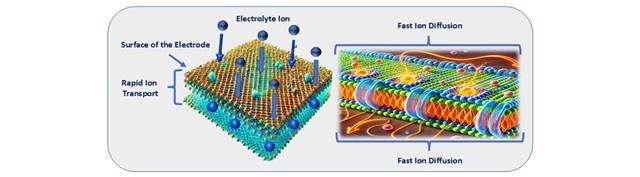
- Working Principle – The supercapacitor stores energy by pulling ions from the electrolyte onto its porous graphene surface.
- Function – The surface acts like a sponge for ions and a fast pathway for electricity, allowing quick charging and high-power output.
- Key Features – Type – Graphene-based high-voltage supercapacitor.
- Dual Functional Surface – The PGCN surface is both water-repellent (to prevent moisture-induced degradation) and highly compatible with organic electrolytes (super organophilic), enabling efficient and rapid penetration into the pores.
- Porous Structure – The micro- and mesoporous architecture significantly boosts ion diffusion compared to traditional electrodes,
- It results in high power density up to 17,000 W/kg.
- Performance Metrics – The electrode achieves an operating voltage of 3.4 V (surpassing the conventional 3.0 V limit)
- And, it holds 33% more energy, enhancing suitability for electric vehicles and grid storage.
- Eco-Friendly & Scalable Synthesis – The material is produced using a sustainable hydrothermal method.
- It is environmentally friendly and capable of being scaled up from lab-level to industrial-scale production.
- Applications – Electric vehicles, solar panels, grid-scale energy storage, and portable electronics.
- Benefits – Faster acceleration and increased range for EVs.
- Improved safety and electrolyte stability.
- Reduced need for stacking multiple cells.
- Long-term durability with 96% performance retention after 15,000 cycles.
- Significance – Supports India’s clean energy goals and the Aatma Nirbhar Bharat initiative by strengthening indigenous capabilities in advanced energy-storage technologies.
Reference
PIB | Novel supercapacitor for EVs



