Prelims: Current events of national and international importance | Geography
Why in News?
Recent reports say that 2025 marked the fourth consecutive year in which all major glaciated regions recorded net ice-mass loss.
State of Global Water Resources 2025 report
- Released by – World Meteorological Organisation’s (WMO)
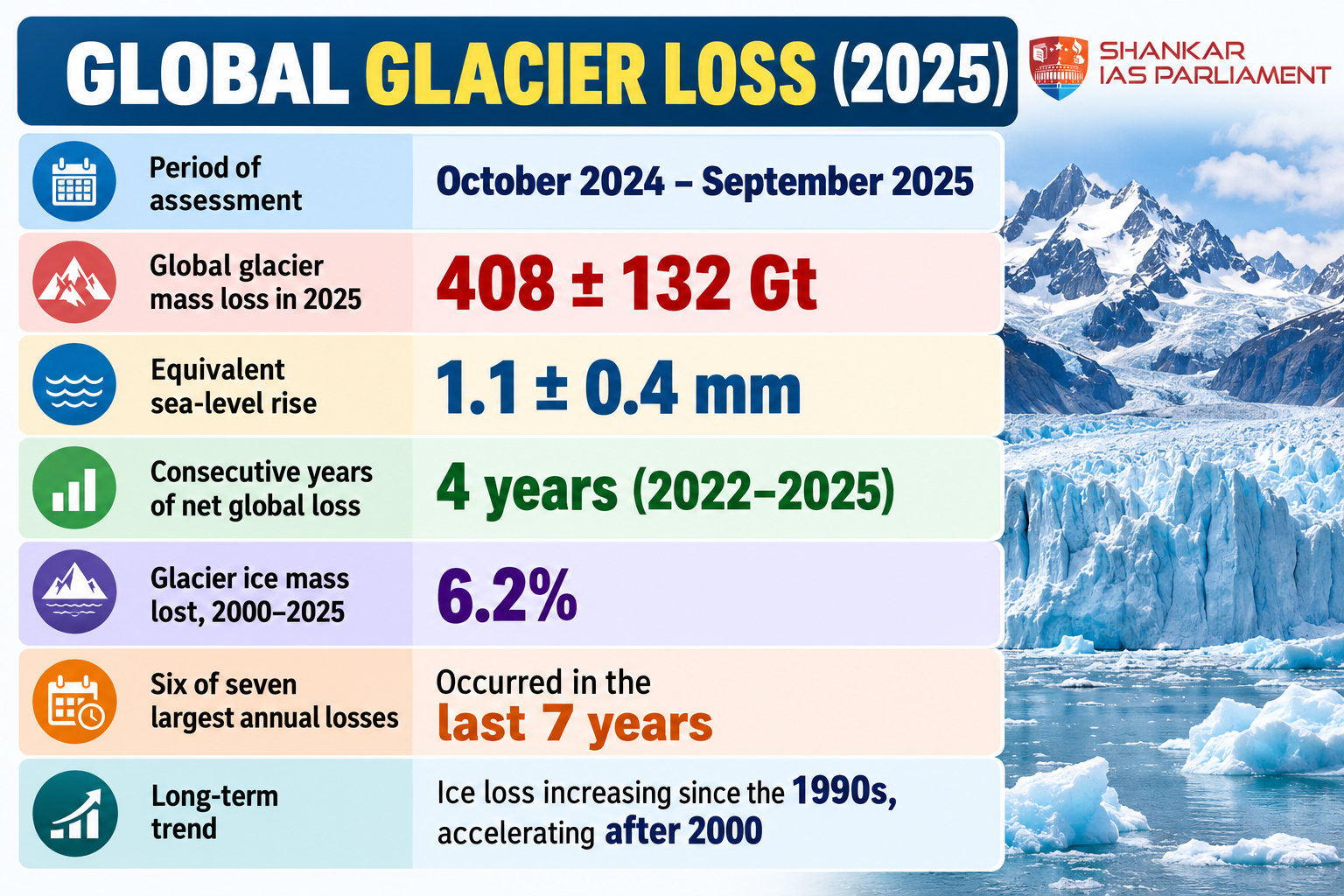
- Key findings
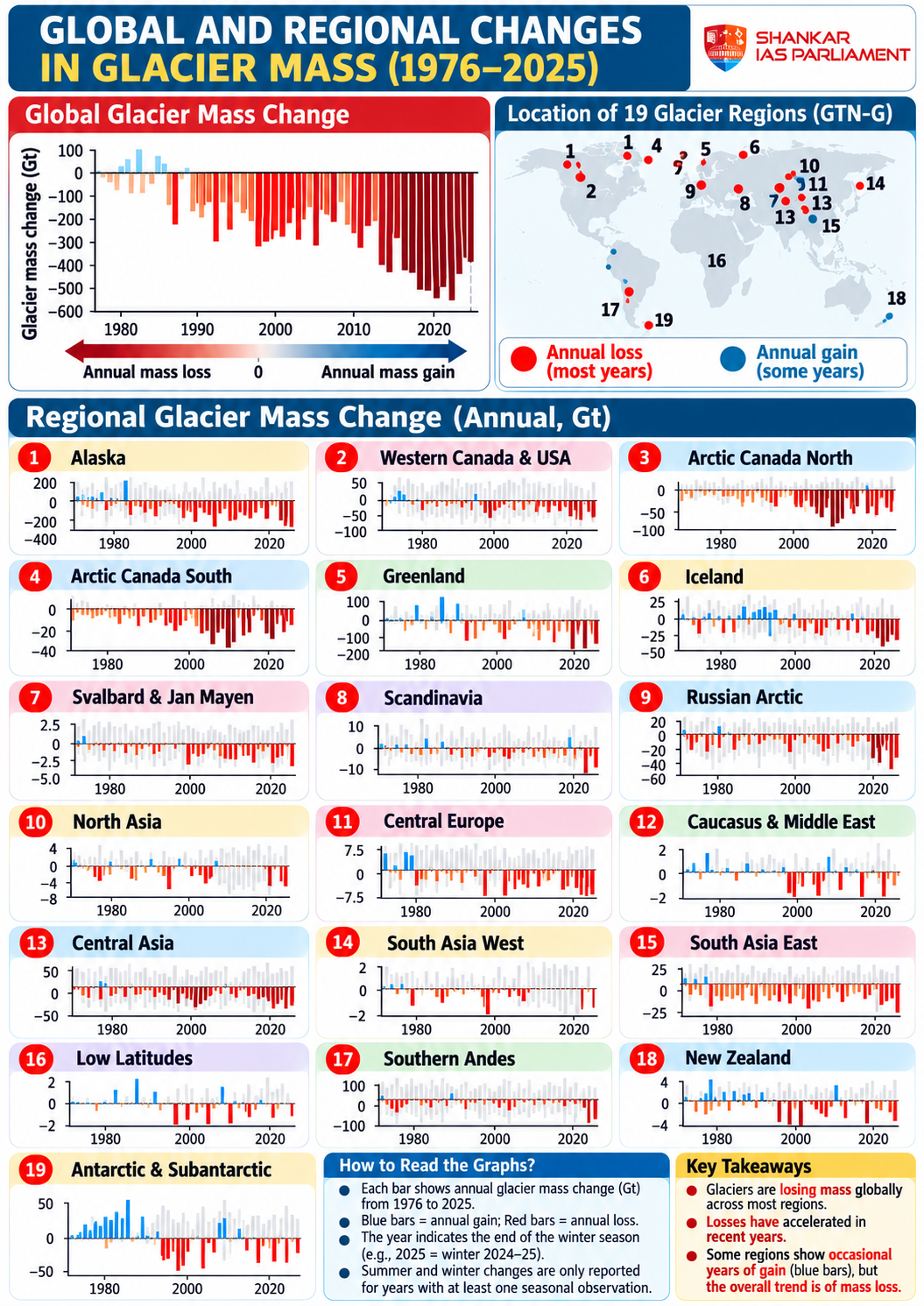
- Regions Exceptionally High Mass Losses – In 2025, the following regions experienced annual mass balances that ranked among the three most negative years on record:
- Central Asia
- South Asia West
- Russian Arctic
- Iceland
- Western Canada & USA
- Trends Since the 1990s
- Ice loss has increased across nearly all glaciated regions.
- Summer melting now exceeds winter accumulation.
- This imbalance has accelerated, especially since 2000.
- Glacier Mass Balance – It is defined as the difference between accumulation and ablation.
- Positive balance – Accumulation > melting/loss
- Negative balance – Melting/loss > accumulation
- Peak Water – It refers to the stage at which a glacier attains its maximum meltwater runoff.
- After peak water
- Initially, increased glacier melting leads to greater water availability.
- Once maximum runoff is reached, continued glacier shrinkage results in a decline in meltwater contribution.
- Regions having reached peak water
- Caucasus
- Western Canada & USA
- Central Europe
- These regions have exhibited minimal or no increase, and in some cases a decline, in minimum summer runoff despite ongoing annual glacier mass loss.
Reference
Down to Earth | WMO Report



