Prelims: Current events of national and international importance | Geography
Why in News?
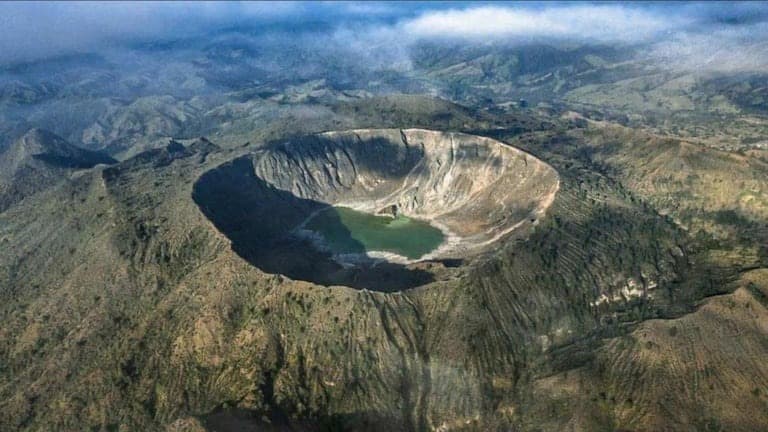
Recent unusual activity at Chichón volcano, including crater lake changes and underground signals, points to an active hydrothermal system.
- Name – Derived from the local Chiapas term “Chichón,” meaning little bump, reflecting the volcano’s shape.
- Location – Southern Mexico.
- Type – Stratovolcano. It is a tall, cone-shaped mountain made of layers of ash and lava. They are famous for steep sides and powerful eruptions, like Mount Fuji or Mount St. Helens.
- Geological Setting – Part of the Trans-Mexican Volcanic Belt.
- Lies above a subduction zone, where the Cocos Plate subducts beneath the North American Plate.
- A stratovolcano with a crater lake formed after the 1982 eruption.
- History – One of Mexico’s deadliest volcanoes. Its 1982 eruption killed over 2,000 people and buried towns under pyroclastic flows and ash.
- It caused a global temperature dip from sulfur dioxide emissions and reshaped the summit, forming the current crater and lake.
- It has remained mostly dormant but geochemically active since then.
- Activity – Alert Level – Yellow alert, phase 2 (abnormal but non-eruptive activity)
- Crater Lake Observations – High temperature (up to 118°C), with chemical changes (sulfates, chloride, H₂S and CO₂).
- Seismic & Underground Activity – Shallow, low-magnitude quakes indicate an active hydrothermal system beneath the crater, with the potential for sudden phreatic (steam-driven) explosions.
- Hazards – Possible phreatic (steam-driven) explosions.
- Toxic gas emissions (hydrogen sulfide H₂S and carbon dioxide CO₂).
- Localized hydrothermal hazards around the crater lake.
- Monitoring – The National Autonomous University of Mexico (UNAM) is deploying drones and remote sensing platforms for heat and gas monitoring.
- Limited real-time seismic, gas, and thermal surveillance.
- Permanent danger zone – The crater and immediate surroundings remain restricted due to residual hazards from the 1982 eruption and ongoing hydrothermal activity.
Reference
Indian Defence Review | Chichón Volcano



