Mains: GSIII – Infrastructure
Why in News?
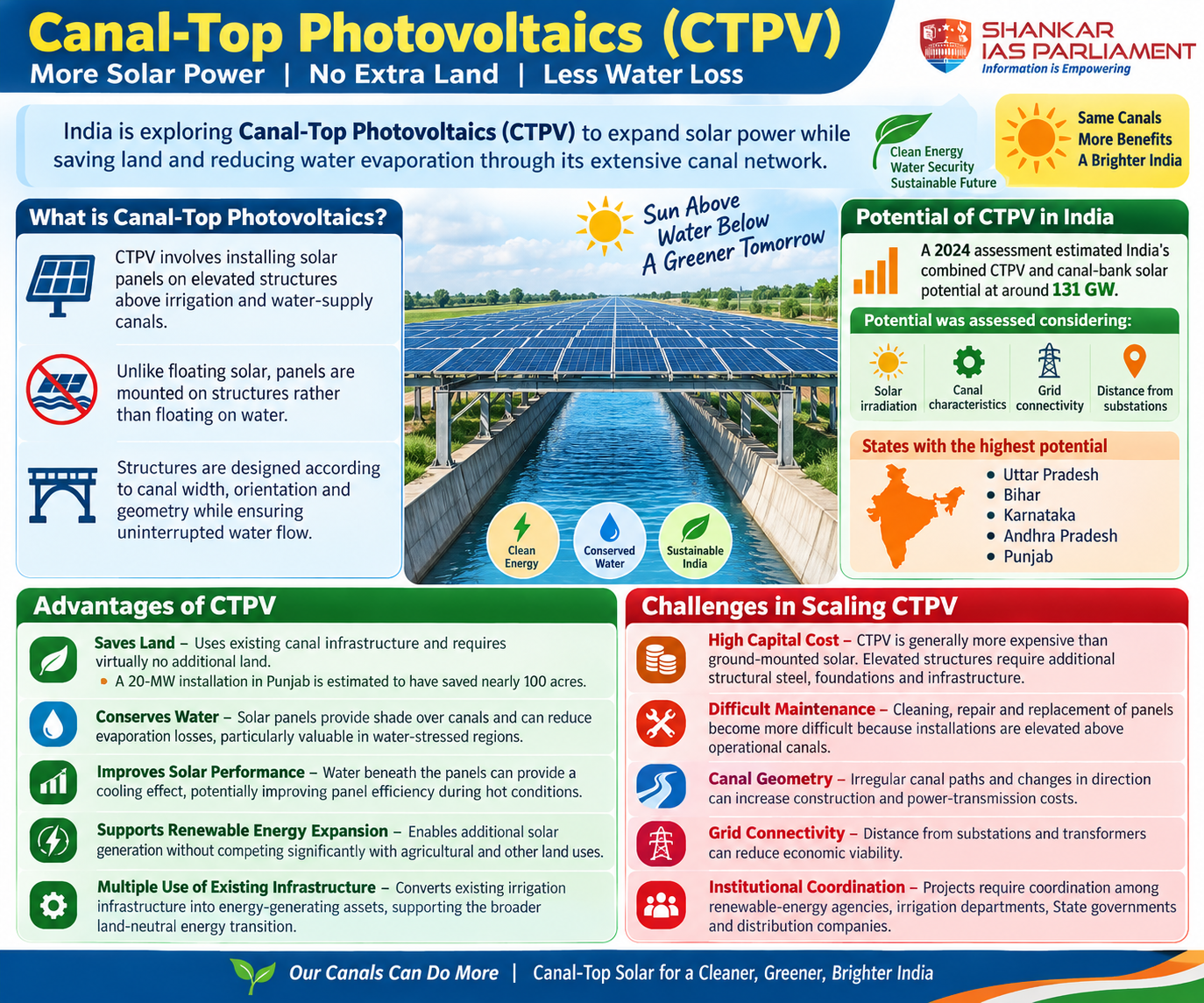
India is exploring Canal-Top Photovoltaics (CTPV) to expand solar power while saving land and reducing water evaporation through its extensive canal network.
What is Canal-Top Photovoltaics?
- CTPV – It involves installing solar panels on elevated structures above irrigation and water-supply canals.
- Unlike floating solar, panels are mounted on structures rather than floating on water.
- Structures are designed according to canal width, orientation and geometry while ensuring uninterrupted water flow.
- Potential of CTPV in India – A 2024 assessment estimated India's combined CTPV and canal-bank solar potential at around 131 GW.
- Potential was assessed considering:
- Solar irradiation
- Canal characteristics
- Grid connectivity
- Distance from substations
- Protected areas – States with the highest potential include:
- Uttar Pradesh
- Bihar
- Karnataka
- Andhra Pradesh
- Punjab
What are the Advantages of CTPV?
- Saves Land – Uses existing canal infrastructure and requires virtually no additional land.
- A 20-MW installation in Punjab is estimated to have saved nearly 100 acres.
- Conserves Water – Solar panels provide shade over canals and can reduce evaporation losses, particularly valuable in water-stressed regions.
- Improves Solar Performance – Water beneath the panels can provide a cooling effect, potentially improving panel efficiency during hot conditions.
- Supports Renewable Energy Expansion – Enables additional solar generation without competing significantly with agricultural and other land uses.
- Multiple Use of Existing Infrastructure – Converts existing irrigation infrastructure into energy-generating assets, supporting the broader land-neutral energy transition.
What are the Challenges in Scaling CTPV?
- High Capital Cost – CTPV is generally more expensive than ground-mounted solar. Elevated structures require additional Structural steel, Foundations, infrastructure.
- Difficult Maintenance – Cleaning, repair and replacement of panels become more difficult because installations are elevated above operational canals.
- Canal Geometry – Irregular canal paths and changes in direction can increase construction and power-transmission costs.
- Grid Connectivity – Distance from substations and transformers can reduce economic viability.
- Institutional Coordination – Projects require coordination among renewable-energy agencies, irrigation departments, State governments and distribution companies.
|
Policy Support measures
|
- MNRE launched a pilot-cum-demonstration scheme in 2014 for grid-connected CTPV and canal-bank projects.
- It targeted 50 MW each for CTPV and canal-bank projects.
- Financial assistance was provided subject to specified limits.
- Punjab has invited proposals for 40 MW of CTPV projects across its canal network.
- Haryana is also exploring CTPV over selected irrigation canals.
- The PM Surya Sarovar Yojana (PM-SSY), aimed at expanding floating solar on reservoirs and inland water bodies, could also strengthen policy interest in other land-efficient solar technologies.
|
What is the Way Forward?
- Identify Suitable Canal Stretches – Prioritise locations based on Solar potential, Canal geometry, Land scarcity, Electricity demand, Grid connectivity.
- Provide Viability Gap Funding – Use low-cost finance and viability gap funding to overcome high initial costs.
- Standardise Designs – Develop standard technical specifications for structures, safety, and maintenance and canal operations.
- Strengthen Institutional Capacity – Build capacity among State nodal agencies, irrigation departments and DISCOMs.
- Promote Public-Private Participation – Encourage private investment through predictable policies and long-term project frameworks.
- Scale through Learning – Use pilot projects to develop standardised designs, reduce costs and improve maintenance practices.
What lies ahead?
- Canal-top photovoltaics can help India pursue the energy transition without intensifying competition for land and water.
- Although higher costs and maintenance challenges limit large-scale deployment, better institutional coordination can unlock its potential.
- CTPV should complement—not replace—rooftop, ground-mounted and floating solar, forming part of India's diversified renewable-energy strategy.
Reference
The Hindu| Canal-Top Solar Photovoltaics (CTPV)



