0.1885
7667766266
x

Common Plastic into Fuels

iasparliament Logo
September 23, 2026

Prelims: Current events of national and international importance | Science & Technology

Why in News?

Researchers are recently demonstrating a low-temperature process to convert polyethylene (the world’s most common plastic) into gasoline- and diesel-like liquid hydrocarbon fuels with yields reaching ~60%.

  • Target Material - Focuses on polyethylene, a ubiquitous thermoplastic polymer composed of long, resilient hydrocarbon chains used in shopping bags, food packaging, and cutting boards.
  • Dual-Role Molten Salts - Utilizes commercially available inorganic molten salts containing aluminum chloride (AlCl3), which serve simultaneously as the solvent medium and the active catalyst.
  • Low Temperatures- Operates at below 200C significantly lower than traditional plastic-to-fuel methodsand requires no external hydrogen gas, noble-metal catalysts, or organic solvents.

Molecular Mechanism

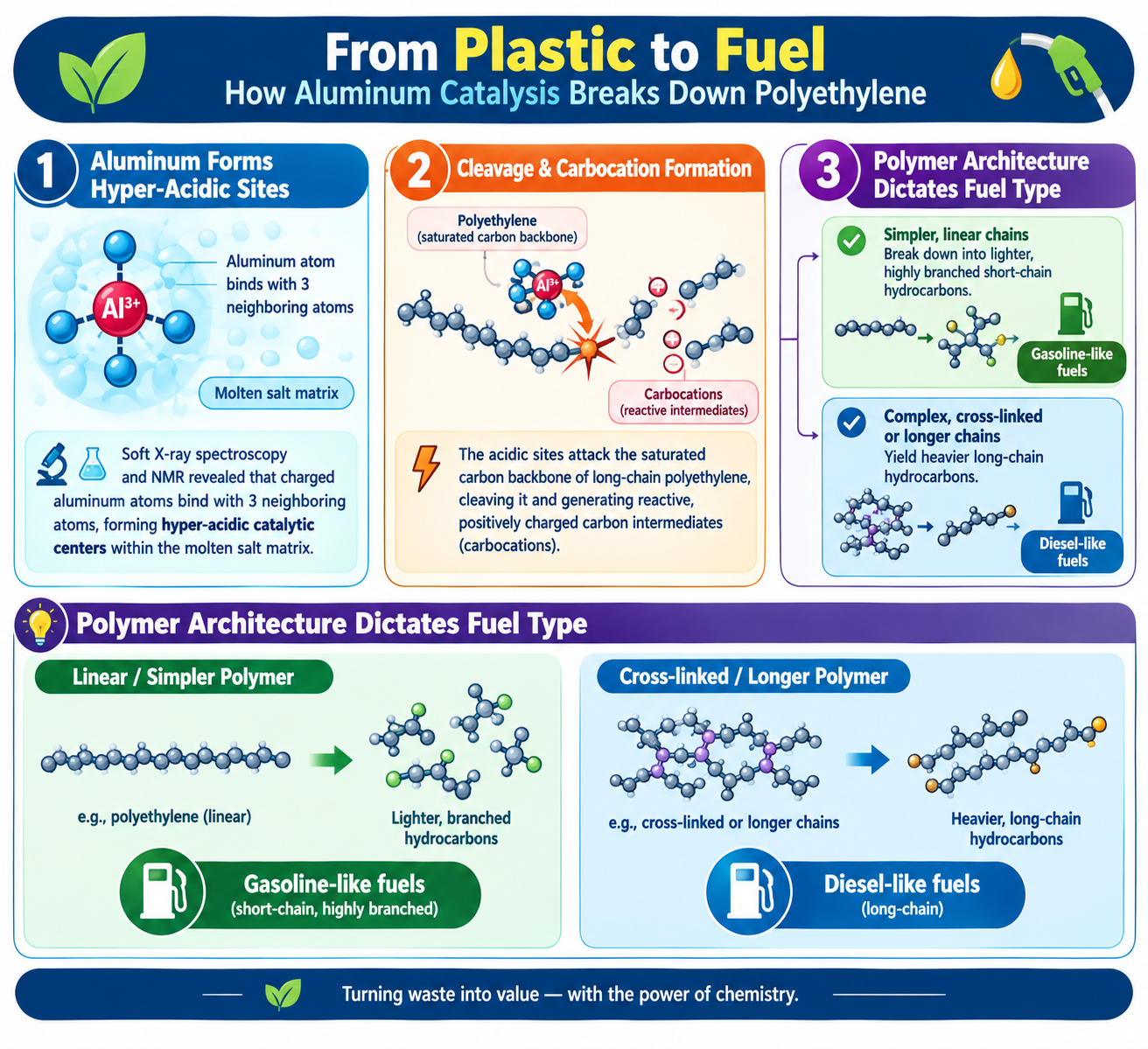
  • Soft X-ray spectroscopy and Nuclear Magnetic Resonance (NMR) revealed that charged aluminum atoms bind with 3 neighboring atoms, forming hyper-acidic catalytic centers within the molten salt matrix. 
  • The acidic sites attack the saturated carbon backbone of long-chain polyethylene, cleaving it and generating reactive, positively charged carbon intermediates (carbocations).
  • Polymer Architecture Dictates Fuel Type
    • Simpler, linear polymer chains selectively break down into lighter, highly branched short-chain hydrocarbons (gasoline-like fuels).
    • Complex, cross-linked, or longer polymer structures yield heavier long-chain hydrocarbons (diesel-like fuels).

Common Plastic into Fuels

Feature

Conventional Thermal Pyrolysis

ORNL Molten Salt Process (2026)

Operating Temperature

High (450C to 500C)

Low (<200C)

Reaction Medium

Thermal gas phase / vacuum

Inorganic molten salt matrix

Consumables / Additives

Requires noble metals (Pt, Pd) or external H2gas

No noble metals, external H2, or organic solvents

Yield & Selectivity

Broad mix of waxes, gases, and char; low liquid yield

~60% yield of gasoline- and diesel-range liquid fuels

Significance

  • Offers a viable pathway for upcycling low-value plastic waste into high-density energy resources rather than downcycling into inferior-quality plastic products.
  • Operating at sub-200C reduces the energy input required for plastic depolymerization, making industrial-scale plastic-to-fuel plants more economically viable.
  • Industrial scaling will depend on developing material confinement systems to prevent reactor corrosion from molten salts and simplify salt recovery and reuse.

Reference

Business Line | Common plastic into gasoline and diesel-like fuels



There are no reviews yet. Be the first one to review.

ARCHIVES

sidetext