Mains: GS I – World History
Why in News?
Commemorating the anniversary of the 1918 Battle of Haifa, fought on September 23.
What is the historical and tactical context of the Battle of Haifa (1918)?
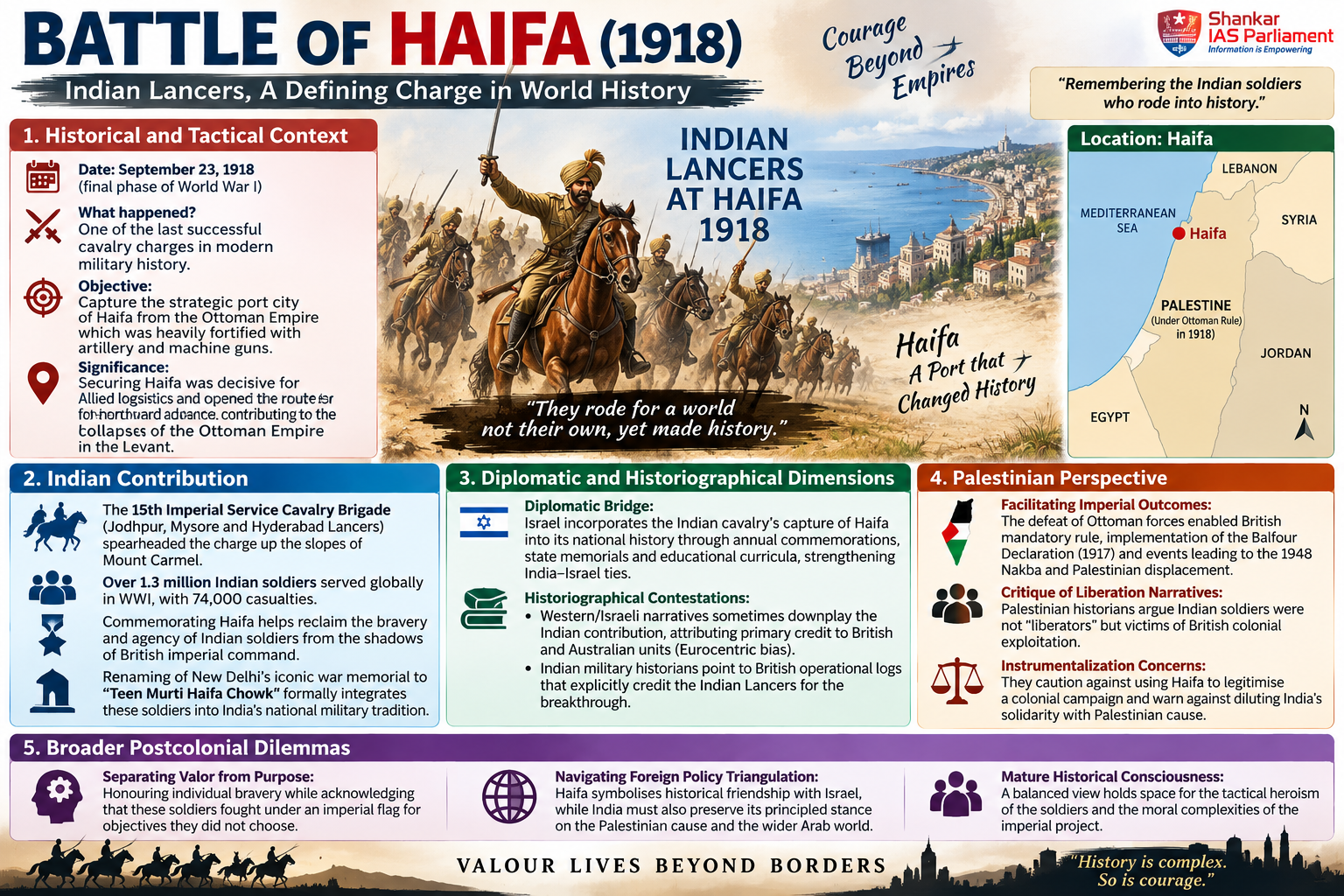
- The Military Engagement – Fought on September 23, 1918, during the final phase of World War I, the Battle of Haifa is celebrated as one of the last successful cavalry charges in modern military history.
- Indian Contribution – The 15th Imperial Service Cavalry Brigade comprising the Jodhpur, Mysore, and Hyderabad Lancers spearheaded a daring charge up the slopes of Mount Carmel against heavily fortified Ottoman artillery and machine gun positions to capture the strategic port city of Haifa.
- Operational Impact – British war diaries highlight that capturing Haifa was decisive in securing Allied logistics and opening the route for the northward advance to Damascus, contributing to the ultimate collapse of the Ottoman Empire in the Levant.
How does India use the memory of Haifa to reclaim postcolonial military agency?
- Historical Recovery – Over 1.3 million Indian soldiers served globally in WWI, with 74,000 casualties in an imperial war not of their making.
- Commemorating Haifa allows postcolonial India to reclaim these soldiers' bravery and agency from the shadows of British imperial command.
- Symbolic Institutional Recognition – The renaming of New Delhi’s iconic war memorial to "Teen Murti Haifa Chowk" formally integrates these colonial-era combatants into India's national military tradition.
- Demonstrating Global Footprint – It serves as a reminder that Indian troops shaped critical global geopolitical events long before India emerged as a sovereign republic.
What are the diplomatic and historiographical dimensions of the India-Israel relationship regarding Haifa?
- Diplomatic Bridge – Israel incorporates the Indian cavalry's capture of Haifa into its national history through annual civic commemorations, state memorials, and educational curricula, using it as a cornerstone of bilateral goodwill and strategic partnership.
- Historiographical Contestations –
- Western Eurocentric Bias – Some Western and Israeli historians downplay the Indian contribution, attributing primary credit to British and Australian units, a view influenced by Eurocentric biases regarding colonised non-European troops.
- Evidence from Archives – Indian military historians counter these claims by pointing directly to contemporary British operational logs that explicitly attribute the tactical breakthrough to the Indian Lancers.
Why does the Palestinian perspective view the Haifa commemoration with moral and political ambiguity?
- Facilitating Imperial Outcomes – The defeat of Ottoman forces secured British mandatory rule over Palestine, enabling the implementation of the Balfour Declaration (1917) and accelerating events that culminated in the 1948 Nakba (catastrophe) and Palestinian displacement.
- Critique of Liberation Narratives – Palestinian diplomats and historians argue that Indian soldiers were not "liberators" but victims of British colonial exploitation.
- From their perspective, celebrating the outcome implicitly legitimizes a colonial campaign that resulted in foreign rule and dispossession.
- Instrumentalization Concerns – Palestinian officials warn against contemporary efforts to link India's postcolonial identity with the foundational narrative of Israel, stressing that historical memory should not dilute India's historical solidarity with anti-colonial struggles.
What are the broader postcolonial dilemmas in commemorating colonial-era military history?
- Separating Valor from Purpose – Postcolonial nations face the structural dilemma of honouring individual bravery and human sacrifice while acknowledging that these soldiers fought under an imperial flag for political objectives they did not choose.
- Navigating Foreign Policy Triangulation – For modern Indian diplomacy, Haifa acts as a symbol of historical friendship with Israel, while simultaneously requiring careful navigation to preserve India's principled stance on the Palestinian cause and the wider Arab world.
- Mature Historical Consciousness – A balanced historical view avoids one-dimensional celebration, holding space for both the tactical heroism of the soldiers and the moral complexities of the imperial project.
Reference
The Hindu | Haifa



