Prelims: Current events of national importance | Ancient History
Why in News?
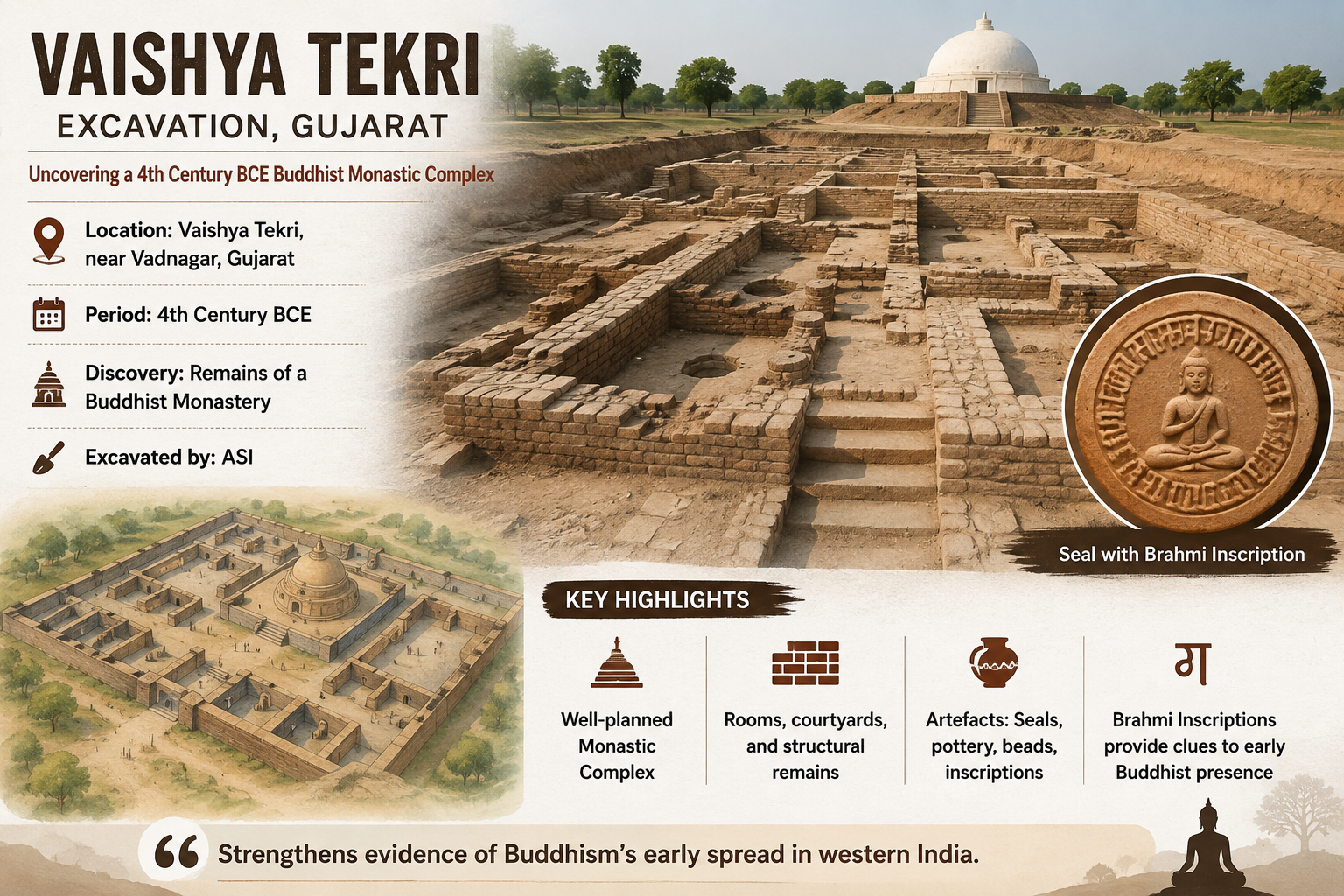
The Madhya Pradesh government, in collaboration with archaeological experts, has initiated fresh excavations at Vaishya Tekri in Ujjain to revive the study of Mauryan Emperor Ashoka.
Key Highlights of the Excavation
- The central mound at Vaishya Tekri measures roughly 350 feet at its base and nearly 100 feet in height, making it significantly larger than the Great Stupa at Sanchi (~54 feet).
- Earlier Findings (1938–39) - Excavated by the Archaeology Department of the erstwhile Gwalior State, the site yielded large-sized Mauryan bricks, punch-marked coins, and a cast Avanti coin.
- Engineering Techniques - The core was constructed using rammed blackish murum faced with brick masonry, built upon a unique bowl-shaped foundation to resist outward structural thrust.
- Surrounding Landscape - A square moat created by quarrying construction materials, as well as evidence of a western processional pathway for worshippers coming from ancient Ujjayini.
Historical Context
- Viceroyalty (Kumara) - Emperor Bindusara appointed Ashoka as the viceroy (Kumara) of Avanti with his administrative headquarters at Ujjain around 282 BCE.
- Epigraphic Support - Ashokan Rock Edicts explicitly mention a Kumara stationed at Ujjayini, confirming his administrative presence before he seized the Mauryan throne.
- Connection with Devi - While traveling from Pataliputra to Ujjain, Ashoka stopped at Vidisha and married Vedisadevi (Devi), the daughter of a prominent local merchant (Vaishya).
- Spread of Buddhism - Devi and Ashoka's children, Mahinda and Sanghamitta, played a pivotal role in propagating Theravada Buddhism to Sri Lanka.
- The mound's local name, Vaishya Tekri, stems from Devi’s merchant lineage.
Vaishya Tekri vs. Kumhar Tekri
- Vaishya Tekri - The primary and larger mound, traditionally linked to Devi and Buddhist monastic activity.
- Kumhar (Kumbhar) Tekri - A smaller nearby mound identified in local traditions and historical records.
- 7th-century Chinese scholar-pilgrim Xuanzang (Hsuan-tsang) noted in his travelogue that a stupa near Ujjain marked the site of a "hellish prison" or "hell" built by King Ashoka.
- Archaeological digs at Kumhar Tekri revealed a 3rd-century BCE burial-cum-cremation ground, matching Xuanzang's observations.
Revelation of the new excavation
- Stratigraphic Sequence - Establish exact construction phases and differentiate Mauryan core structures from later Sunga or Satavahana renovations.
- Monastic Landscape - Map surrounding structures such as viharas (monasteries), votive stupas, and residential quarters rather than treating the stupa as an isolated monument.
- Urban Dynamics- Provide insights into trade networks along the Shipra River connecting Ujjain with coastal ports like Bharuch (Broach) and Sopara.
Reference
The Indian Express | Tracing Ashoka in Ujjain



