Prelims: Current events of national and international importance | Science & Technology
Why in News?
An international team of scientists led by the University of Cambridge has unveiled the CosmoCube mission.
Aim - To observe the ~150-million-year period following the Big Bang but preceding the formation of the first stars ("Cosmic Dawn").
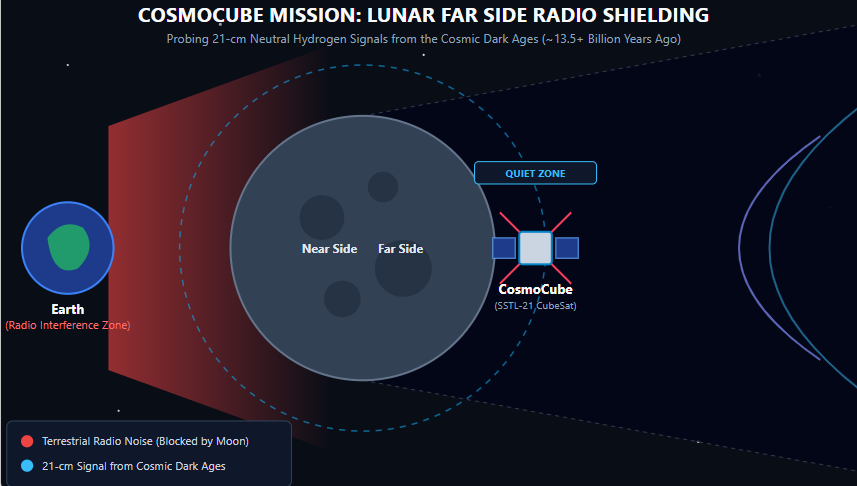
Orbit - The satellite will operate in lunar orbit, spending approximately 40 minutes behind the Moon's far side during every two-hour orbit.
The Moon acts as a natural physical shield against radio frequency interference (RFI) originating from Earth.
Target Signal - Designed to detect the extremely faint 21-cm hydrogen line emitted by neutral hydrogen atoms during the early universe.
Overcoming Earth Constraints - Low-frequency radio waves from the early universe are blocked by Earth's ionosphere and drowned out by terrestrial FM radio, telecommunications, and orbital satellites.
Observation Target – It aims to collect roughly 1,000 hours of pristine radio astronomical data from the quietest radio environment in the inner Solar System.
Scientific Significance
Probing Dark Matter - By measuring hydrogen gas behavior before star formation, the mission aims to reveal how dark matter's gravitational influence helped gather hydrogen together to trigger the birth of the first stars and galaxies.
Compact Architecture- Built using Surrey Space Technology Ltd’s (SSTL) compact 'SSTL-21' spacecraft platform, carrying miniature radiometers with RF Systems-on-Chip (RFSoC) technology.
Challenge - The mission highlights the urgency of radio astronomy on the lunar far side before increasing space traffic and lunar missions (such as NASA's Artemis program or ISRO's future lunar plans) create local radio noise.