|
One Liners 18-03-2026
|
|
Geography
|
|
Delhi Urban Flood Mitigation Program
- 6 Target Areas of the Plan
- Yamuna river flood mitigation.
- Drainage revitalisation.
- Decentralised wastewater and stormwater management.
- Low-lying area resilience.
- Urban water bodies restoration.
- Advance early warning and monitoring.
|
|
Polity & Governance
|
|
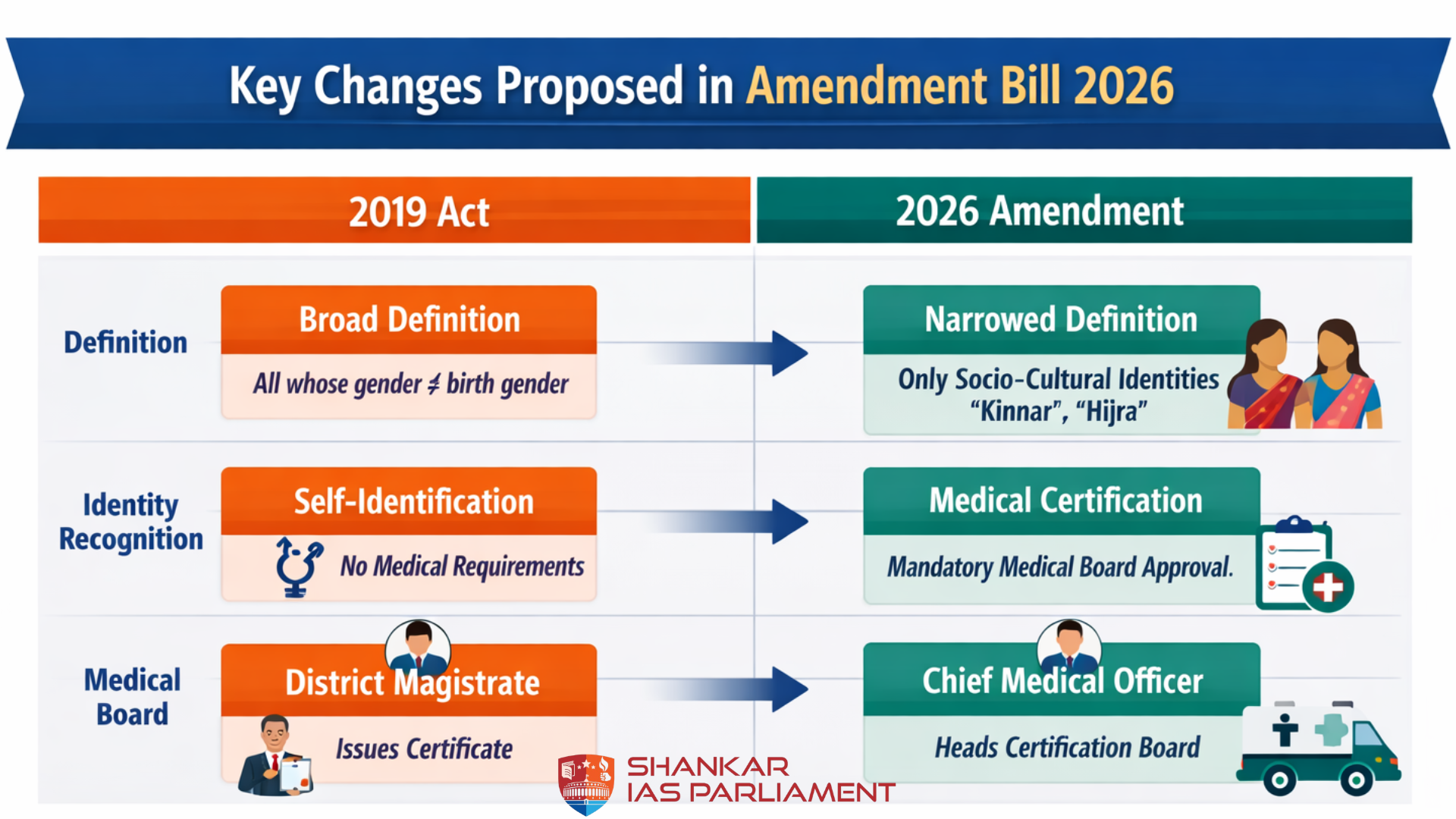
Transgender Protection (Amendment) Bill, 2026
|
|
International Relations and Issues
|
|
Black Sea Grain Initiative
EU foreign policy chief Kaja Kallas confirmed discussions with UN Secretary-General António Guterres on adapting the Black Sea Grain Initiative model to reopen the Strait of Hormuz.
- Launched in – July 2022.
- Brokered by – UN and Turkey in during the Russia–Ukraine war.
- Objective – To allowed safe passage of Ukrainian grain and fertilizer exports through the Black Sea despite the conflict.
- Impact – It helps to stabilize global food supplies and reduce price shocks, especially for developing countries dependent on imports.
- Collapse – Russia withdrew in July 2023, ending the deal.
- Significance – Though short-lived, it became a template for multilateral protection of trade corridors in conflict zones, proving cooperative frameworks can safeguard critical flows.
|
|
Economy
|
|
Supreme Court’s Nine-Judge Bench on “Industry” Definition
The Bench is revisiting the scope of “industry” under Section 2(j) of the repealed Industrial Disputes Act, 1947, despite its replacement by the Industrial Relations Code, 2020, because the definition has long shaped workers’ rights.
- 1978 Precedent – Bangalore Water Supply v. A. Rajappa expanded “industry” to hospitals, schools, municipalities via the “triple test.”
- Current Issue – Whether auxiliary services (e.g., a defence canteen) are “industrial” or “sovereign.”
- Sovereign Functions – Traditionally judiciary, defence, law and order, legislation; but boundaries are blurred—currency printing is sovereign, a mint is industrial; tourism once sovereign, now privatized.
- Implications – If welfare or auxiliary services are deemed industries, employees can access industrial tribunals; otherwise, they must seek remedies under writ jurisdiction.
|
|
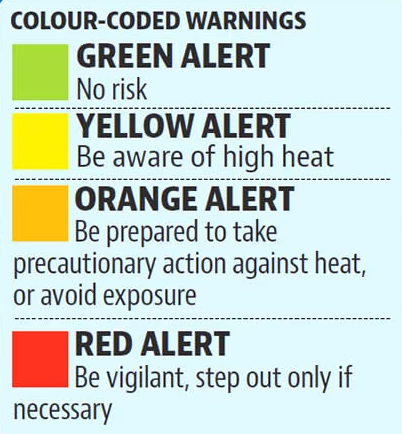
Triple Test
|
|
Agriculture
|
|
White Revolution 2.0
- Launched in – 2024 by the Ministry of Cooperation and the Ministry of Fisheries, Animal Husbandry & Dairying.
- Aim – To expand dairy cooperatives into uncovered Panchayats, boost employment, empower women, and increase milk procurement by 50% in five years.
- Key Points
- Scale – Target of 75,000 new dairy cooperative societies over five years.
- India’s position – Largest milk producer globally since 1998, contributing ~25% of world output.
- Productivity gains
- Overall cattle & buffalo productivity up 36.6% (2013–14 to 2024–25).
- Indigenous cattle productivity up 44.9%.
- Buffalo productivity up 25.8%.
- Growth rate – Milk production rising at 5.8% annually, validating schemes like NPDD and Rashtriya Gokul Mission.
- Digital systems – Automated Milk Collection Units ensure transparency, accurate testing, and direct farmer payments.
- Socio-economic impact
- 1.7 crore farmers are cooperative members, 38% women.
- Per capita milk availability: 485 g/day (above ICMR’s 300 ml/day).
- Cooperatives provide stable income, market access, and nutritional security.
|
|
Security
|
|
Indian Cyber Crime Coordination Centre (I4C)
Background
- Police & Public Order – State subjects under the Constitution;
- Enforcement handled by – State/UT Law Enforcement Agencies (LEAs).
- Central Role – Ministry of Home Affairs supplements with advisories, funding, and capacity building.
- I4C established in – 2018 as a scheme; became an Attached Office of MHA on 1 July 2024.
Key Initiatives & Achievements
- Citizen Financial Cyber Fraud Reporting & Management System (CFCFRMS)
- Launched in – 2021 for immediate reporting of financial fraud.
- Till Jan 31, 2026 – Rs.8,690 crore saved across 24.65 lakh complaints.
- Helpline 1930 operational.
- 12.94 lakh SIM cards & 3.03 lakh IMEIs blocked.
- Suspect Registry (2024)
- Collaboration with banks/financial institutions.
- Till Jan 2026 – 23.05 lakh suspect identifiers & 27.37 lakh mule accounts flagged.
- Prevented transactions worth Rs.9,518 crore.
- Samanvaya Platform
- MIS & data repository for LEAs.
- Provides analytics, interstate crime linkages, and techno-legal support.
- Module Pratibimb maps criminals & infrastructure.
- Led to 21,857 arrests and 1,49,636 investigation assistance requests.
- e-FIR System – Implemented in Delhi, Rajasthan, Chandigarh, Madhya Pradesh, Goa, and Uttarakhand for cyber fraud cases.
|
|
Science
|
|
Ayush Digital Health Infrastructure – A-HMIS & THERAN
- A-HMIS (Ayush Hospital Management Information System)
- A comprehensive IT platform developed under Ayush Grid.
- Objective – To manage healthcare delivery and patient care across Ayush facilities.
- It digitizes inventories and enables real-time tracking of medicine availability by doctors and pharmacists.
- THERAN (The Research Application Nexus)
- Originally developed by – Siddha Central Research Institute, Chennai, under the Central Council for Research in Siddha.
- Strategic decision – Ministry of Ayush decided to upscale and customize THERAN to serve as the unified HMIS solution across Ayush systems.
- It aligns with the operational and clinical requirements of Ayurveda, Siddha, Unani, and Homeopathy institutions.
|
|
Government Schemes
|
|
Ayushman Bharat – Pradhan Mantri Jan Arogya Yojana (AB‑PMJAY) Performance
- Key Statistics (as of Feb 28, 2026)
- Hospital admissions authorized – 11.69 crore
- Total cost sanctioned – Rs.1.73 lakh crore
- Admissions in last 2 years – 4.40 crore (showing rapid uptake).
- About the Scheme
- Launched in – 2018.
- Beneficiaries – Approximately 55 crore beneficiaries, representing the bottom 40 per cent of the population, making it the world’s largest government-funded health insurance program.
- Coverage – Rs.5 lakh per family per year for secondary & tertiary hospitalization.
- Implementing Agency – National Health Authority (NHA).
- Expansion (Budget 2024) – Extended to all citizens above 70 years, regardless of income.
|
|
Food Safety & Standards Authority of India (FSSAI)
Enforcement & Infrastructure
- Mandate – Lays down science-based food standards.
- Regulates manufacture, storage, distribution, sale, and import under the Food Safety and Standards Act, 2006.
- Shared responsibility
- FSSAI (Central) – Standards, coordination.
- State Food Safety Authorities – Enforcement at field level via Designated Officers (DOs) and Food Safety Officers (FSOs).
- Enforcement (2022–23 to 2024–25)
- Samples analyzed – 5,18,559
- Penalties imposed – 88,192
- Convictions secured – 3,614
- Licenses cancelled – 1,161
- Risk-Based Inspections – 56,259
|