Prelims: Current events of national and international importance | Science & Technology
Why in News?
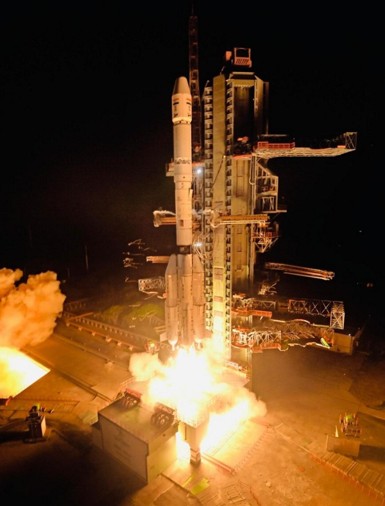
Recently, ISRO's NVS-03 (Next-Generation Navigation Satellite) has successfully reached its intended Geosynchronous Orbit (GSO).
Key Highlights
- Mission Profile & Vehicle- Originally launched aboard the GSLV-F18 rocket into an initial Geosynchronous Transfer Orbit (GTO) on October 30, 2026.
- The satellite was raised to its final orbit through 4 Liquid Apogee Motor (LAM) orbit-raising maneuvers.
- Constellation Augmentation - NVS-03 is the third spacecraft in the NVS series.
- It is designed to replace older, aging satellites and replenish the NavIC (Navigation with Indian Constellation / IRNSS) space segment.
- Indigenous Rubidium Atomic Clock- The satellite features an indigenously developed Rubidium Atomic Clock (by SAC, Ahmedabad).
- It mitigates past reliance on imported atomic clocks that had suffered high failure rates in early IRNSS satellites.
- L1 Band Signal Inclusion - In addition to the conventional L5 and S-bands, NVS-03 broadcasts in the interoperable L1 civil frequency band.
- It allows seamless integration into personal consumer electronics like smartphones, smartwatches, and vehicle telematics.
- Mass - ~2,250 kg
- Mission Life - ~12 years.
- Coverage Area - Indian landmass and an extended region up to 1,500 km beyond its boundaries.
NavIC (IRNSS)
- NavIC (Navigation with Indian Constellation, formerly IRNSS) is an independent regional satellite navigation system designed, built, and operated by ISRO.
- Constellation Architecture - Standard baseline architecture consists of 7 operational satellites (3 in Geostationary Orbit (GEO) and 4 in inclined Geosynchronous Orbit (GSO)) supported by a ground control network.
- Services Offered
- Standard Positioning Service (SPS) - Open to all civilian users (positioning accuracy <20 metres, timing accuracy <40 nanoseconds).
- Restricted Service (RS)- An encrypted signal intended exclusively for authorized strategic, defence, and security agencies.
- Global Recognition- Recognized by the International Maritime Organization (IMO) as a component of the World-Wide Radio Navigation System (WWRNS) for ocean navigation.
Reference
The Hindu | NVS-03 in geosynchronous orbit



