Prelims: Current events of national and international importance | Geography
Why in News?
A study led by researchers from IIT Kharagpur and IISER Kolkata analyzed a stalagmite recovered from Mawsmai Cave in Meghalaya to reconstruct approximately 6,000 years of monsoon dynamics in Northeast India.
Key Highlights
- Sample Analysis- Researchers analyzed an 11 cm-long stalagmite collected from a chamber roughly 300 metres inside Mawsmai Cave (East Khasi Hills district), where relative humidity stays above 95%.
- Early Holocene Wet Phase - Stable oxygen isotope (δ18O) analysis indicated significantly stronger monsoon rainfall during the Early Holocene.
- Gradual Monsoonal Decline - The study revealed a progressive decline in Indian Summer Monsoon (ISM) strength starting around 7,700 years before present, indicating a long-term drying trend.
- Cyclical Climate Drivers - The stalagmite records uncovered recurring wet-and-dry climate cycles occurring at intervals of approximately 110 and 118 years.
- It links regional Indian rainfall changes to global solar variability and broader ocean-atmosphere atmospheric oscillations.
Speleothems (Stalagmites & Stalactites)
- Secondary mineral deposits formed in limestone caves.
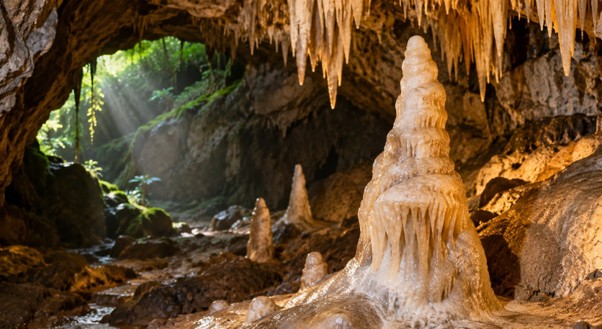
- Stalagmites grow upward from the cave floor from mineral-rich water drippings, acting as natural climate archives or "paleoclimate proxies".
- As rainwater seeps through overlying soil and limestone, its oxygen isotope composition reflects past surface temperature and total precipitation levels.
- Stalactites are icicle-shaped mineral formations that hang downward from the ceilings of caves, hot springs, or man-made structures like concrete bridges.
Relevance of Meghalaya Caves in Paleoclimatology
- The Meghalayan Age - The current geological age (the late stage of the Holocene, starting ~4,200 years ago) was formally named after a mega-drought event preserved in a stalagmite from Mawmluh Cave in Meghalaya.
- Karst Topography - The Khasi, Jaintia, and Garo hills feature extensive soluble limestone bedrock, creating one of Asia's densest karst networks and rich natural palaeoclimate libraries.
Reference
DD News | Meghalaya cave stalagmite



