Prelims: Current events of national and international importance | International Relations
Why in News?
India has prioritised Artificial Intelligence (AI) and Maritime Security in its bid for a non-permanent seat on the United Nations Security Council (UNSC) for the 2028–29 term.
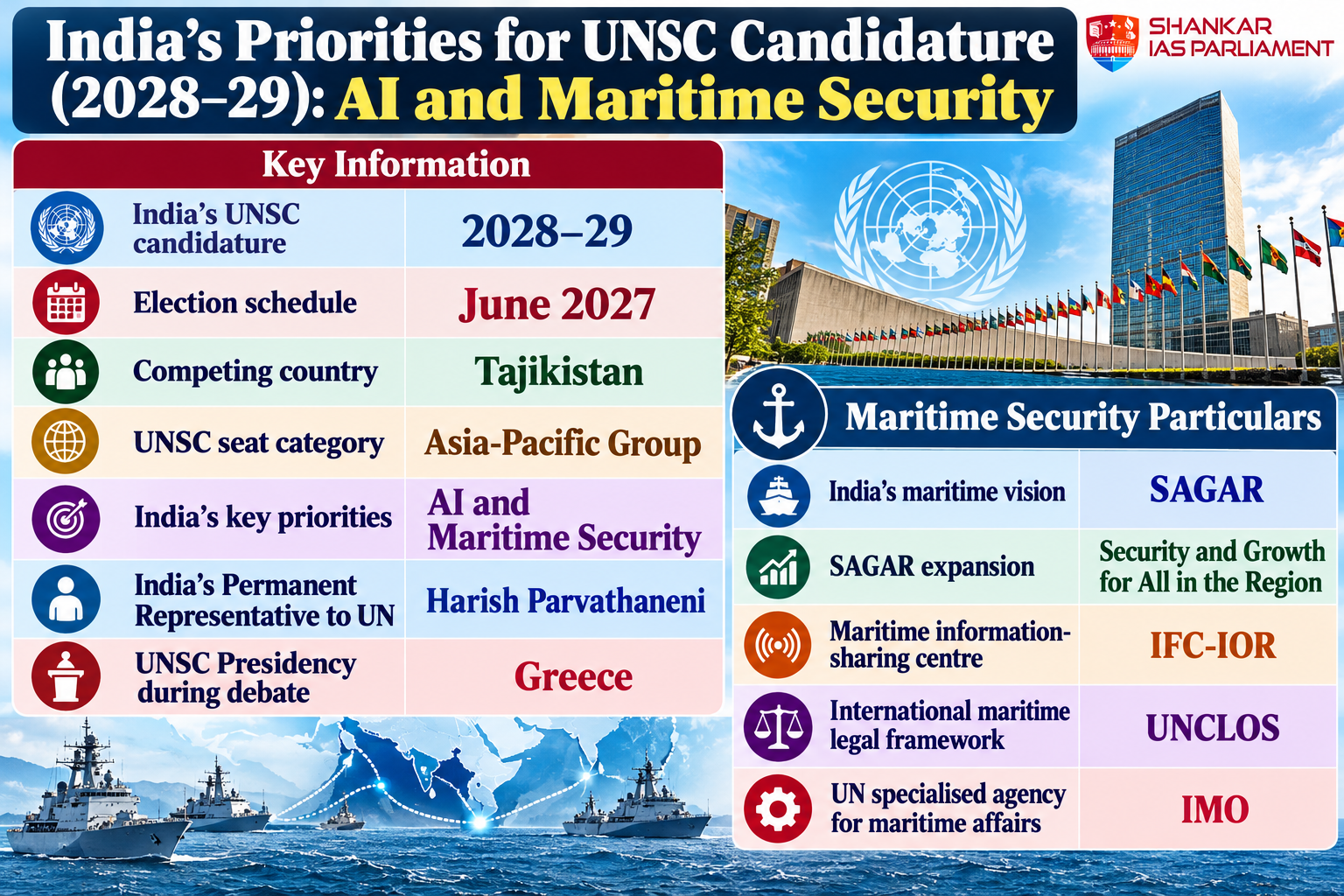
- India's Permanent Representative to the UN, Ambassador Harish Parvathaneni, emphasised these priorities at the UNSC high-level open debate on Emerging Technologies and Maritime Security: Implications for Peace and Security, held on October 29, 2026.
- The debate was held under the Greek Presidency of the UNSC.
|
India’s Candidature for the United Nations Security Council (2028–29)
|
- India has formally announced its candidature for a non-permanent seat on the United Nations Security Council (UNSC) for the 2028–29 term.
- The elections for the non-permanent seat are scheduled to take place in June 2027.
- According to the report, India and Tajikistan will compete for the single seat allocated to the Asia-Pacific Group category.
|
Key Priorities Identified by India
- Maritime Security
- Safeguarding the freedom of navigation and ensuring unimpeded lawful maritime commerce.
- Ensuring the safety and security of all seafarers.
- Protecting critical maritime infrastructure as well as global supply chains.
- Strengthening international cooperation to effectively address maritime threats.
- Significance – Oceans facilitate economic connectivity and underpin global commerce.
- Maritime security is essential for:
- International trade and economic connectivity.
- Food and energy security.
- Livelihoods of coastal communities.
- International peace and prosperity.
- Artificial Intelligence and Emerging Technologies
- India emphasized the transformative role of emerging technologies in enhancing maritime security.
|
Technology
|
Applications
|
|
Artificial Intelligence (AI)
|
Analysis of maritime data and detection of suspicious activities
|
|
Autonomous Systems
|
Automated maritime surveillance and operations
|
|
Satellite-based Surveillance
|
Monitoring maritime movements and activities
|
|
Advanced Cyber Capabilities
|
Strengthening maritime infrastructure security
|
India's Initiatives for Maritime Security
- Information Fusion Centre – Indian Ocean Region (IFC-IOR)
- The centre is located near New Delhi.
- The centre highlights the importance of international cooperation and information sharing for maritime security.
- It enhances maritime domain awareness by facilitating information exchange and coordination.
- SAGAR Initiative
- Full form: Security and Growth for All in the Region.
- The initiative reflects India’s vision for inclusive maritime cooperation in the Indian Ocean Region.
- It emphasises regional security, cooperation, and sustainable development.
International Legal and Institutional Framework
- United Nations Convention on the Law of the Sea (UNCLOS)
- It provides the international legal framework governing the use of oceans and their resources.
- It establishes rules for maritime zones, navigation, and the rights and responsibilities of States.
- UN Charter
- It provides the broader framework for maintaining international peace and security.
- India emphasised that emerging technologies should be governed in accordance with the UN Charter and international law.
- International Maritime Organization (IMO)
- It is a specialised agency of the United Nations.
- It is responsible for improving the safety and security of international shipping and preventing marine pollution from ships.
- India called for strengthening the work of the IMO and other relevant institutions, rather than duplicating their mandates.
- Role of UNSC
- Should focus on technological developments having demonstrable implications for international peace and security.
- It should encourage:
- Practical international cooperation.
- Confidence-building measures.
- Resilience of maritime infrastructure.
Reference
The Hindu | India’s Priorities for UNSC Candidature (2028–29): AI and Maritime Security



