Prelims: Current events of national and international importance | Geography
Why in News?
A recent major study warns that the Hindu Kush-Himalaya (HKH) region is approaching a critical ecological tipping point.
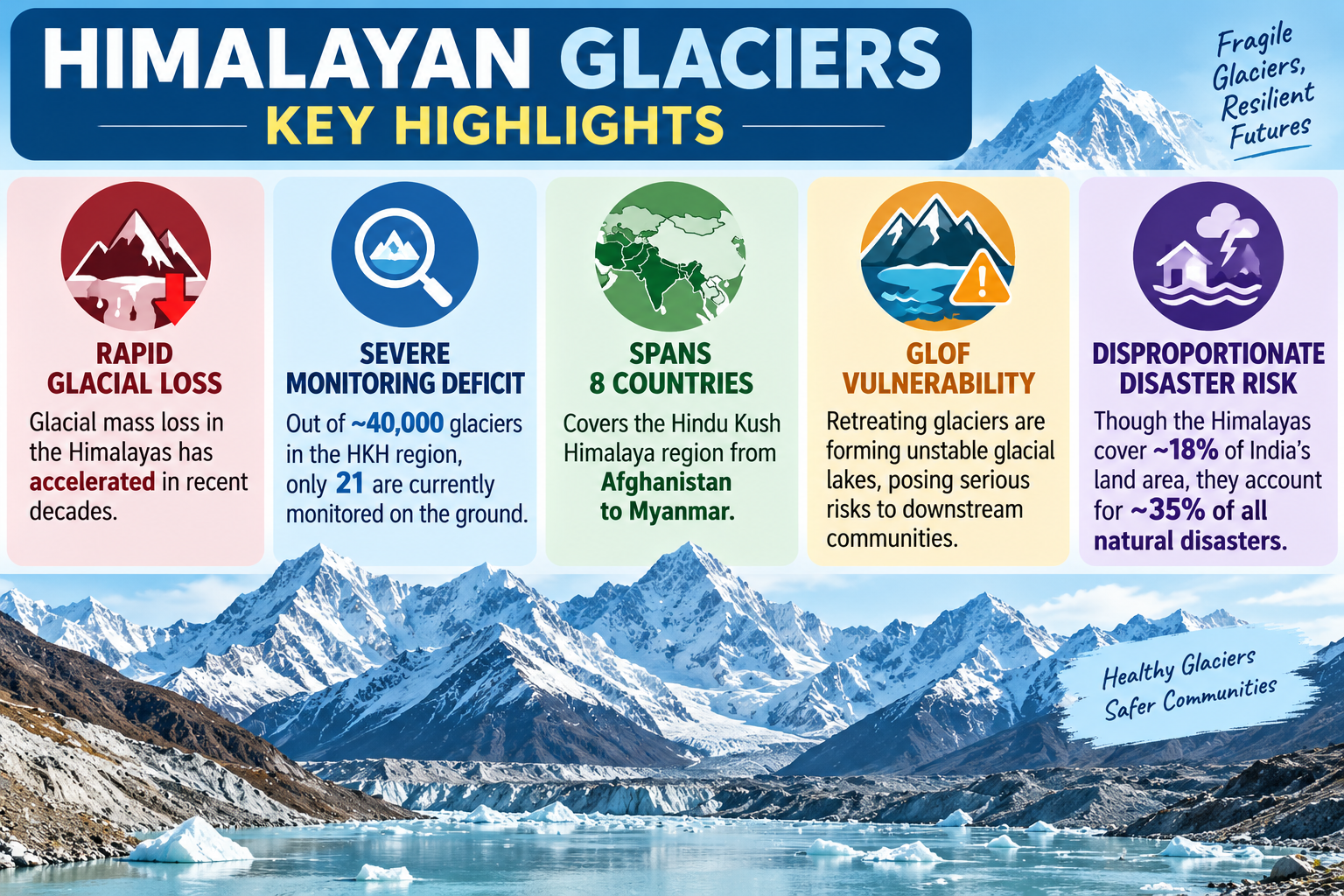
Key Highlights
- Glacial Loss- Glacial mass loss in the Himalayas has accelerated drastically over recent decades compared to prior baseline studies.
- Severe Monitoring Deficit - Out of an estimated 40,000 glaciers across the HKH region only 21 glaciers are currently monitored on the ground.
- It spans across 8 countries from Afghanistan to Myanmar.
- Glacial Lake Outburst Flood (GLOF) Vulnerability - Retreating glaciers are leaving behind highly unstable glacial lakes held back by loose moraine debris and ice, posing extreme risks to downstream communities.
- Proportionate Disaster Vulnerability - While the Himalayan region accounts for roughly 18% of India's geographical landmass, it accounts for ~35% of all natural disasters in the country.
Peak water represents the point in time when annual river runoff driven by accelerating glacial melt reaches its absolute maximum before experiencing an irreversible, long-term decline.
- Mid-Century Threshold - The study projects that major Himalayan-fed river systems will reach peak water by mid-century (around 2050), after which seasonal river flows will drop sharply during non-monsoon dry seasons.
- Macroeconomic Threat - The Himalayan cryosphere directly underpins over 20% of India's Gross Domestic Product (GDP) supporting agriculture, hydropower, heavy industry, and municipal drinking water for over 1.3 billion downstream populations.
- Yet, approaching peak water poses a direct threat to national economic stability.
Significance
- Highlights the need to reclassify the Himalayan ecosystem as critical national infrastructure requiring dedicated budget allocations, regional risk mitigation, and climate adaptation strategies.
- Demands a rapid expansion of ground-based glaciological research stations beyond the current 21 monitored sites to improve early warning systems for GLOFs, landslides, and flash floods.
- Underscores that because the HKH region spans eight sovereign nations, regional risk reduction requires synchronized, cross-border real-time hydrological data sharing and joint disaster response frameworks.
Reference
The Hindu | Himalaya approaching tipping point



