0.1022
7667766266
x

Animal Diplomacy

iasparliament Logo
October 05, 2026

Mains: GS II – Bilateral Relations

Why in News?

Recently, China agreed to loan two giant pandas (named Ping Ping and Fu Shuang) to Zoo Atlanta in Georgia.

What is Animal Diplomacy and how has it evolved historically?

  • Definition — The strategic use of living fauna both endemic and rare species as state gifts, scientific loans, or symbolic instruments in international relations to build goodwill and project soft power.
  • Ancient and Medieval Precedents —
  • Mediterranean and Abbasid Era — Cleopatra’s gift of a giraffe ("cameleopard") to Julius Caesar; Caliph Harun al-Rashid’s gifting of the elephant Abul-Abbas to Charlemagne in 802 CE.
  • Eurasian Exchanges — Russian tsars exchanging polar bears with European monarchs in the 1600s to demonstrate status and logistical capability.
  • Modern Institutionalization — Transitioned from unilateral imperial gifts to structured, media-centric public diplomacy (e.g., Australia’s WWII platypus diplomacy, China’s post-1970s Giant Panda leasing framework).

What is India’s historical and contemporary engagement with Animal Diplomacy?

Historical Era

Milestone

Strategic and Cultural Significance

Medieval Transit (1414)

Malindi (Kenya) envoys gifting a giraffe to Ming Admiral Zheng He in Bengal.

Highlighted Bengal's role as a major Indian Ocean maritime trade hub.

Early Modern (1515)

Sultan of Gujarat gifting a one-horned rhinoceros to King Manuel I of Portugal.

Inspired Albrecht Dürer’s iconic woodcut, introducing Indian fauna to European art.

Mughal Era (1600s)

Emperor Jahangir acquiring exotic species (e.g., North American turkey) via Portuguese Goa.

Demonstrated royal interest in natural history and global trade networks.

Post-Independence

PM Nehru gifting Asian elephants (e.g., Indira to Japan, USSR, China, USA).

Post-war soft power projection and building people-to-people ties with children globally.

Contemporary (2020s)

Transcontinental translocation under Project Cheetah (Namibia, South Africa, Botswana) and Gifting peacocks to UN Geneva (2026).

Repositioning India as a global leader in ecological restoration and biodiversity stewardship.


What is the strategic value of Animal Diplomacy?
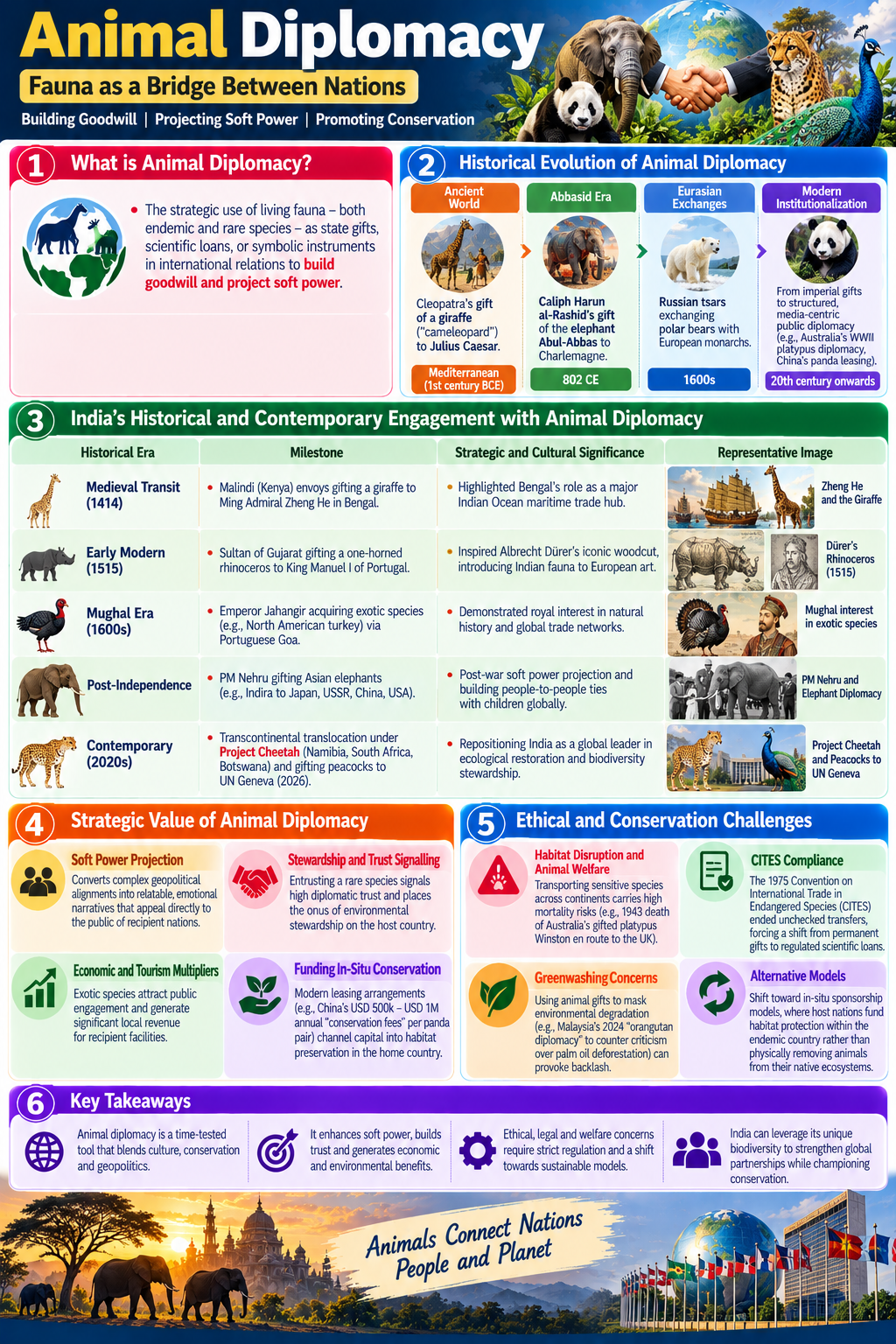
  • Soft Power Projection — Converts complex geopolitical alignments into relatable, emotional narratives that appeal directly to the public of recipient nations.
  • Stewardship and Trust Signalling — Entrusting a rare or endemic species signals high diplomatic trust and places the onus of environmental stewardship on the host country.
  • Economic and Tourism Multipliers — Exotic species serve as major attractions for recipient facilities, generating significant public engagement and local revenue.
  • Funding In-Situ Conservation — Modern leasing arrangements (e.g., China’s USD 500k – USD 1M annual "conservation fees" per panda pair) channel capital directly into habitat preservation and captive breeding in the home country.

Animal Diplomacy

What are the ethical and conservation challenges?

  • Habitat Disruption and Animal Welfare — Transporting sensitive species across continents carries high mortality risks (e.g., the 1943 death of Australia's gifted platypus Winston en route to the UK).
  • CITES Compliance — The 1975 Convention on International Trade in Endangered Species (CITES) ended unchecked transfers of wild fauna, forcing a shift from permanent state gifts to regulated scientific loans.
  • Greenwashing Concerns — Attempting to use animal gifts to mask environmental degradation—such as Malaysia's initial 2024 "orangutan diplomacy" to counter criticism over palm oil deforestation—can provoke backlash from conservation bodies.
  • Alternative Models — Shift toward in-situ sponsorship models, where host nations fund habitat protection within the endemic country rather than physically removing animals from their native ecosystems.

Reference

Indian Express | Animal Diplomacy

There are no reviews yet. Be the first one to review.

ARCHIVES

sidetext


