XPoSat
The X-Ray Polarimeter Satellite (XPoSat) that is scheduled to be launched later this year by the Indian Space Research Organisation (ISRO).
- The X-Ray Polarimeter Satellite (XPoSat) is being built in collaboration with the Raman Research Institute (RRI), Bengaluru.
- XPoSat will study various dynamics of bright astronomical X-ray sources in extreme conditions.
- India’s first, and only the world’s second polarimetry mission.
- It is meant to study various dynamics of bright astronomical X-ray sources in extreme conditions.
- IXPE - The first polarimetry mission is NASA’s Imaging X-ray Polarimetry Explorer (IXPE) that was launched in 2021.
- Payloads - The spacecraft will carry two scientific payloads in a low earth orbit.
- Primary payload POLIX
- XSPECT
- POLIX (Polarimeter Instrument in X-rays) is being developed by RRI in collaboration with ISRO’s U.R.Rao Satellite Centre (URSC) in Bengaluru.
- POLIX will measure the polarimetry parameters (degree and angle of polarisation).
- The XSPECT (X-ray Spectroscopy and Timing) payload will give spectroscopic information.
- It would observe several types of sources, such as X-ray pulsars, blackhole binaries, low-magnetic field neutron star, etc.
X-rays have much higher energy and much shorter wavelengths, between 0.03 and 3 nanometers.
References
- IE - What is XPoSat, India’s first polarimetry mission?
- ISRO - XPoSat
Pygmy Hogs
The conservation of pygmy hogs is crucial to India’s wildlife protection goals.
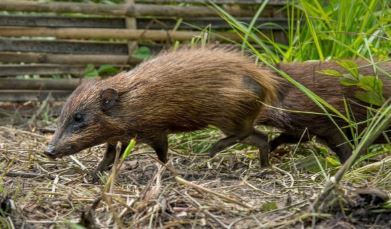
- Pygmy hogs are smallest and rarest wild piggy.
- Their skin is dark brownish-black in colour and their hair is dark.
- Distribution - Native to alluvial grasslands in the foothills of the Himalayas.
- Once found all the way from Uttar Pradesh to Assam, but vanished by the early 1960s.
- Now their population is confined to Assam and southern Bhutan.
- Diet - They are omnivores and feed on roots, tubers, insects, rodents, and small reptiles.
- Significance - they are an indicator species. They live only in the wet high grasslands at the foothills of the Himalayas.
- Their presence ensures a healthy habitat for other rarities such as the one-horned rhinoceros, hog deer, Eastern barasingha, tiger, water buffalo, lesser florican and the hispid hare.
- Threats - loss and degradation of habitat due to agricultural encroachments, human settlements, livestock grazing, etc.
- Conservation Status
- IUCN - Endangered
- CITES - Appendix 1
- Conservation Efforts - Pygmy Hog Conservation Programme in 1995
References
- IE - Why the conservation of pygmy hogs is crucial to India?
- Animalia - Pygmy Hog
- IUCN - Pygmy Hog
NHRC and Paris Principles
An organisation affiliated to the UN High Commissioner for Human Rights has deferred re-accreditation of the National Human Rights Commission (NHRC) of India for a year.
- The Global Alliance for National Human Rights Institutions’ (GANHRI) Sub Committee on Accreditation (SCA) deferred re-accreditation to NHRC for the second time.
- The first such instance was in 2016 and accreditation was restored in 2017.
- Significance of Accreditation - Without the accreditation, NHRC will be unable to represent India at the UN Human Rights Council.
- NHRC - The National Human Rights Commission (NHRC) of India was established on 12 October, 1993.
- It is a statutory body under the Protection of Human Rights Act (PHRA), 1993.
- The statute was amended by the Protection of Human Rights (Amendment) Act, 2006.
- NHRC is in conformity with the Paris Principles.
- The NHRC is an embodiment of India’s concern for the promotion and protection of human rights.
- Paris Principles - Officially known as ‘Principles Relating to the Status of National Human Rights Institutions’.
- The Paris Principles set out the minimum standards that NHRIs must meet in order to be considered credible and to operate effectively.
- The key pillars of the Paris Principles are pluralism, independence and effectiveness.
- Paris Principles was adopted Paris in October 1991, and adopted by the General Assembly of the United Nations in 1993.
- Paris Principles are a crucial step in development of standards for national human rights institutions across the world.
- The six principles require a country‘s human rights agency to be independent from the government in its structure, composition, decision-making and method of operation.

References
- IE - Global agency affiliated to GANHRI defers NHRC accreditation
- GANHRI - Paris Principles
WTO Appellate Body Division
India has appealed against a ruling of the World Trade Organization's (WTO) trade dispute settlement panel in the Appellate Body.
- The World Trade Organization's (WTO) trade dispute settlement panel ruled that India’s import duties on certain information and technology products are inconsistent with the global trade norms.
- India has appealed against it ruling in the Appellate body of WTO.
- The Appellate Body was established in 1995.
- It is a standing body of seven persons that hears appeals from reports issued by panels in disputes brought by WTO Members.
- The Appellate Body can uphold, modify or reverse the legal findings and conclusions of a panel.
- Appellate Body Reports are adopted by the Dispute Settlement Body (DSB) unless all members decide not to do so.
- The Appellate Body has its seat in Geneva, Switzerland.
- Currently, the Appellate Body is unable to review appeals given its ongoing vacancies.
- The term of the last sitting Appellate Body member expired on 30 November 2020.
References
- The Hindu - India challenges WTO panel ruling
- WTO - Appellate Body
Community-based initiative for Hornbills
A community-based conservation initiative, involving the Kadar tribal community, has restored the dwindling hornbill population.
- Initiative - The Hornbill nest tree monitoring programme was started in 2005 to address the declining hornbill population and restore their vanishing nesting habitat
- It involved the Kadars, an indigenous community, in the Vazhachal forest division.
- The programme had technical support of the Western Ghats Hornbill Foundation for the conservation processes.
- The Athirappilly - Vazhachal areas is the only location where all the four south Indian species of hornbills are seen.
- The Great Hornbill (the State bird of Kerala)
- Malabar Pied Hornbill
- Malabar Grey Hornbill
- Indian Grey Hornbill
Kadar Tribal Community
- Kadar, small tribe of southern India residing along the hilly border between Cochin in Kerala and Coimbatore in Tamil Nadu.
- Kadar live in the forests and do not practice agriculture.
- They are specialized collectors of honey, wax, sago, cardamom, ginger.
References
- The Hindu - How a community-based initiative restored dwindling hornbill population in Western Ghats
- Britannica - Kadar



