River Kolak
Kolak fisherfolk living along the banks of River Kolak is in distress as chemicals from Vapi industries destroy river catch.
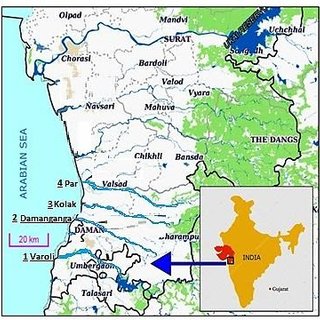
- Kolak River is a river in Gujarat in western India.
- The west flowing river originates is Kaprada taluka.
- Kolak River flows into the Arabian Sea near Udwada.
- Its basin has a maximum length of 50 km.
- It is also connected to Madhuban reservoir of Damanganga River.
- It flows through the north side of Vapi city in Gujarat.
- Kolak village on the bank of River Kolak in Gujarat’s Valsad district.
- The village is home to 4,646 people, most of whom rely on fishing for their livelihood.
- The effluent discharge from Vapi’s industries is causing pollution of the river.
References
- DTE - Critically polluted River Kolak: Kolak fisherfolk in distress
Da Vinci glow
The experts predicted that a ‘da Vinci glow’ would be visible around the new moon on May 19, 2023.
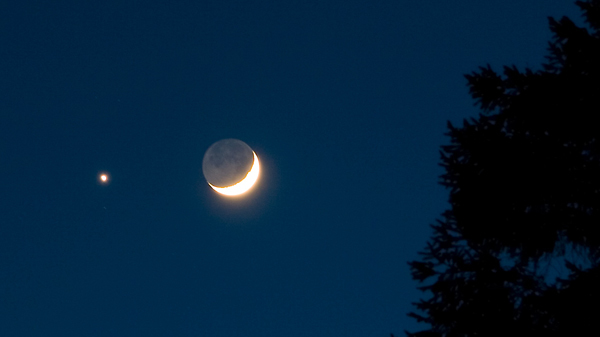
- The da Vinci glow is a phenomenon in which the crescent moon is on the horizon, but the outline of a full moon is visible.
- The phenomenon usually happens close to sunset.
- On some days, this happens after the sun sets, and the sky is dark but not completely dark.
- This glow is also called earthshine, since it occurs due to light reflected from the earth and not the sun.
- The earthshine is the sunlight first reflected by the earth’s surface, and then it’s reflected by the moon before it reaches our eyes.
- Since it is reflected twice, it is dimmer than the visible part of the moon and thus appears as a faint glow, called the da Vinci glow.
- Earth's clouds are the primary source of this earthshine.
According to NASA, earthshine makes night on the moon 50-times brighter than a full-moon night on the earth.
- Leonardo da Vinci (1452-1519) was the first person to describe the phenomenon in the 16th century and it was named after him.
- Before da Vinci’s theory, the ‘ashen glow’ of the moon was often called the ‘old moon in the new moon’s arms’.
References
- The Hindu - What is da Vinci glow?
- CNN - When can you see the moon in the Da Vinci glow
- NASA - The Da Vinci Glow
Dag Hammarskjold Medal
Three Indian U.N. peacekeepers will be honoured posthumously with the Dag Hammarskjold Medal for their supreme sacrifice in the line of duty.
- The Security Council established the United Nations Dag Hammarskjöld Medal as a posthumous award to members of peacekeeping operations.
- The medal is a tribute to the sacrifice of those who have lost their life as a result of service in peacekeeping operations of UN.
- In 1997, on the occasion of the 50th anniversary of peacekeeping, the Security Council held a meeting to honour United Nations peacekeepers.
- The medal is the highest honour awarded to U.N. Peacekeepers.
- In 1998, the first Medal was presented to the family of Dag Hammarskjöld.
- The second medal honoured Commandant René de Labarrière, who was the first peacekeeper to lose his life in a United Nations peacekeeping operation, in 1948.
- The International day of UN Peacekeepers is observed every year on 29 May.
- Each year on Peacekeeper's Day, this medal is awarded at a ceremony at UN headquarters.
- Other Awards given on Peacekeeper’s day
- Captain Mbaye Diagne Medal for Exceptional Courage
- UN Military Gender Advocate of the Year Award
Dag Hammarskjöld was a Swedish economist and diplomat who served as the second Secretary-General of the United Nations (1953-1961)
- 2023 peacekeeper’s day marks the 75th anniversary of the UN Peacekeeping Mission.
- The three Indian U.N. peacekeepers will be honoured posthumously with the Dag Hammarskjold Medal this year. They are,
- Border Security Force (BSF) personnel Head Constables Shishupal Singh and Samwali Ram Vishnoi served with the Organisation Stabilisation Mission in the Democratic Republic of the Congo.
- Shaber Taher Ali was employed in a civilian capacity with the U.N. Assistance Mission for Iraq.
Similar Topics - Women U.N. Peacekeepers, Group of Friends, UN Peacekeeping Missions and Blue Helmets
References
- The Hindu - Indian peacekeepers to be honoured with Dag Hammarskjold medal
- UN - Peacekeeper's Awards
NITI Aayog's Health Index
NITI Aayog’s annual ‘health index’ for the COVID year of 2020-21 was released.
- The annual health index was launched by the NITI Aayog in 2017.
- The Health Index is a weighted composite index based on 24 indicators grouped under the domains of ‘health outcomes’, ‘governance and information’, and ‘key inputs/ processes’.
- The health index measures the performance of states and UTs on a weighted composite score on 2 parameters –
- Incremental performance (year-on-year progress)
- Overall performance.
- The states and UTs are categorised separately as ‘larger states’, ‘smaller states’ and UTs and they are then ranked based on their scores.
- The fifth health index (2020-21) report has not been made public yet.
- COVID year 2020-21 assessment report
|
Category
|
Top Performers
|
Bottom Performers
|
|
Larger States (19)
|
Kerala (1st)
|
Bihar (19th)
|
|
Tamil Nadu (2nd)
|
Uttar Pradesh (18th)
|
|
Telangana (3rd)
|
Madhya Pradesh (17th)
|
|
Smaller States (8)
|
Tripura (1st)
|
Arunachal Pradesh (6th)
|
|
Sikkim (2nd)
|
Nagaland (7th)
|
|
Goa (3rd)
|
Manipur (8th)
|
|
Incremental Performance
|
Rajasthan
|
|
|
Uttarakhand
|
-
|
|
Odisha
|
|
|
UTs (8)
|
Lakshadweep
|
Delhi
|
References
- IE - NITI Aayog's Annual Health Index for 2020-21
- NITI Aayog - Health Index
Global Greenhouse Gas Watch (G3W)
The World Meteorological Congress has approved a new greenhouse gas (GHG) monitoring initiative in a landmark decision.
- Global Greenhouse Gas Watch (G3W) is an initiative coordinated by World Meteorological Organisation (WMO).
- G3W aims to establish internationally coordinated monitoring of greenhouse gas fluxes (top-down) to support the provision of the UNFCCC parties and other stakeholders.
- The new global GHG watch will fill critical information gaps and provide an integrated and operational framework.
- The framework will bring all space-based and surface-based observing systems, as well as modelling and data assimilation capabilities, under one roof.
- Components - There are 4 main components of G3W
- Surface-based and satellite- based observations.
- Prior observations.
- Near-real time international exchange of input and output data.
- Global high-resolution modelling/data assimilation.
- Output - The system will provide sustained delivery of monthly global estimates of net GHG fluxes into and out of the atmosphere at a 100 by 100 km resolution.
- Benefits - Improved evaluation of sources and sinks of greenhouse gases.
- Indicate their association with the biosphere, the ocean and the permafrost areas.
References
- DTE - WMO approves a global tracker for greenhouse gas emissions
- WMO - Global Greenhouse Gas Watch (GGGW)



