Constitution Literate District
Kollam in Kerala is India’s first Constitution literate district.
- The Citizen is a Constitution literacy campaign jointly launched by the Kollam district panchayat, District Planning Committee and the Kerala Institute of Local Administration (KILA).
- The ambitious campaign involved 2,200 trainers called ‘senators’.
- The senators visited schools, offices, auto stands and tribal councils to spread awareness.
- Around 16.3 lakh people in the district above the age of 10 have been educated on various aspects of the Constitution.
- The Preamble of the Constitution has been distributed in all households and installed at schools and institutions.
- Kollam will be officially declared India’s first Constitution literate district by Chief Minister of Kerala.
References
- The Hindu - India’s first Constitution literate district
Sovereign Green Bonds
The Reserve Bank of India (RBI) will auction maiden tranche of sovereign green bonds (SGrB) worth Rs 8,000 crore.
- In the Union Budget 2022-2023, the government had announced the sale of green bonds as part of its market borrowing, for the first time.
- The proceeds would be deposited to the Consolidated Fund of India (CFI) in line with the regular treasury policy.
- Then deployed in public sector projects that help reduce the carbon footprint of the economy.
- The government will use the proceeds raised from SGrBs to finance or refinance expenditure (in parts or whole) for various green projects.
- The framework for the sovereign green bond was issued by the government in November 2022.
- The RBI is auctioning 2 green bonds worth Rs 4,000 crore each.
- New GOI SGrB 2028 with tenure of 5 and
- New GOI SGrB 2033 with tenure of 10 years.
|
Green bonds are bonds issued by any sovereign entity, inter-governmental groups or alliances and corporates with the aim that the proceeds of the bonds are utilised for projects classified as environmentally sustainable.
|
- Significance - An important financial instrument to deal with the threats of climate change and related challenges.
- Makes environmental projects connect with capital markets and investors and channel capital towards sustainable development.
- Foreign Investment - The foreign investors can invest in green bonds as securities under the 'Fully Accessible Route'.
- Greenium - The main difference between regular sovereign bond auctions and green bond auctions is the premium.
- Globally, green bonds are issued at a premium as the instrument and referred to as a “greenium”.
- This is meant to facilitate access to cheaper capital for environment-friendly projects.
A premium refers to a lower yield or lower return, and in turn, higher price on a debt instrument.
Yield is inversely proportional to the bond prices.
References
- Business Standard - India's Rs 8,000-cr green bond debuts
- IE - What do Sovereign Green Bonds mean?
Agriculture Infra Fund
The Centre has approved Rs. 15,225 crore credit for over 20,000 projects so far, under Agriculture Infra Fund (AIF).
- The Agriculture Infra Fund (AIF) is a pan India Central Sector Scheme, launched in July 2020.
- AIF provides a medium - long term debt financing for creation of post-harvest management infrastructure and community farm assets.
- AIF is also known as ‘National Agriculture Infra Financing Facility’.
- Lending Institute - Multiple, including Commercial Banks, Cooperative Banks, RRBs, Small Finance Banks, NCDC, NBFCs etc.
- Duration - 2020-21 to 2032-33 (10 years).
- Beneficiary - AIF provides all-round financial support to create post-harvest management infrastructure and build community farming asset throughout the country to,
- Farmers and agri-entrepreneurs
- Farmer Producer Organisations (FPOs)
- Self Help Groups (SHGs)
- Joint Liability Groups (JLGs) and many others.
- Target
- Rs. 1 lakh crore credit disbursal in 6 years from 2020-21.
- Interest subvention and credit guarantee assistance until 2032-33.
- Benefits
- Credit Guarantee for loans up to Rs. 2 Crore.
- Interest subvention of 3% p.a., limited to Rs. 2 crore per project.
References
- Business Line - Centre approves credit agri-infra projects
- Vikaspedia - Agriculture Infrastructure Fund
- National Agriculture Infra Financing Facility
T+1 Settlement
Indian Equity market is moving to ‘T+1’ trade settlement cycle from January 27, 2023.
- ‘T+1’ (trade plus one) settlement means that a transaction on the back of any purchase or sale of securities will reflect the next day (after a period of 1 day) in the DeMat account of the investor.
- T refers to the trading day; T+1 - trading day plus one day.
|
Advantages
|
Risks
|
|
Provides better liquidity to investors and thereby enhance trade and participation.
Reduces the overall capital requirements.
Boosts operational efficiency as the rolling of funds and stocks will be faster.
|
Any downtime for a bank or a large bank could pose a challenge in settling the trades.
Higher volatility in capital markets could pose a contagion risk to the ecosystem.
|
Securities Exchange Board of India (SEBI) is the apex capital market regulator in India.
- Trade settlement in India - Earlier in India, trade settlement used to take place on a ‘T+2’ basis.
- SEBI had cut the number of days in the settlement cycle before as well.
|
Year
|
Settlement cycle
|
|
Before 2002
|
T+5 days
|
|
2002 - 2003
|
T+3 days
|
|
After 2003
|
T+2 days
|
- In September 2021, SEBI provided flexibility to exchanges to offer either ‘T+1’ or ‘T+2’ settlement.
- Implementation - The stock exchanges, NSE and BSE, decided to change to ‘T+1’ in a phased manner.
- In the first phase of implementation, the bottom 100 stocks in terms of market value moved to ‘T+1’ settlement.
- Thereafter, gradually stocks were added month after month.
- Global Practices - India will be the second largest market after China to implement the ‘T+1’ settlement cycle of stocks.
- Most international markets such as the US, Europe, and Japan are still under the ‘T+2’ settlement cycle.
References
- Economic Times - T+1 settlement cycle
- The Hindu - Indian stock markets migrating to T+1 settlement cycle
Lake Chad Basin
Droughts, flooding and a shrinking Lake Chad is fuelling conflict and migration in the region.
- Lake Chad is located in the Sahel, the vast semi-arid region south of the Sahara desert.
- It is bordered by 4 countries - Chad, Cameroon, Niger and Nigeria.
- Source - It is fed mainly by the Chari River through the Lagone tributary.
- The Lagone tributary used to provide 90 % of its water.
Lake Chad has shrunk 90% in 60 years, which climate change a significant contributor.
- Significance - The Lake is vital for indigenous, pastoral and farming communities in these countries.
- The lake has been supporting drinking water, irrigation, fishing, livestock and economic activity for over 30 million people in the region.
- Basin - The Lake Chad basin in west and central Africa covers 8% of the African continent and is home to 42 million people.
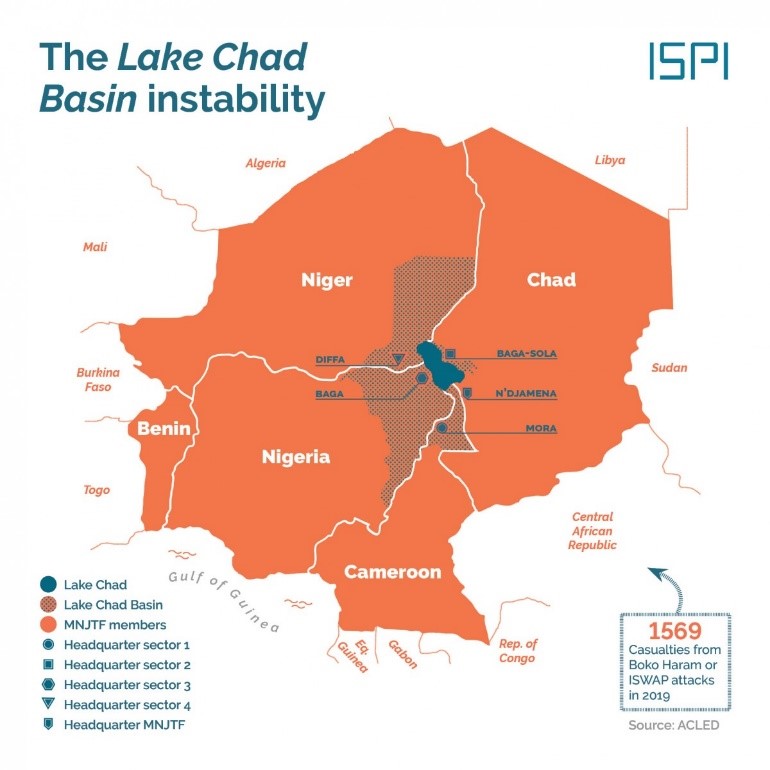
- Issue - The area is particularly sensitive to drought and the lake has shrunk in size during prolonged dry periods historically.
- As the lake shrinks, the competition for the dwindling resource increased and tensions across communities are heightened.
- Over the last decades, competition for land, water and food has increased.
- This competition is leading to the inter-communal fighting and displacement.
- A 13-year insurgency of the Boko Haram extremist group and other militant groups have destabilized the Lake Chad basin and the wider Sahel region.
- Link between lake and conflict - A report by a humanitarian organisation has highlighted the dangerous link between climate change and conflict in countries in the Lake Chad Basin.
References
- Down To Earth - Climate change fuelling conflict in Lake Chad Basin
- India Today - Climate change fuelling conflict in Lake Chad Basin



