Sengol
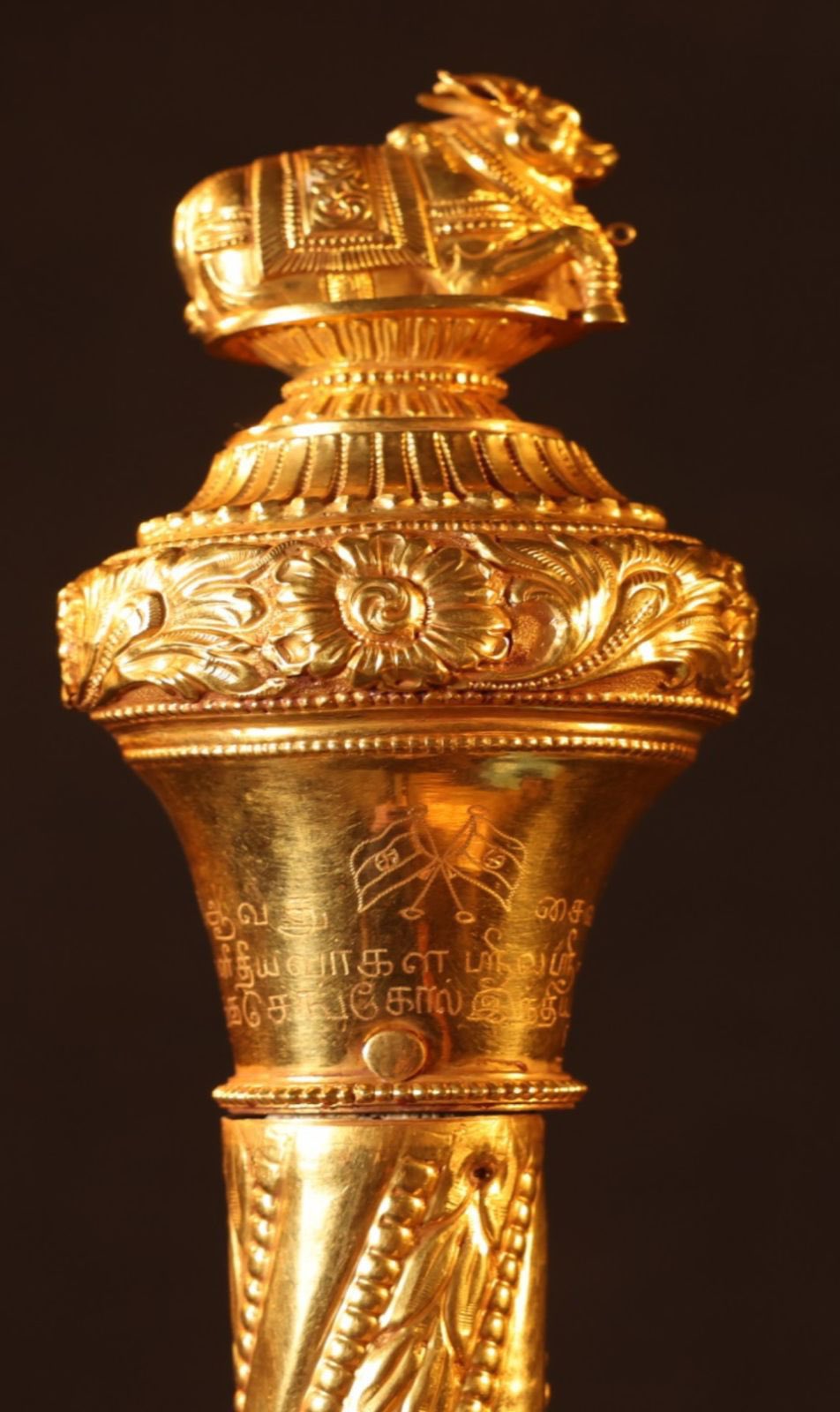
The new building of Parliament will witness the same historic event of vesting the Hon’ble PM with the Sengol.
- When India attained independence from the British, a question aroused about the ceremony to symbolise the transfer of power from British to Indian hands.
- To signify the transfer of power from one ruler to another, C.Rajagopalachari suggested using a Sengol followed by Cholas.
- The Adheenams (Priests) gave the Sengol to Lord Mountbatten first and then took it back in a procession to Jawaharlal Nehru.
- On the night of August 14, 1947, Jawaharlal Nehru received the 'Sengol' from the priest of the Thiruvaduthurai Adheenam (Mutt) in Tamil Nadu.
- A song composed by the 7th-century Tamil saint Tirugnana Sambandar, was played during the ceremony.
- This exact moment signifies the independence of India and transfer of its power.
- Sengol - The ‘Sengol’ was later kept in a museum in Allahabad.
- The Sengol is a historic sceptre which symbolises power.
- The recipient of the Sengol has the ‘order’ (‘Aanai’ in Tamil) to rule justly and fairly.
- The sceptre measures five feet in length and has a ‘Nandi’ bull on top.
- The Nandi, with its unyielding gaze is the beholder of “Nyaya” and symbolising justice.
- The word ‘Sengol’ is derived from the Tamil word ‘Semmai’, meaning ‘Righteousness’.
- The golden sceptre was crafted by Vummidi Bangaru Chetty, a famous jeweller in the Madras Presidency.
- The makers of the sceptre are Vummidi Ethirajulu and Vummidi Sudhakar, both are living in Chennai.
References
- IE - ‘Sengol’ to be installed in the new parliament
- PIB - PM Modi will establish the Sengol in the Parliament House
- The Hindu - ‘Sengol’ to be installed in new Parliament building
Health for All
WHO launches first-ever roadmap to link health with sustainable economic growth at the 76th World Health Assembly.
- WHO Council on the Economics of Health for All launched the first of a kind roadmap during the ongoing 76th World Health Assembly (WHA).
- The Council on the Economics of Health for All launched ‘Health for All: Transforming economies to deliver what matters’ report.
- The roadmap focuses on the links between health and sustainable, inclusive and innovation-led economic growth.
- The roadmap structures economic activity in a way that will allow us to reach the goal of seeing all people with access to essential health services faster with better result.
- WHO Council on the Economics of Health for All was established in November 2020 in response to the COVID-19 pandemic.
- It recommended reorienting economies to deliver health for all across four interrelated themes:
- Measurement: Valuing and measuring Health for All.
- Valuing and measuring what matters through new economic metrics.
- Capacity: Pathways to Health for All.
- How to strengthen dynamic public sector capacity to achieve health for all.
- Finance: Investing in Health for All.
- How to finance health for all as a long-term investment, not a short-term cost.
- Innovation: Governing Innovation for All.
- how to advance health innovation for the common good;
- The Council is currently comprised of 10 members, including the Chair.
- The Council is all-female group comprises distinguished economists and area experts.
References
- Down To Earth - Health for all: WHO launches first-ever roadmap
- WHO - Council on the Economics of Health For All
Pandemic Treaty
The World Health Organization’s (WHO) is drafting new rules for dealing with pandemics.
- The World Health Organization’s (WHO) Intergovernmental Negotiating Body (INB) published a ‘zero-draft’ of the pandemic treaty on February 1, 2023.
- After five rounds of formal negotiations, the latest 208-page draft of the treaty is still under negotiation.
- The WHO already has binding rules known as the International Health Regulations.
- These regulations are also being reviewed in the wake of COVID-19.
- Genesis - At a Special Session of the World Health Assembly (WHASS) in 2021, member states agreed by consensus to establish an intergovernmental negotiating body (INB).
- The purpose of INB is to draft an international instrument for pandemic preparedness and response by the WHO.
- The ‘pandemic treaty’ was first proposed by Chile and the European Union (EU).
- It has subsequently gained public endorsement by multiple world leaders and the WHO.
- The treaty aims to improve preparedness for future pandemics and enhance global cooperation in responding to them.
International Health Regulations
- The International Health Regulations was adopted after the 2002-2003 SARS outbreak.
- In 2005, it set out countries’ obligations where public health events have the potential to cross borders.
- These include advising the WHO immediately of a health emergency and measures on trade and travel.
- These regulations are still considered appropriate for regional epidemics, such as Ebola but inadequate for a global pandemic.
References
- IE - WHO's Pandemic Treaty
- Down to Earth - WHO publishes zero-draft of pandemic treaty
Polar Cyclone on Uranus
NASA’s Jet Propulsion Laboratory (JPL) announced that for the first time, scientists have strong evidence of a polar cyclone on Uranus.
- Uranus is the 7th planet from the Sun and it takes about 84 years to complete a full revolution.
- For many decades, the poles of the planet were not pointed towards Earth.
- Since about 2014, scientists have had a better view of Uranus’s pole as it is slightly pointed towards our planet.
- Therefore have been able to look deeper into the polar atmosphere.
- The Very Large Array in New Mexico observed warm and dry circulation of air at poles, which are signs of strong cyclone.
- Polar cyclone in other planets - The evidence of a Polar Cyclone on Uranus shows the dynamic nature of the planet.
- It also reiterates the hypothesis that all planets with substantial atmospheres in our solar system show signs of a swirling vortex at the poles, irrespective of whether they are composed of rock or gas.
- Apart from Mercury, every planet in the solar system have been identified with cyclones at the pole now.
- Mercury does not have a substantial atmosphere to have cyclones.
- Uranus cyclone - Unlike Earth, cyclones on Uranus are not formed over water as they don’t have water.
- Methane clouds are formed at poles due to circulating winds.
- The cyclones on Uranus are locked at the poles and do not drift.
- Cyclones in Saturn also exhibit same property of locked to the poles.
References
- IE - Polar Cyclone on Uranus
- AGU - Evidence of a Polar Cyclone on Uranus
Leipzig Transport Summit
International Transport Forum (ITF) organised 3-days Transport Summit in Leipzig, Germany.
- The annual Summit of the International Transport Forum is the world’s largest gathering of transport ministers and the premier global transport policy event.
- Transport Summit 2023 held at Leipzig, Germany for 3 days.
- The event held under the theme of ‘Transport Enabling Sustainable Economies’.
- Transport ministers from across 64 member countries of the ITF gathered for the summit.
- ITF Transport Outlook 2023 report was released at the summit.
- The report says decarbonising transportation can reduce the need for investment in core infrastructure.
- Decarbonisation, in turn, can help in achieving the goals of the 2015 Paris Agreement.
- International Transport Forum (ITF) is a think tank for transport policy which is administratively integrated with the OECD yet politically autonomous.
- ITF organises the Annual Summit of transport ministers.
- ITF is the only global body that covers all transport modes.
India is not a member of OECD, hence not a member of ITF.
References
- Down To Earth - Leipzig Transport Summit
- International Transport Forum



