Vienna Convention on Diplomatic Relations
After vandalism by pro-Khalistan protestors at Indian High Commission in London, The Ministry of External Affairs invoked the Vienna Convention.
- The Vienna Convention on Diplomatic Relations (1961) provides the framework for the establishment, maintenance and termination of diplomatic relations on a basis of consent between independent sovereign States.
- The Convention was adopted by the United Nations Conference on Diplomatic Intercourse and Immunities on the 18th April, 1961.
- It entered into force on April 24, 1964 and is nearly universally ratified, with Palau and South Sudan being the exceptions.
- Diplomatic Immunity - The Convention codifies the longstanding custom of diplomatic immunity.
- Under this immunity, diplomatic missions are granted privileges that enable diplomats to perform their functions without fear of coercion or harassment by the host country.
- It affirms the concept of ‘inviolability’ of a diplomatic mission, which has been one of the enduring cornerstones of international diplomacy.
- Article 22 - The ‘receiving State’ (host nation) has some basic obligations towards the diplomatic missions it hosts on its sovereign territory, under Article 22 of the Convention.
- The security of any High Commission or Embassy is the responsibility of the host nation.
- While diplomatic missions can also employ their own security, ultimately, the host nation is accountable for security.
- Based on this, the Ministry of External Affairs demanded an explanation on the London incident.
- In India - The Diplomatic Relations (Vienna Convention) Act, 1972 was enacted in India to give effect to the Vienna Convention and to provide for matters connected therewith.
- The act extends to the whole of India.
References
- IE - What is the Vienna Convention, invoked by MEA?
- UN - UN Conference on Diplomatic Intercourse and Immunities
National Chambal Sanctuary
Three States have commenced joint action to stop illegal sand mining in National Chambal Sanctuary.
- National Chambal Sanctuary is situated at the trijunction of Rajasthan, Madhya Pradesh and Uttar Pradesh.
- The Chambal River cuts through the mazes of ravines and hills in the sanctuary.
- Significance - The sanctuary is known for its population of gharials and Gangetic dolphins.
- The 5,400 sq. km. sanctuary is a fragile lotic ecosystem critical for breeding of gharials.
Gharials
Gharials are fish-eating fresh water crocodiles. Gharials are a good indicator of clean river water.
|
Protection
|
Status
|
|
Wild Life (Protection) Act, 1972
|
Schedule I
|
|
IUCN
|
Critically Endangered
|
|
CITES
|
Appendix I
|
- Threat - Illegal sand mining is threatening the flora and fauna in some parts of the sanctuary.
- Avian site - The sanctuary is listed as an ‘Important Bird and Biodiversity Area’ and is also a proposed Ramsar site.
- About 320 species of resident and migratory birds inhabit the sanctuary, and migratory birds from Siberia form part of its rich avian fauna.
- The river sanctuary is the breeding site of Indian Skimmer.
- Protection - The sanctuary is protected under the Wildlife Protection Act, 1972.
References
- The Hindu - To stop illegal sand mining in the Chambal sanctuary
- Ranthambhore National Park - National Chamabal Sanctuary
World Happiness Report 2023
On the occasion of ‘International Day of Happiness’, annually observed on March 20, ‘World Happiness Report’ unveiled its 11th edition this year.
- The World Happiness Report is based on people's own assessment of their happiness, as well as economic and social data.
- It was first published in 2012 and published annually since then. 2023 report is its 11th edition.
- The report is published by the United Nations Sustainable Development Solutions Network (UN-SDSN).
- The report considers 6 key factors: social support, income, health, freedom, generosity, and absence of corruption.
- It assigns a happiness score based on an average of data over a 3-year period.
- 2023 Rankings - The 2023 report ranked 137 countries on the list.
- For the 6th year running, Finland was named the world's happiest country followed by Denmark and Iceland.
- Israel occupied fourth position, up 5 spots from last year.
- Unhappiest: War-scarred Afghanistan has occupied the bottom spot (137th) on the table since 2020.
- Its humanitarian crisis deepen since the Taliban government took power in 2021 following the US-led military pull-out.
- Ukraine: Ukraine's ranking improved from 98 to 92 this year, despite the Russian invasion.
- But Ukraine’s overall score fell from 5.084 to 5.071, on a scale of zero to 10.
- India: India was ranked 126th on the report (136th in 2022).
- India’s Neighbours: Nepal featured at 78, China at 64, Bangladesh at 118 and Sri Lanka at 112 and Pakistan at 108.
References
- The Hindu - Finland happiest country in the world: U.N. report
- Hindustan Times - Top 10 list of world’s happiest countries
- World Happiness Report 2023
India-Bangladesh Friendship Pipeline
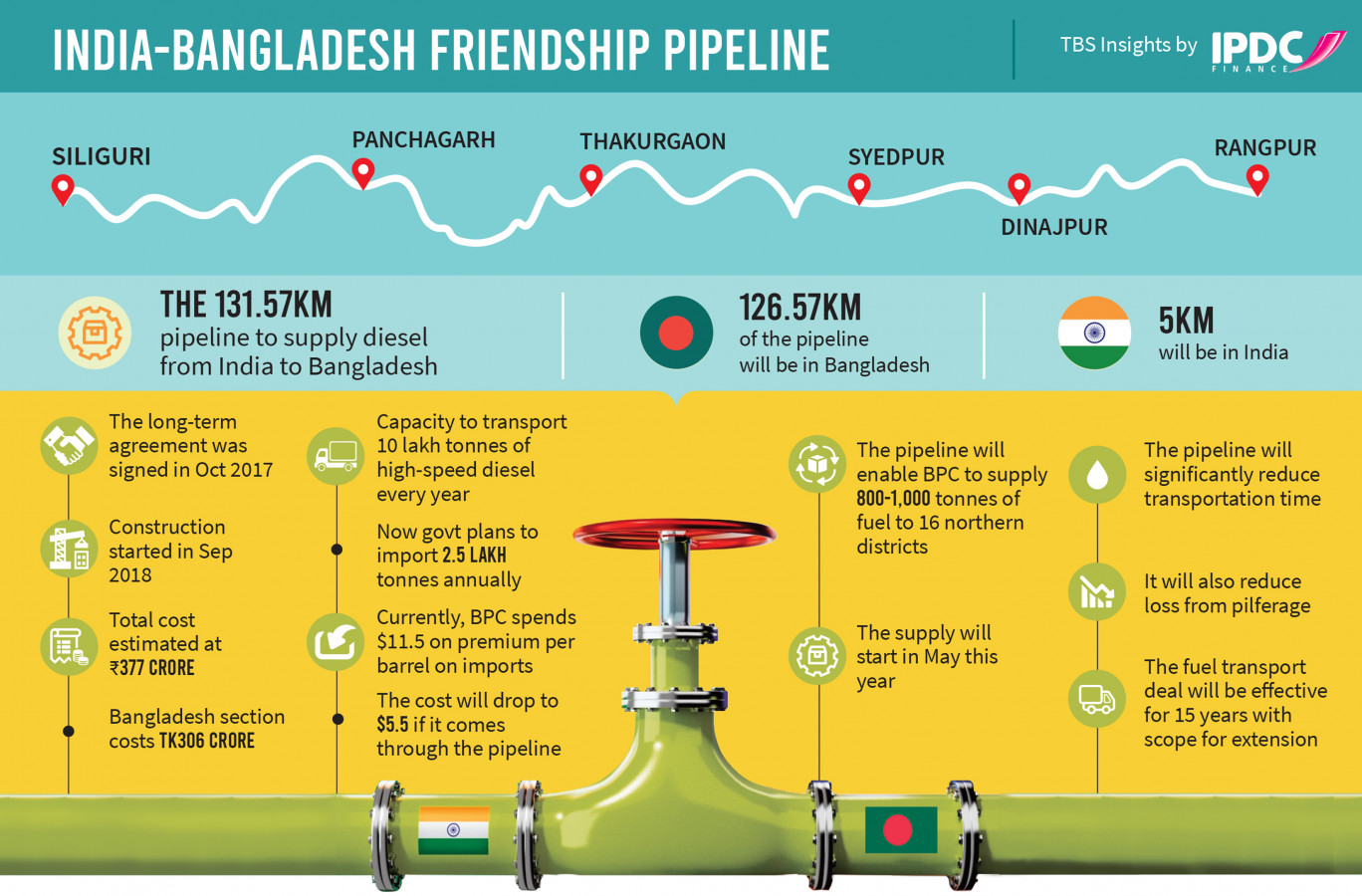
Prime Minister of India and Prime Minister of Bangladesh jointly inaugurated the India-Bangladesh Friendship Pipeline (IBFP) in a virtual mode.
- The India-Bangladesh Friendship Pipeline (IBFP) is the first cross border energy pipeline between India and Bangladesh.
- IBFP is laid from Siliguri in North Bengal to Parbatipur in Banglaesh’s Dinajpur province.
- Construction of the 131.5 kilometre long pipeline began in 2018.
- The pipeline was built with Rs 377 crore drawn from a line of credit offered by India to Bangladesh.
- This is the 2nd cross-border energy pipeline between India and its neighbours where the first one being Motihari-Amalekhgunj Petroleum Pipeline between India and Nepal.
- The energy pipeline will carry one million tonnes of high-speed diesel (HSD) from Numaligarh refinery in Assam to Bangladesh Petroleum Corporation’s Parbatipur depot.
- The Indian Oil Corporation Ltd (IOCL) is the recognised government to government (G2G) exporter of refined products to Bangladesh.
References
- PIB - Indian PM and Bangladesh PM jointly inaugurated the IBFP
- Swarajya - The New Diesel Pipeline From India To Bangladesh
Mice created with cells from 2 males
For the first time, scientists at Osaka University in Japan have created baby mice from two males.
- The baby mice created from two male mice opens up new avenues in reproductive biology and fertility research for animals and people.
- The scientists took skin cells from the tails of male mice and transformed them into stem-cell-like ‘induced pluripotent stem cells’.
- Then they converted male mouse cells into female cells through a process and produced functional egg cells.
- The process involved growing the pluripotent stem cells and treating them with a compound called reversine.
Pluripotent stem cells can develop into many different types of cells or tissues.
- Finally, they fertilized those eggs and implanted the embryos into female mice.
- About 1% of the embryos (7 out of 630) grew into live mouse pups.
- The pups appeared to grow normally and were able to become parents themselves in the usual way.
- Synthetic mouse embryos - In 2022, scientists in California and Israel created synthetic mouse embryos.
- These synthetic mouse embryos are created from stem cells without a dad’s sperm or a mom’s egg or womb.
- Those embryos mirrored natural mouse embryos up to 8 ½ days after fertilization, containing the same structures, including one like a beating heart.
References
- The Hindu - Scientists create mice with cells from 2 males
- IE - Scientists create mice with cells from 2 males for first time



