Sea Cucumber
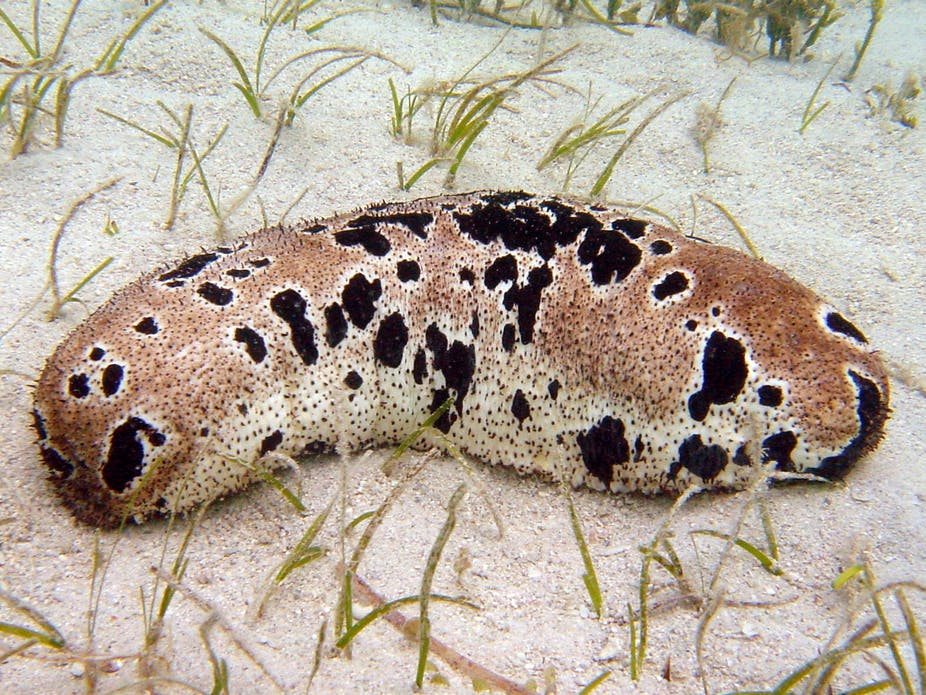
Indian Coast Guard (ICG) team at Mandapam, Tamilnadu seized two tonnes of sea cucumber, a banned marine species.
- Sea cucumber is primarily smuggled from Tamil Nadu to Sri Lanka in fishing vessels.
- In 2020, the world’s first conservation area for endangered sea cucumbers was set up in Lakshadweep Islands.
|
Agency or Act
|
Conservation Status
|
|
IUCN Red List
|
Endangered
|
|
CITES
|
Appendix II and III
|
|
Wildlife Protection Act, 1972
|
Schedule I
|
- Threats - Illegal overfishing and smuggling for food & traditional medicine and human population density.
- Sea cucumbers are in high demand in China and Southeast Asia.
- Geographic hotspots for conservation action include east Africa, the Coral Triangle in the southwest Pacific and Central-Western Pacific.
Humboldt Penguin
Mumbai’s Byculla Zoo announced the addition of two new Humboldt penguin chicks.
- Humboldt penguin (Spheniscus humboldti) is a medium-sized species that belongs to a genus that is commonly known as the ‘banded’ group.
- It has an average height of over 2 ft.
- Emperor penguin, the largest of penguin species, stands at over 4 ft tall, while the little penguin has a maximum height of 1 ft.
- Humboldt penguins are endemic to the Pacific coasts of Chile and Peru.
- They are so named because their habitat is located near the Humboldt Current, a large oceanic upwelling characterised by cold waters.

- Humboldt Penguins burrow and create nesting sites in guano (fecal) deposits.
- Their breeding season in the wild is either March-April or September-October depending on the location of the colony.
- They have large, bare skin patches around their eyes, an adaptation to help keep them cool.
|
Agency
|
Conservation Status
|
|
IUCN Red List
|
Vulnerable
|
|
CITES
|
Appendix I (endangered)
|
- Threats - Habitat destruction, overfishing of their prey species, drowning in gill nets, guano harvesting, ecological disasters like oil spills, pollution like trash in the ocean, human interference & El Niño Southern Oscillation events.
Planet Nine
A study says that it has found more evidence for a distant giant planet in our solar system called Planet Nine.
- It has found that the Planet Nine could have a mass of 6.2 (+2.2/-1.3) Earth masses. It may be a typical extra-solar super-Earth.
- Planet Nine is not a new discovery. It had appeared in the images taken by the Hubble Space Telescope in 2004.
- It orbits far beyond Neptune in a highly eccentric orbit around the Sun.
- A 2018 study noted that a trans-Neptunian object called 2015 BP519 had an unusual trajectory as it was affected by Planet Nine’s strong gravity.
Criteria for Planet
- International Astronaumical Union determines the criteria and vote on the decisions.
- The 3 conditions for a celestial object to be declared as a planet
- It must orbit the Sun.
- It should be massive enough to acquire an approximately spherical shape.
- It has to clear its orbit (being the object that exerts maximum gravitational pull within its orbit).
- Dwarf Planet - If a celestial object satisfies any 2 of the above 3 conditions, it is called as dwarf planet.
- It orbits the sun, and has enough mass to assume a nearly round shape.
- It has not cleared the neighbourhood around its orbit and is not a moon.
- Exoplanet is a planet outside the Solar System. The first confirmation of detection of exoplanet occurred in 1992.
Meghalaya Enterprise Architecture Project
Ministry of Electronics & Information Technology (MeitY) launched Meghalaya Enterprise Architecture Project (MeghEA).
- MeghEA envisions making Meghalaya a high income state by 2030 by improving service delivery and governance for the people at the grassroots level using power of Digital technologies.
- The project is spread across 6 pillars - Governance, Human Resources, Entrepreneurship, Primary Sector, Infrastructure and Environment.
- It will be implemented by the MeitY, National Informatics Centre (NIC), and Information Technology Department of state.
- During the launch of the North East vision document (2018), Meghalaya was selected as the pilot first pilot State for preparing MeghEA and implementing MeghEA integrated Finance Solution Architecture.
- Goals - MeghEA demands coordination between strategies, policies, processes, services and organizational capacity to absorb change.
- Coordinate all ICT initiatives under one umbrella.
- Implement and ICT enable state government process reengineering to provide multi-channel service delivery in a manner that increases digital take-up and completion rates.
- Ensure that state government applications and systems provide end-users with information they need to make decisions and influence government operations.
- Craft an ecosystem for the digital economy to boost shared prosperity.
- Preparation of a vision and roadmap to achieve the MeghEA vision (including SDGs adopted by the State) and mission levers
- Connect (connected citizen connected government),
- Collaborate (efficiently collaborating government) and
- Empower (digitally enabled citizens).
- Interoperability among various public, private and governmental applications leading to a connected ecosystem to foster innovation and promote secure data sharing.
India Enterprise Architecture
- The UN e-Governance survey emphasized on a whole-of-government approach, policy integration and use of Big Data Analytics to provide better governance to citizens.
- So, a working group was constituted by Standardisation Testing and Quality Certification (STQC), MeitY under the J. Satyanarayana, to develop the India Enterprise Architecture (IndEA) framework.
- In 2018, IndEA was notified under the Digital India Programme to design and implement integrated, nationally portable and scalable digital platforms.
- IndEA provides a generic framework comprising of a set of architecture reference models that can be converted into a Whole-of-Government Architecture for India, Ministries, States, Govt. Agencies etc.
- IndEA framework is based on federated architecture approach.
- It recognizes the need to accommodate both greenfield (new) and brownfield (existing / legacy) e-Governance initiatives.
SPIN Scheme
Khadi and Village Industries Commission (KVIC) launched the Strengthening the Potential of India (SPIN) Scheme and set up a pottery cluster under SFURTI Scheme in Varanasi to empower the marginalized potters.
- SPIN Scheme is a specially-designed no-subsidy program that enables to make potters self-sustainable.
- It enables the registered potters to get easy direct loans from the banks under Pradhan Mantri Shishu Mudra Yojana.
- Under the SPIN Scheme, KVIC is acting as a facilitator for financial aid to potters through RBL bank and also providing training to the artisans.
- There will be no financial burden on the exchequer and the loan will be repaid by the potter in easy instalments.
Source: PIB, The Indian Express, Hindustan Times, The Conversation, Bird Life International



