Global Hunger Index 2022
India ranks 107 out of 121 countries on the Global Hunger Index in which it fares worse than all countries in South Asia except Afghanistan.
- The Global Hunger Index (GHI) is an annual report, jointly published by Concern Worldwide and Welthungerhilfe.
- The GHI is a tool for comprehensively measuring and tracking hunger at global, regional, and national levels.
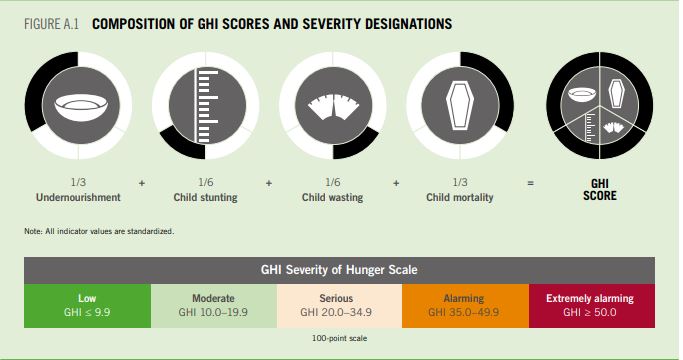
- GHI scores are based on the values of four indicators
- Undernourishment – Insufficient caloric intake.
- Child wasting - Low body weight to height.
- Child stunting - Low height for their age.
- Child mortality – Children who die before their 5th birthday.
- Calculation of GHI
- The GHI 2022 found that South Asia has the world's highest levels of child stunting and child wasting.
- South Saharan countries in Africa have the highest levels of undernourishment and child mortality rates.
- GHI in South Asian countries
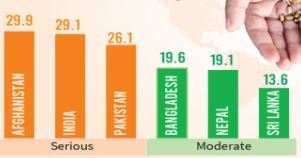
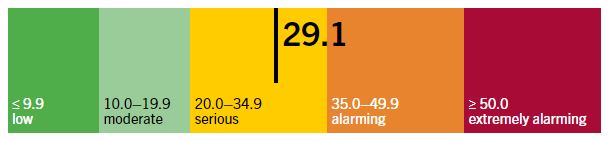
- India - India scores 29.1 indicating it has a serious level of hunger.
- Rank – 107 out of 121 countries (India ranked 101 in 2021)
- 16.3% of the population in India is undernourished
- 19.3% of the children under 5 are wasted.
- 35.5% of the children under 5 are stunted.
- 3.3% of child mortality.
References
- https://www.thehindu.com/news/national/india-ranks-107-out-of-121-countries-on-global-hunger-index/article66010797.ece?homepage=true
- https://www.hindustantimes.com/india-news/global-hunger-index-2022-india-slips-six-places-ranked-107-of-121-countries-101665804181638.html
- https://www.globalhungerindex.org/india.html
‘No First Use’ Commitment
The successful launch of a Submarine Launched Ballistic Missile proves India’s nuclear deterrence capability that underpins India's policy of 'credible minimum deterrence' and 'no first use' commitment.
- No First Use policy is India’s commitment to not be the first to use a nuclear weapon in a conflict.
- No First Use pledge is a component of a country’s Nuclear Doctrine, adopted from 2003.
- India’s Nuclear Doctrine
- India will build and maintain a credible minimum deterrence.
- India will use Nuclear weapons only in retaliation against a nuclear attack on Indian Territory or on Indian forces.
- In the event of an attack against India, or Indian forces anywhere, by biological or chemical weapons, India will retain the option of retaliating with nuclear weapons.
- India would not use nuclear weapons against non-nuclear weapon states.
- India would continue to put strict controls on the export of nuclear and missile related materials and technologies.
- India remains committed to the goal of a nuclear weapons free world, through global, verifiable and non-discriminatory nuclear disarmament.
- Nuclear Command Authority - According to the doctrine, nuclear retaliatory attacks can only be authorised by the Nuclear Command Authority.
- The Nuclear Command Authority comprises a Political Council and an Executive Council.
- The Political Council is chaired by the Prime Minister.
- The Executive Council is chaired by the National Security Advisor.
- Nuclear powered neighbours of India - China declared its No First Use policy in 1964, and has since maintained this policy.
- Pakistan does not have No First Use policy.
- India signed US-India Civil Nuclear Agreement in 2005 to resume full nuclear trade with the US.
References
- https://www.pib.gov.in/PressReleasePage.aspx?PRID=1867778
- https://www.thehindu.com/news/national/ins-arihant-launches-submarine-launched-ballistic-missile/article66010395.ece
- https://archive.pib.gov.in/archive/releases98/lyr2003/rjan2003/04012003/r04012003html#:~:text=A%20posture%20of%20%22No%20First,designed%20to%20inflict%20unacceptable%20damage.
INS Tarkash
The Indian Navy was represented by INS Tarkash in the 7th edition of IBSAMAR exercise held at Port Gqeberha (also known as Port Elizabeth), South Africa.
IBSAMAR is a joint multinational maritime exercise, among the Indian, Brazilian and South Africa navies.
- INS Tarkash is a state-of-the-art stealth frigate of the Indian Navy.
- It is the 5th Talwar-class frigate constructed for the Indian Navy, built at the Yantar shipyard in Kaliningrad, Russia.
- It is equipped with a versatile range of weapons and sensors capable of addressing threats in all three dimensions.
- Talwar Class warships active in Indian Navy
- INS Talwar
- INS Trishul
- INS Tabar
- INS Teg
- INS Tarkash
- INS Trikand
- Talwar class frigates are guided missile frigates designed and built by Russia.
- These frigates are armed with BrahMos supersonic missiles.
- Talwar frigates are designed to detect and eliminate enemy submarines and large surface ships.
References
- https://www.pib.gov.in/PressReleasePage.aspx?PRID=1867619
- https://www.naval-technology.com/news/newsins-tarkash-completes-sea-trials-for-indian-navy/
Grameen Udyami Project
Skill India certifies candidates trained under the second phase of Grameen Udyami Project to boost skill development in tribal communities.
- Grameen Udhyami is a unique multi-skilling project funded by the National Skill Development Corporation.
National Skill Development Corporation (NSDC) is a not-for-profit company that aims to promote skill development.
- Grameen Udhyami Project aims to skill tribal youth across India to enable them to create a perennial stream of income without having to migrate to urban areas.
- Implementation - Grameen Udyami Yojana is implemented under Sansadiya Parisankul Yojana.
- The project is being implemented in six states - Maharashtra, Rajasthan, Chhattisgarh, Madhya Pradesh, Jharkhand, and Gujarat.
- Training - Transportation, boarding & lodging during the learning period is provided to candidates by the implementation Agencies.
- The training under the project will be conducted in the Job roles which are relevant to the local economy.
- It focuses on agriculture, fisheries, and forest-related roles to suit the local demand.
- Skilling will also be done in upcoming sectors like construction, food processing, handicraft, healthcare, BFSI, IT-ITES, etc.
- The content and curriculum will also include employability skills, financial and digital literacy, and entrepreneurship modules.
- Similar Project - Udyami Bharat Programme
References
- https://www.pib.gov.in/PressReleasePage.aspx?PRID=1867519
- http://grameenudhyami.org/
- https://vikaspedia.in/schemesall/schemes-for-unemployed-and-poor/grameen-udyami-yojana
ABO-incompatible Organ Transplant
Manipal Hospital, Yeshwanthpur, became the first hospital in Karnataka to complete 27 ABO-incompatible kidney transplants.
The first ABO-incompatible kidney transplant was performed in India in the year 2011.
- ABO-incompatible transplant is done when blood types of the receiver and donor are different.
- Such transplants are very complex and done by suppressing the levels of antibodies in the recipient’s body.
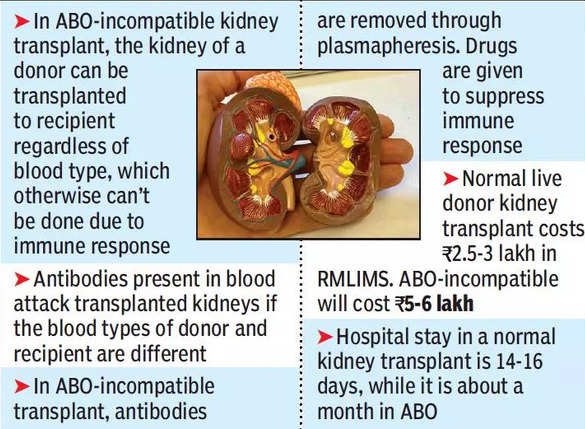
- If there is a mismatch in the blood of donor and recipient, antibodies in recipient’s body reject transplanted organs.
- In ABO-incompatible transplant, these antibodies are removed through plasmapheresis.
Plasmapheresis is a process in which the liquid part of the blood, or plasma, is separated from the blood cells.
- Immunosuppressants are also given to reduce the chances of rejection.
- The ABO-incompatible transplants have similar success rates as a standard transplant.
References
- https://www.thehindu.com/news/cities/bangalore/abo-incompatible-organ-donors-and-recipients-share-their-experiences/article66002132.ece
- https://www.newindianexpress.com/cities/bengaluru/2022/oct/13/abo-incompatible-kidney-transplants-find-more-success-2507566.html
- https://timesofindia.indiatimes.com/city/lucknow/abo-transplant-a-ray-of-hope-for-chronic-kidney-patients/articleshow/86723216.cms



