Proxima Centauri
The European Southern Observatory (ESO) has detected a new planet ‘Proxima d’ around Proxima Centauri.
- Proxima Centauri is the closest star to our Solar System, lying just over four light-years away.
- It is a faint red dwarf star, which might or might not spell doom.
- It is part of the Alpha Centauri star system.
|
Exoplanets of Proxima Centauri
|
Characteristics
|
|
Proxima b
|
It is a planet with a mass comparable to that of Earth that orbits the star every 11 days.
It is within the habitable zone.
|
|
Proxima c
|
It is on a longer five-year orbit around the star.
|
|
Proxima d
|
It is the third detected in the system and the lightest yet discovered orbiting this star.
|

Reference
- https://www.sciencedaily.com/releases/2022/02/220210085019.htm
- https://www.eso.org/public/news/eso2202/
- https://earthsky.org/astronomy-essentials/proxima-centauri-our-suns-nearest-neighbor/
White Cheeked Macaque
Scientists from the Zoological Survey of India (ZSI) have found a new mammal species in the country - the White Cheeked Macaque.
- The White Cheeked Macaque has distinct white cheeks, long and thick hair on the neck and a longer tail than other Macaque species.
- It is the last mammal to have been discovered in Southeast Asia.
- While the Macaque was first discovered in China in 2015, its existence was not known in India before this.
- Its presence has been discovered in the remote Anjaw district in central Arunachal Pradesh.
- Both the Arunachal macaque as well as the White Cheeked Macaque exist in the same biodiversity hotspot in the eastern Himalayas.
- Protection Status - This species is not included in the Wildlife Protection Act of India, which presently doesn’t cover it simply because we didn’t know it existed in India.
- Threat - The potential threat to all species of macaques in the landscape is due to hunting by locals for consumption and habitat degradation due to urbanization and infrastructure development.
Reference
- https://indianexpress.com/article/india/meet-indias-newest-mammal-white-cheeked-macaque-7763461/
- https://www.thehindu.com/news/national/other-states/scientists-find-white-cheeked-macaque-in-arunachal-pradesh/article38399803.ece
Dholes
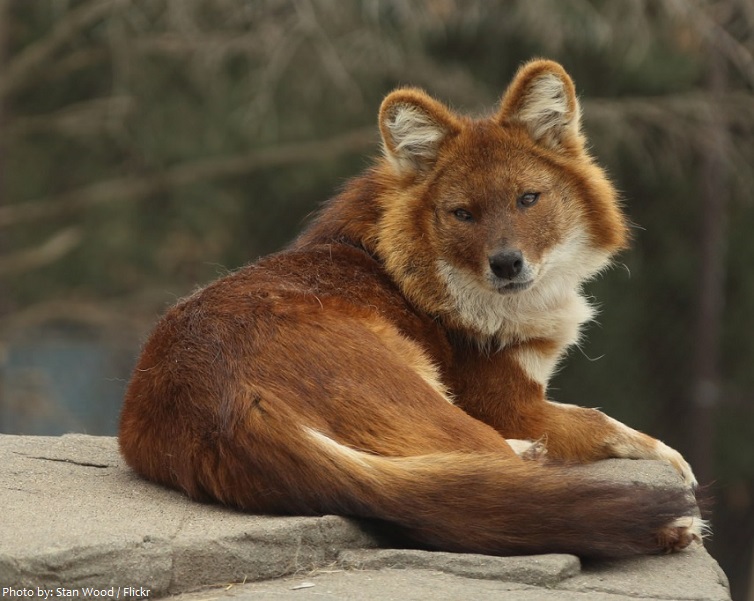
A new study has reported the presence of dholes in the high mountains of Central Asia nearly 30 years after their presence was last recorded.
- Dholes or Asiatic wild dogs (Cuon alpinus) are canid native to Central, South, East Asia, and Southeast Asia.
- India perhaps supports the largest number of dholes, with key populations found in 3 landscapes - Western Ghats, Central India and Northeast India.
- Dholes are the apex social carnivores in the tropical forests of South and South East Asia.
- It is a highly social animal, living in large clans without rigid dominance hierarchies and containing multiple breeding females.
- They hunt in packs and tend to venture into forested landscapes adjoining protected areas.
- Threats - Anthropogenic factors, which fragment and alter landscapes seriously affects dholes.
- Other threats are habitat loss, loss of prey, competition with other species, persecution due to livestock predation and disease transfer from domestic dogs.
|
Protection Status
|
|
IUCN List of Threatened Species
|
Endangered
|
|
CITES
|
Appendix II
|
|
Wildlife Protection Act, 1972
|
Schedule II
|
Besides the tiger, the dhole is the only large carnivore in India that is under the IUCN’s ‘endangered’ category.
Reference
- https://www.downtoearth.org.in/news/wildlife-biodiversity/researchers-spot-dholes-in-kyrgyzstan-after-3-decades-81411
- https://www.thehindu.com/news/national/article61700366.ece
Fairbank's Disease
- Fairbank's disease or Multiple epiphyseal dysplasia (MED) a rare genetic disorder which affects the growing ends of bones.
- It is a group of disorders of cartilage and bone development, primarily affecting the ends of the long bones in the arms & legs (epiphyses).
- Bones usually elongate by a process that involves the depositing of cartilage at the ends of the bones, called ossification.
- This cartilage then mineralizes and hardens to become bone. In MED, this process is defective.
- Two types of MED - They are distinguished by their patterns of inheritance as
- Autosomal dominant and
- Autosomal recessive.
- Causes - Dominant MED is caused by mutations in the COMP, COL9A1, COL9A2, COL9A3, or MATN3 genes (or can be of unknown cause).
- Recessive MED is caused by mutations in the SLC26A2 gene.
- Symptoms - Joint pain in the hips and knees; early-onset arthritis; a waddling walk; and mild short stature as adults.
- Recessive MED may also cause malformations of the hands, feet, and knees; scoliosis; or other abnormalities.
- Most people are diagnosed during childhood, but mild cases may not be diagnosed until adulthood.
- MED patient usually requires management of pain and orthopedic procedures, for which facilities are available at tertiary care institutions in India.
Reference
- https://www.pib.gov.in/PressReleasePage.aspx?PRID=1796442
- https://rarediseases.info.nih.gov/diseases/10756/multiple-epiphyseal-dysplasia
Acromegaly Disorder
- Acromegaly is a hormonal disorder that develops when your pituitary gland produces too much growth hormone during adulthood.
- When you have too much growth hormone, your bones increase in size.
- In childhood, this leads to increased height and is called gigantism.
- But in adulthood, a change in height doesn't occur. Instead, the increase in bone size is limited to the bones of your hands, feet and face, and is called acromegaly.
- Symptoms - Sleeplessness, Excess fatigue, A hoarse voice, Profuse sweating, Frequent headaches, Abnormal weight gain, Develop odour in the body, Enlargement of jaws or tongue etc.
- As acromegaly is uncommon and the physical changes occur slowly over many years, the condition sometimes takes a long time to recognize.
- Untreated, high levels of growth hormone can affect other parts of the body, in addition to your bones. This can lead to health problems.
- But treatment can reduce your risk of complications and significantly improve your symptoms, including the enlargement of your features.
Reference
- https://www.pib.gov.in/PressReleasePage.aspx?PRID=1796442
- https://www.mayoclinic.org/diseases-conditions/acromegaly/symptoms-causes/syc-20351222#:~:text=Acromegaly%20is%20a%20hormonal%20disorder,in%20height%20doesn't%20occur.



