Non-convertible Debentures
Several companies have announced public issues to raise funds through non-convertible debentures, offering interest rates between 8.25-9.7%.
- Debentures are long-term financial instruments which acknowledge a debt obligation towards the issuer.
- Some debentures have a feature of convertibility into shares after a certain point of time at the discretion of the owner.
- The debentures which can't be converted into shares or equities are called non-convertible debentures (NCDs).
- Features of NCD - Companies provide NCDs through open market public issues. Interested investors can buy them with a specified period.
- To compensate for the ‘non-convertibility’ drawback, lenders are usually given a higher rate of return compared to convertible debentures.
- They are not backed by any collateral, thus only companies with good credit rating can issue debentures. They are mostly backed by the creditworthiness and debt servicing capability of a company.
- The interest rates are mostly fixed.
- NCDs can be traded in the stock market.
- Benefits - NCDs are used as tools by the companies to raise long-term funds by companies through a public issue.
- The owner of the NCDs enjoy other benefits such as
- High liquidity through stock market listing,
- Tax exemptions at source and
- Safety since they can be issued by companies which have a good credit rating as per the norms laid down by RBI for issuing NCDs.
- In India, usually these are issued at a minimum maturity of 90 days.
Reference
- https://indianexpress.com/article/explained/are-non-convertible-debentures-safe-for-retail-investors-7664910/
- https://economictimes.indiatimes.com/definition/non-convertible-debentures
- https://groww.in/p/non-convertible-debentures/
Black Box
Black Box of the IAF chopper that crashed with CDS General Bipin Rawat and others were recovered.
- A Black Box is a vital electronic device that is installed in aircraft to help investigators in case of unfortunate accidents.
- It is neither black in colour, nor box in shape, but is a device made in high-visibility orange colour.
- It records 88 vital parameters about a flight including, airspeed, altitude, cockpit conversations, and air pressure among others.
- There are two recorders in black box:
- Flight Data Recorder (FDR) that stores all the recent history of the flight through the recording of dozens of parameters collected multiple times per second and.
- Cockpit Voice Recorder (CVR) that records cockpit sound including pilot conversations
- To withstand the harshest crashes, the black box is double wrapped in a corrosion-resistant stainless-steel container with high-temperature insulation.
- If underwater, the device sends out a signal on contact with saltwater that can be picked up within a radius of about 2 kilometres.
Reference
- https://www.thehindu.com/todays-paper/black-box-recovered/article37920133.ece
- https://zeenews.india.com/aviation/what-is-a-black-box-the-device-that-can-solve-mystery-behind-gen-bipin-rawats-helicopter-crash-2417454.html
- https://www.indiatoday.in/science/story/what-is-black-box-cds-bipin-rawat-mi-17v5-helicopter-crash-air-force-coonoor-1885834-2021-12-09
World Inequality Report 2022
The ‘World Inequality Report 2022’, released by The World Inequality Lab, says that India is a poor and very unequal country, with affluent elite.
- According to the report, since the mid-1980s, deregulation and liberalisation policies have led to one of the most extreme increases in income and wealth inequality observed in the world.
- An average adult earns PPP USD 23,380 per year in 2021, and the average adult owns USD 102,600.
- These averages mask wide disparities both between & within countries.
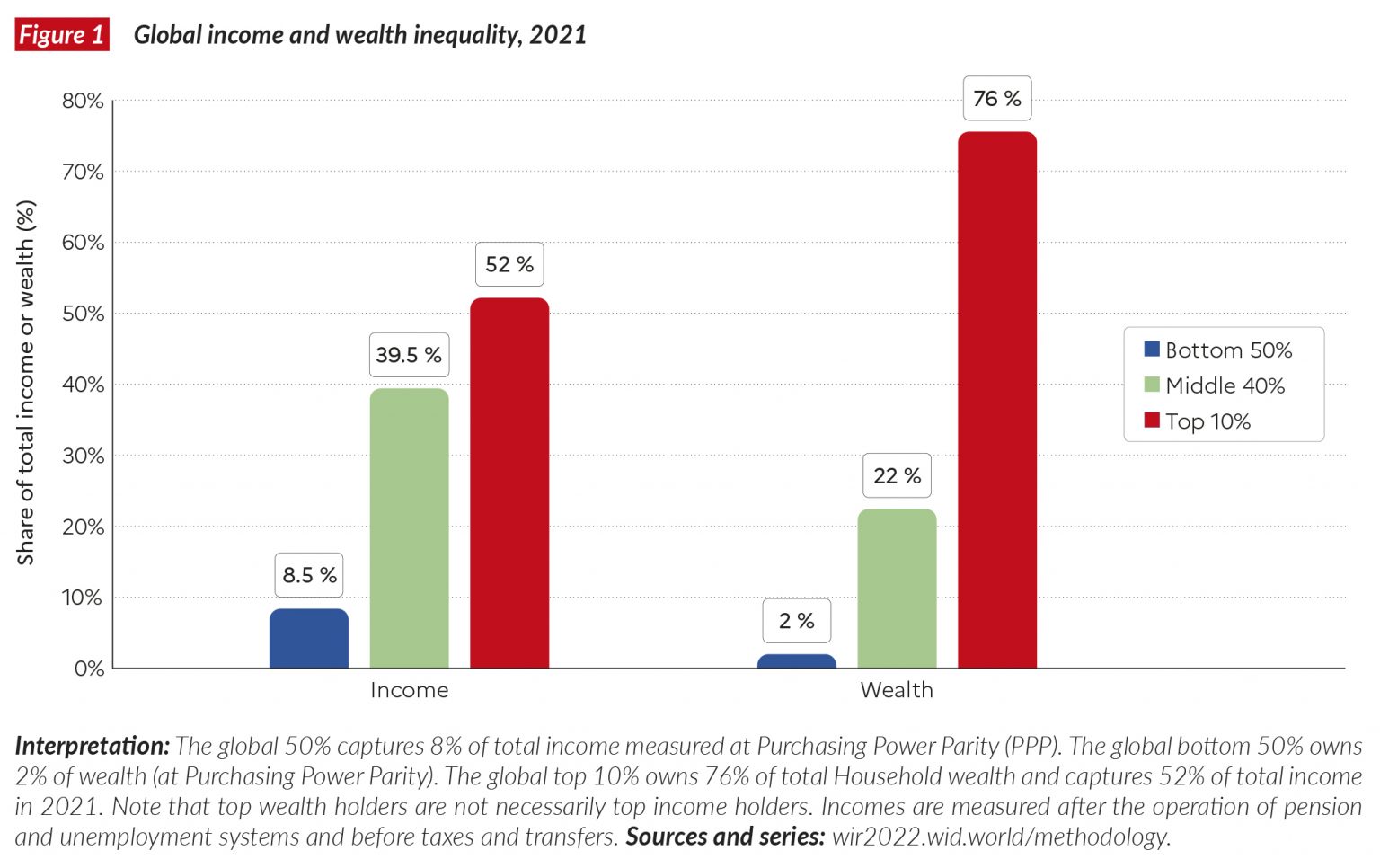
- Income inequality - The richest 10% of the world earns 52% of global income, whereas the poorest half of the population earns 8% of it.
- On average, an individual from the top 10% of the global income distribution earns USD122,100 per year, whereas an individual from the poorest half of the global income distribution makes USD3,920 per year.
- Wealth inequality - The share of public wealth across countries has been on a decline for decades now.
- The decline in public wealth and rise in private wealth was exacerbated by the outbreak of the coronavirus pandemic.
- The poorest half of the global population barely owns any wealth at all, possessing just 2% of the total.
- In contrast, the richest 10% of the global population own 76% of wealth.
- On average, the poorest half of the population owns PPP USD 4,100 per adult, i.e. and the top 10% own USD 771,300 on average.
- Gender inequality - Women’s share of total incomes from work (labor income) neared 30% in 1990 and stands at less than 35% today.
Middle East and North Africa (MENA) is the most unequal region in the world, Europe has the lowest inequality levels.
- India - The report highlights that India is among the most unequal countries in the world, with rising poverty and an 'affluent elite.'
- In India, the top 10% and top 1% hold 57% and 22% of the total national income respectively while the bottom 50% share has gone down to 13%.
- Income inequality in India under the British colonial rule (1858-1947) was very high, with a top 10% income share around 50%.
- After independence, due to socialist-inspired five-year plans, this share was reduced to 35-40%.
- Due to the economic liberalisation policies of the 1990s, India has been facing one of the most extreme increases in income and wealth inequality observed in the world.
- While the top 1% has largely benefited from these economic reforms, the growth among low and middle-income groups has been relatively slow and poverty persists.
- In India, private wealth went up from 290% in 1980 to 560% in 2020.
- The share of female labour income share in India is equal to 18% which is significantly lower than the average in Asia (21%, excluding China) & is among the lowest in the world.
Reference
- https://economictimes.indiatimes.com/news/economy/indicators/india-amongst-the-most-unequal-countries-in-the-world-report/articleshow/88141807.cms
- https://wir202wid.world/executive-summary/
- https://www.downtoearth.org.in/news/economy/world-s-most-extreme-inequality-increase-in-india-80566
SAMPANN Project
More than One Lakh pensioners are currently being serviced by Principal Controller of Communication Accounts/ Controller of Communication Accounts offices all over India via SAMPANN.
- System for Accounting and Management of Pension (SAMPANN) project was launched by the Government of India in 2018.
- It is a Comprehensive pension management system for pensioners of the Department of Telecommunications.
- It provides direct credit of pension into the bank accounts of pensioners.
- It is being implemented by Controller General of Communication Accounts, Department of Telecommunications, Ministry of Communications.
Reference
- https://pib.gov.in/PressReleasePage.aspx?PRID=1779637
- https://dotpension.gov.in/Home/AboutUs
Mount Semeru
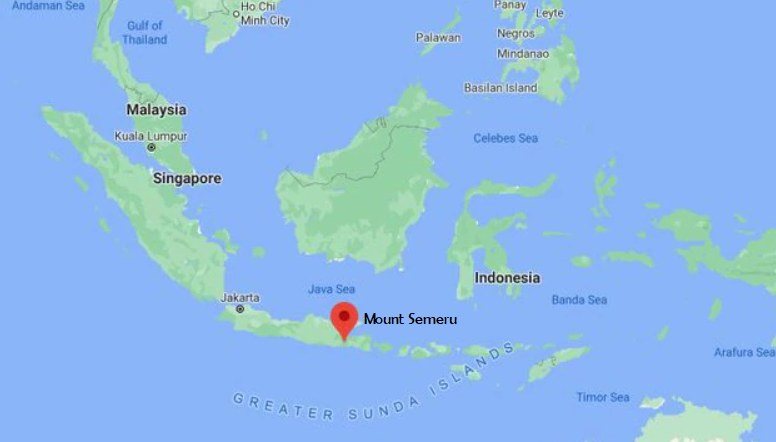
The eruption of Mount Semeru, East Java, Indonesia has killed at least 14 persons and left dozens injured.
- Semeru, an active volcano in East Java, is located in a subduction zone, where the Indo-Australian plate subducts under the Eurasia plate.
- It is the highest volcano on Java that lies at the southern end of a volcanic massif extending north to the Tengger caldera.
- This stratovolcano is also known as Mahameru (The Great Mountain.)
- Semeru has been in almost continuous eruption since 1967. It is known for its regular ash explosions that occur at intervals of 10-30 minutes.
- The recent eruption of the Semuru volcano was triggered due to heavy rain.
- Days of heavy rain had gradually eroded Semeru's lava dome, a mound of hardened lava that acts like a volcano's plug, which partially collapsed.
Reference
- https://www.thehindu.com/news/international/indonesia-semeru-volcano-eruption-many-dead/article37849027.ece
- https://www.volcanodiscovery.com/semeru.html
- https://edition.cnn.com/2021/12/08/asia/indonesia-mount-semeru-volcano-eruption-cimate-intl/index.html



