Soft Robots
Researchers have now developed soft robots that are capable of navigating complex environments, such as mazes, without input from humans or computer software.
- Soft robots are flexible robots that can be programmed to execute specific tasks.
- Unlike their hard-edged cousins, they can be used to perform more delicate manoeuvres, such as reaching into difficult crevices or holding onto delicate objects.
- They are usually made of liquid crystal elastomers, which are polymers having viscosity and elasticity.
- The latest designs have them shaped like twisted ribbon, resembling translucent rotini.
- These soft robots demonstrate a concept called ‘physical intelligence,’ as opposed to computational intelligence.
- [Structural design and smart materials are what allow the soft robot to navigate various situations by drawing energy from its environment. This is called Physical intelligence.]

- Working - Twisted ribbon is placed on a surface that is at least 55 degrees Celsius hotter than the ambient air.
- This causes the portion of the ribbon touching the surface to contract, while the portion of the ribbon exposed to the air does not.
- This induces a rolling motion in the ribbon and the warmer the surface, the faster it rolls.
- Navigation - The ribbon robot navigates in two ways.
- First, if one end of the ribbon encounters an object, the ribbon rotates slightly to get around the obstacle.
- Second, if the central part of the robot encounters an object, it “snaps.”
- The snap is a rapid release of stored deformation energy that causes the ribbon to jump slightly and reorient itself before landing.
- Many soft robots are made to resemble living organisms, such as octopus, and are manufactured using 3-D printers.
- Popular uses of these robots are in surgeries or making specialised exo-suits that can help in rehabilitating patients.
- Drawback - The soft materials reduce their durability as well make them harder to control.
Reference
- https://www.thehindu.com/sci-tech/science/science-for-all-what-are-soft-robots/article65482904.ece
- https://news.ncsu.edu/2022/05/twisted-soft-robots/
- https://cosmosmagazine.com/technology/soft-robot-twisted-moving/
Stockholm+50
Since the United Nations Conference on the Environment is head towards its 50th anniversary, the Stockholm+50 meeting has been convened.
- Stockholm+50 is an international meeting convened by the UN General Assembly to be held in Stockholm, Sweden in June 2022.
- Sweden will host Stockholm+50, with the support of Kenya.
- It will be held during the same week as World Environment Day, which is held on 5 June each year and is also a result of the 1972 event.
- This is being held at a time when the world is facing a triple planetary crisis of climate change, pollution and waste, nature and biodiversity loss
- Stockholm+50 will be collaborative and multi-stakeholder in nature.
- It is open to all participants who will be invited to share experiences and initiatives to protect the planet and contribute to sustainable and inclusive development, including recovery from COVID-19 pandemic.
- Vision - (Stockholm+50) A healthy planet for the prosperity of all - our responsibility, our opportunity
- Principles of engagement
- Intergenerational responsibility
- Interconnectivity
- Implementing opportunity
Stockholm Conference 1972
- The United Nations Conference on the Environment 1972 is also known as the Stockholm Conference.
- It was the first world conference to make the environment a major issue.
- As the idea of the Stockholm Conference was first proposed by Sweden, it’s also termed the “Swedish Initiative”.
- The conference aimed at creating a common governance framework for the planetary environment and natural resources.
- The countries agreed to not harm each other’s environment or the areas beyond national jurisdiction.
- One of the major results of the Stockholm conference was the creation of the United Nations Environment Programme (UNEP).
- The participants adopted a series of principles for sound management of the environment including the Stockholm Declaration and Action Plan for the Human Environment and several resolutions.
|
Principles
|
Purpose
|
|
Stockholm Declaration
|
Placed environmental issues at the forefront of international concerns.
Marked the start of a dialogue between industrialized and developing countries on the link between economic growth, the pollution of the air, water, and oceans and the well-being of people around the world.
|
|
Action Plan for the Human Environment
|
The Action Plan contained three main categories:
- Global Environmental Assessment Programme;
- Environmental management activities;
- International measures to support assessment and management activities carried out at the national and international levels.
|
Reference
- https://www.downtoearth.org.in/news/climate-change/stockholm-syndrome-what-should-50-be-about-83056
- https://www.un.org/en/conferences/environment/stockholm1972
Antarctica Treaty System
- Antarctica is defined as all land and ice shelf south of 60°S, but not the surrounding waters.
- It is regulated by the Antarctica Treaty System (ATS) ratified by 12 countries in Washington in 1959.
- [12 countries are Argentina, Australia, Belgium, Chile, France, Japan, New Zealand, Norway, South Africa, the Union of Soviet Socialist Republics, the UK and the US.]
- The Antarctic Treaty System is the whole complex of arrangements made for the purpose of regulating relations among states in the Antarctic.
- The treaty aims for
- Peaceful exploration of the continent for science and prohibits military activity other than as support for research;
- Free exchange of information and personnel with the UN and other international agencies; prohibits new territorial claims;
- Disallows nuclear explosions or disposal of radioactive wastes; and
- Gives treaty-state observers free access to all stations, premises and equipment.
- Working - The Treaty is augmented by recommendations adopted at Consultative Meetings, by
- The Protocol on Environmental Protection to the Antarctic Treaty (Madrid, 1991),
- Convention on the Conservation of Antarctic Seals (London 1972),
- Convention on the Conservation of Antarctic Marine Living Resources (Canberra 1980).
- Members - Before this treaty was ratified, the UK, Norway, New Zealand, Chile, Argentina, Australia, and France had made territorial claims in Antarctica.
- Australia’s claim is the largest; almost half of the entire continent.
- ATS has been signed by 53 countries, including India (1983).
- By not signing the treaty, the United States, Russia, South Africa, Peru, and Brazil reserve the right to make territorial claims.
- The “no new territorial claims” rule means earlier claims by the rich nations must be respected by the signatories.
- In a way, ATS is similar to the Nuclear Non-Proliferation Treaty: Both endorse privileges to “wealthy imperialists” in the field and can be termed vestiges of colonialism.
- Related Links - Antarctica, Arctic Council, India’s Arctic Policy, Iceberg A68, Ameri Ice Shelf
Indian Antarctic Programme
- The Indian Antarctic program, which began in 1981, is a scientific research and exploration program.
- The National Centre for Polar and Ocean Research (NCPOR), Goa - an autonomous institute under the Ministry of Earth Sciences - manages the entire Indian Antarctic program.
- It has taken scientific expeditions, and has built three permanent research base stations in Antarctica.
|
Research Base Stations
|
Purpose
|
|
Dakshin Gangotri (1983)
|
India’s first scientific research base station established in Antarctica.
|
|
Maitri (1988)
|
Situated on the Schirmacher Oasis, it is India’s second research station.
Lake Priyadarshini is a freshwater lake that India built around Maitri.
|
|
Bharati (2012)
|
India’s first committed research facility located east of Maitri.
|
Reference
- https://www.downtoearth.org.in/blog/climate-change/polar-ebb-stockholm-50-we-need-urgent-agreement-to-protect-antarctica-the-arctic-83061
- https://www.scar.org/policy/antarctic-treaty-system/
- https://pib.gov.in/PressReleasePage.aspx?PRID=1771934
- https://wii.gov.in/antarctica_program
Colour of Neptune and Uranus
Astronomers have an explanation for why Neptune and Uranus are different colours.
- Neptune and Uranus have much in common (similar masses, sizes, and atmospheric compositions), yet their appearances are notably different.
- At visible wavelengths Neptune has a distinctly bluer colour whereas Uranus is a pale shade of cyan.
- Now, a single atmospheric model that matches observations of both planets has been developed, using observations from the Gemini North telescope, the NASA Infrared Telescope, and the Hubble Telescope.
- New research suggests that a layer of concentrated haze that exists on both planets is thicker on Uranus than a similar layer on Neptune and ‘whitens’ Uranus’s appearance more than Neptune’s.
- Excess haze on Uranus builds up in the planet’s stagnant, sluggish atmosphere and makes it appear a lighter tone than Neptune.
- If there were no haze in the atmospheres of Neptune and Uranus, both would appear almost equally blue.
Reference
- https://www.thehindu.com/sci-tech/why-do-uranus-and-neptune-have-different-colours/article65491124.ece
- https://www.news18.com/news/buzz/why-do-neptune-and-uranus-have-different-hues-of-blue-science-has-an-answer-5304259.html
- https://www.space.com/uranus-haze-neptune-layers-different-colors
Reasons for Stagflation
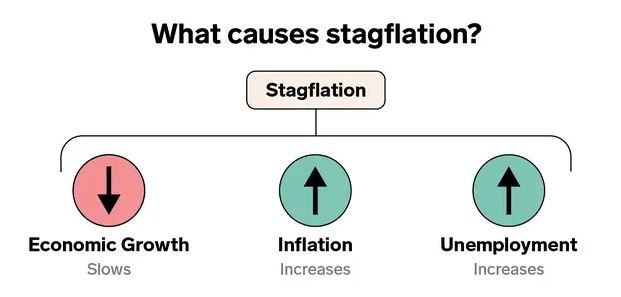
Authorities worldwide are trying to formulate the appropriate set of policies to ensure that stagflation; currently running at multi-decade highs in some advanced economies is cooled without triggering a recession.
- The slowdown in economic activity, in turn, leads businesses to shed jobs and the resultant situation is termed as ‘stagflation’.
- Reasons for latest concerns about stagflation - The outbreak of the COVID-19 pandemic and the curbs imposed to contain the spread of the virus caused the first major recent economic slowdown worldwide.
- But, the subsequent fiscal and monetary measures taken to address the downturn, including substantial increases in liquidity in most of the advanced economies, fuelled a sharp upsurge in inflation.
- The US Fed and the Bank of England are among central banks that have started raising interest rates to cool soaring prices.
- But, the ongoing war in Ukraine following Russia’s invasion of its southern neighbour and the consequent Western sanctions on Moscow has caused a fresh and as yet hard-to-quantify ‘supply shock’.
- There is a sharp surge in prices of commodities ranging from oil and gas to foodgrains, edible oils and fertilizers due to the wake of the conflict.
- Authorities face an uphill battle to contain inflation that is now less a function of demand (and so can be controlled by regulating credit) and almost entirely caused by supply factors that are far harder to manage.
Reference
- https://www.thehindu.com/business/Economy/explained-how-are-fears-of-stagflation-impacting-markets/article65493930.ece?homepage=true
- https://www.businessinsider.com/personal-finance/stagflation?IR=T#:~:text=stable%20or%20predictable.-,What%20causes%20stagflation%3F,and%20fiscal%20and%20monetary%20policies.



